

Explore the amazing world of colored liquids and their interesting behavior when layered. The density experiment is a fun science activity. It shows how different liquids interact based on their properties.
Imagine making a colorful tower with various liquids, each with its own special traits. This activity is not just fun. It also helps us see the science behind liquid layers in a cool way.
In this article, we’ll look into why the density experiment is important. We’ll also see what you can learn from it. We’ll dive into the science of colored liquid layers and their uses in the real world.
What is Density?
Density is a key property that affects how substances behave. It’s the mass of a substance per unit volume. This is important to know if something will sink or float in a liquid.
The definition of density is simple: it’s the mass of an object divided by its volume. This idea is important in science, like physics and chemistry. It helps us identify and compare different substances.
For example, a block of lead and a block of wood of the same size are different. The lead block is much heavier because of its higher density. This is why lead sinks in water, but wood floats. These examples show how knowing about density is important in real life.
In practical terms, knowing a substance’s density helps predict its behavior. For example, in engineering, density is key in designing structures that can handle certain conditions.
Understanding density helps us grasp many natural phenomena and industrial applications. It’s a fundamental concept in science.
The Science Behind Density
To understand density, we need to look at mass, volume, and how atoms are arranged. Density is how much mass is in a given volume. This idea is simple but deeply connected to the atomic structure of a substance.
The atomic structure is key in figuring out a material’s density. Atoms are the basic units of matter. Their arrangement and mass greatly influence density. For example, materials with atoms packed closely together are denser than those with atoms spread out.
How Atoms Affect Density
The mass and arrangement of atoms in space directly impact a substance’s density. Heavier atoms mean more mass, leading to higher density if the volume is the same. On the other hand, how atoms are spaced affects the volume, which also changes density.
For example, lead is denser than aluminum because lead atoms are heavier and closer together. This shows how the atomic structure, including atom mass and arrangement, decides a substance’s density.

Understanding density is more than just knowing a physical property. It’s about understanding the basic rules that control how different materials act. By looking at how mass, volume, and atomic structure work together, we learn why some substances act differently under different conditions.
This knowledge is important in many areas, like engineering and materials science. Knowing about density helps in designing and creating new technologies and products.
The Concept of Liquid Layers
Liquid layers are a fascinating phenomenon that can be seen by making a density column. This experiment layers different liquids, creating a striking density column.
To understand liquid layers, knowing about density is key. Density is how much mass is in a given volume. When you mix liquids of different densities, they stack up. The densest liquid is at the bottom, and the least dense is at the top.
Making a density column is easy with a few simple things. You need a clear container, liquids of different densities (like water, oil, and honey), and food coloring. By pouring these liquids in order of density, you get a stable column with liquid layers.
The secret to a great density column is pouring each liquid slowly and carefully. This shows how density and liquid layers work. It’s also a fun and educational activity for everyone.
Learning about liquid layers through a density column helps us understand physics and chemistry better. It shows how these principles affect our daily lives.
Common Liquids Used in Density Experiments
Many common liquids are used in density experiments. They help show how density works. These liquids are picked because they have different densities, making it easy to see layers.
Common Liquids and Their Densities
Water, vegetable oil, corn syrup, and dish soap are often used. Water has a density of about 1 g/cm³, which is a good starting point. Vegetable oil is less dense, with a density around 0.9 g/cm³. Corn syrup is denser, with a density of about 1.4 g/cm³.
The way these liquids mix is interesting. For example, when you mix water and vegetable oil, they separate into layers. This is because of their different densities, as Scientific American explains. “The density of a liquid determines its position in a column of liquids with different densities.”
“The layering of liquids is a direct result of their densities, providing a visual representation of this fundamental physical property.”
Dish soap can also be used in these experiments. Its density is usually around 1 g/cm³, similar to water. By choosing and layering these liquids carefully, you can make a colorful and educational density column.
Preparing for the Density Experiment
Before starting the density experiment, it’s key to know what you need.
You’ll need glasses or clear containers to layer the liquids. You’ll also need liquids of different densities like vegetable oil, water, and corn syrup. Food coloring will make the liquids look great.
Having a dropper or spoon is important for adding the colored liquids. A tray or plate under the glass will catch spills. With all these ready, the experiment will be fun and easy.
Tips for Setting Up the Experiment
Pour the liquids slowly and carefully to keep them separate. Prepare the colored liquids before by mixing food coloring with each liquid in a separate container.
Being well-prepared lets you enjoy watching the colored layers. You’ll learn a lot about density.
Creating Your Colored Liquid Layers
Creating a colorful density column is easy with a few steps. You just need to layer liquids of different densities. This not only shows how density works but also looks great.
To start, pick the liquids you want to use. You can choose from things like vegetable oil, water, corn syrup, and honey. It’s important to pick liquids with different densities for clear layers.
Then, add a few drops of food coloring to each liquid. This makes them stand out and adds color. You can get creative with the colors you use.
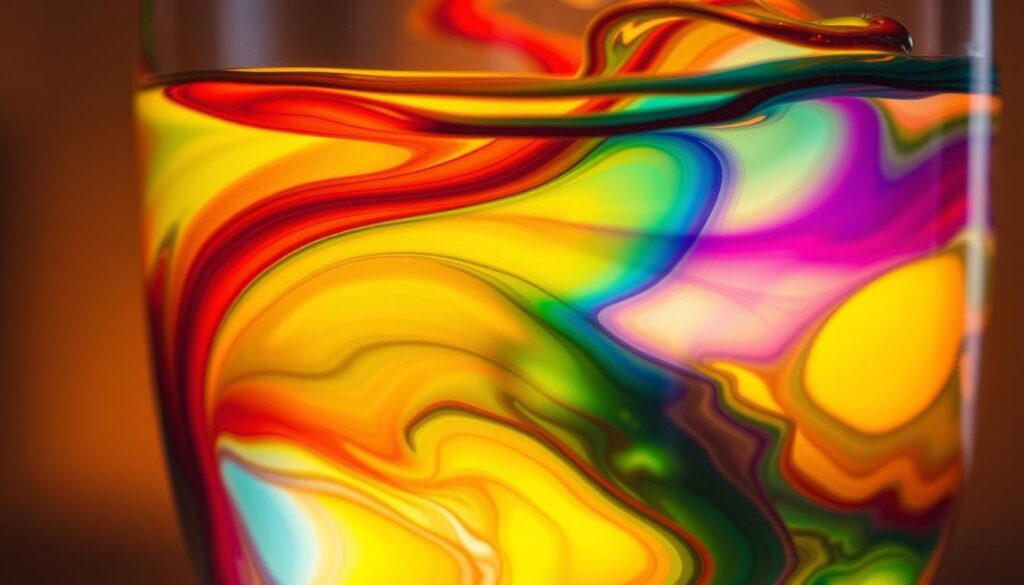
Now, it’s time to layer the liquids. Start with the densest liquid at the bottom. Pour the next densest liquid slowly, trying not to mix it with the one below. Keep going, layering from densest to least dense.
To get clear layers, pour the liquids slowly down the side of the container. This method helps prevent mixing and keeps the layers separate.
By following these steps, you’ll make a beautiful and educational colored liquid layer display. It’s a fun way to learn about density.
Observing the Results
As you finish the density experiment, it’s time to see the amazing results. The density column you made is a beautiful example of density.
When observing the results, you’ll see different colored liquids in layers. Each liquid stays in its place because of its density. This shows how density affects how liquids stack.
The way the liquids layer is not just pretty. It clearly shows that denser liquids sink below less dense ones. By looking at your density column, you learn more about density and liquids.
Pay attention to how clear the layers are and how sharp the boundaries are. This will help you remember what you learned in the experiment.
Explaining the Results
The layering effect in our density experiment is due to the different densities of the liquids. This effect is not just pretty to look at. It’s based on a basic principle of density.
Density is mass per unit volume. When we mix liquids of different densities in a container, they separate. The densest liquid goes to the bottom, and the least dense floats on top.
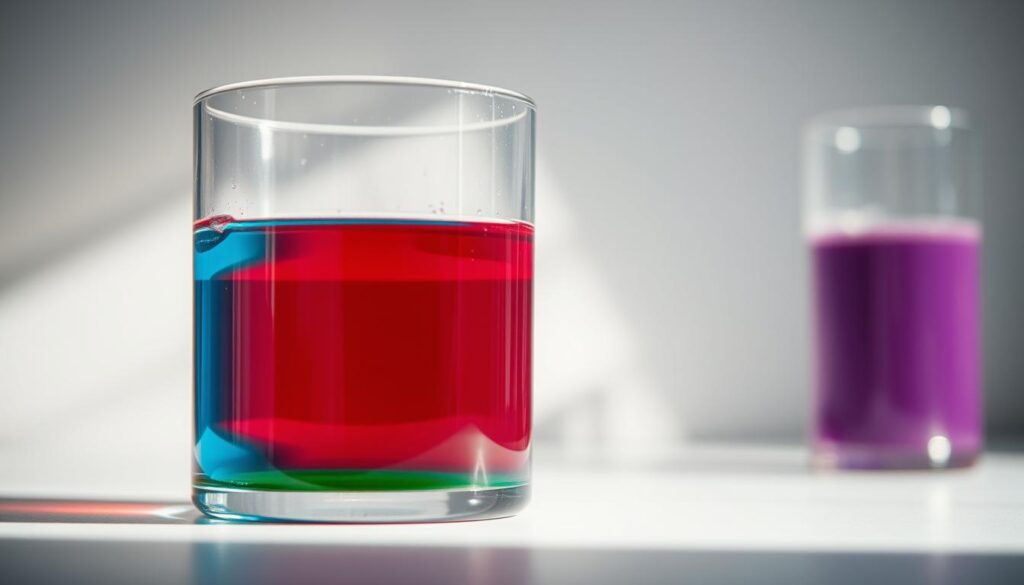
“The layering effect is a direct consequence of the density differences among the liquids.” Our experiment shows this clearly. Colored liquids of different densities stack up in layers.
The layers form because liquids of different densities can’t mix. This inability to mix, along with the density difference, causes the layers we see.
“The density gradient is the driving force behind the layering effect observed in the density experiment.”
In summary, the layering in our experiment comes from the liquids’ different densities. Understanding this helps us see how liquids behave and interact. It shows that density is key in how liquids stack up.
Fun Variations of the Density Experiment
After making your first density column, you might ask, “What’s next?” The answer is, there are many fun variations to try. You can use different liquids or add objects to see how they mix with the layers.
Try adding a few drops of food coloring to your liquids for a colorful effect. Or, add small objects like beads or tiny toys to see where they go.
Changing the container’s shape or size is another density experiment variation. A tall, narrow container can make the layers stand out more. A wider container makes it easier to add or remove things.
Experimenting with temperature is also interesting. Chill or heat some liquids before adding them to see how temperature changes the layers.
These fun variations make the experiment more fun and teach you about science. You can learn about buoyancy and fluid dynamics in a fun way.
Applications of Density in Real Life
Knowing about density helps us understand many natural events and industrial processes. Density is a key physical property. It plays a big role in our everyday lives and in science.
Density helps us know why some things float and others sink. For example, it’s key in making ships and submarines work. The density of these vessels compared to water decides if they float.
Industrial Applications of density are huge. In the oil and gas world, density checks the quality and type of oil. Also, in the drink industry, density helps track the mix of fruit juices and soft drinks.
Environmental Science also uses density knowledge. The density of sea water impacts global weather and ocean flows. Knowing these changes helps scientists forecast weather and climate shifts.
“The density of a substance is a critical parameter in determining its behavior under various conditions, making it a cornerstone in both scientific research and industrial applications.”
In summary, density’s uses are far-reaching and affect many areas of life and science. It’s key for progress in many fields, from industry to nature.
Conclusion: What We Learned from the Experiment
The density experiment with colored liquids is a fun way to learn about density. By layering different liquids, we see how density affects their order.
What we learned is that density is how much mass is in a certain volume. Liquids with different densities stack in a specific way.
This experiment not only makes density clear but also shows its use in real life. It’s important in chemistry and engineering.
In short, doing experiments like this helps us understand science better. It makes us appreciate the science behind it more.