
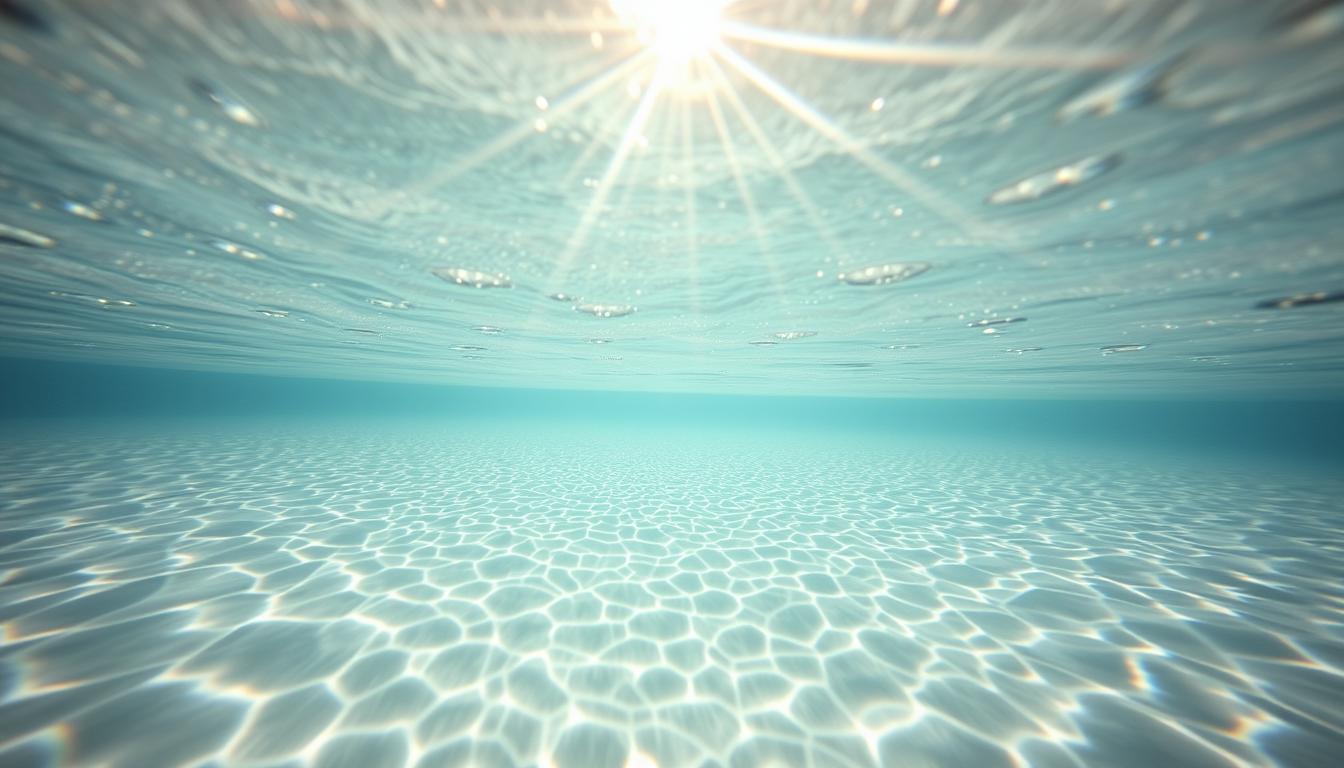
Ever seen a straw seem to bend in a glass of water? This happens because of light bending when it moves from one medium to another. Water’s special properties are key in this process, called Refraction.
Light slows down and bends when it goes from air into water. This bending is what we see. How much it bends depends on the light’s angle and water’s properties.
For centuries, scientists have been interested in light bending in different mediums. Knowing about Refraction is important for many things. It helps in making optical tools and understanding our world.
What is Refraction?
Refraction is when light bends as it moves from one medium to another with different optical density. This key idea in optics helps us understand many things around us.
The science of refraction shows how light changes direction at the boundary of two media. For example, when light goes from air into water, it slows down and bends towards the normal. The normal is an imaginary line that is perpendicular to the water’s surface.
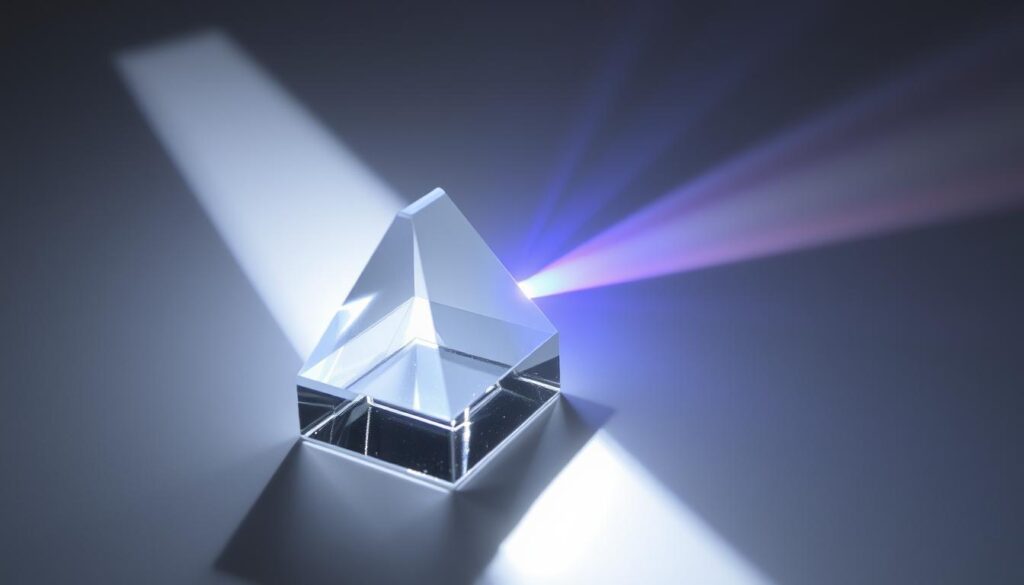
This bending of light is not just interesting; it’s also very important. It affects how we see the world. Refraction is behind many optical effects, like the way a straw looks bent in a glass of water. It also helps lenses in eyeglasses and cameras work.
Knowing about refraction is key for those interested in optics. It’s the foundation of more complex optical phenomena. It’s also vital for designing optical instruments.
How Light Bends in Water
The bending of light as it moves from air into water is fascinating. You can see it with simple refraction experiments.
When light moves from one medium to another, it changes direction. This happens because its speed changes. This is called refraction. It’s seen when light goes from air into water.
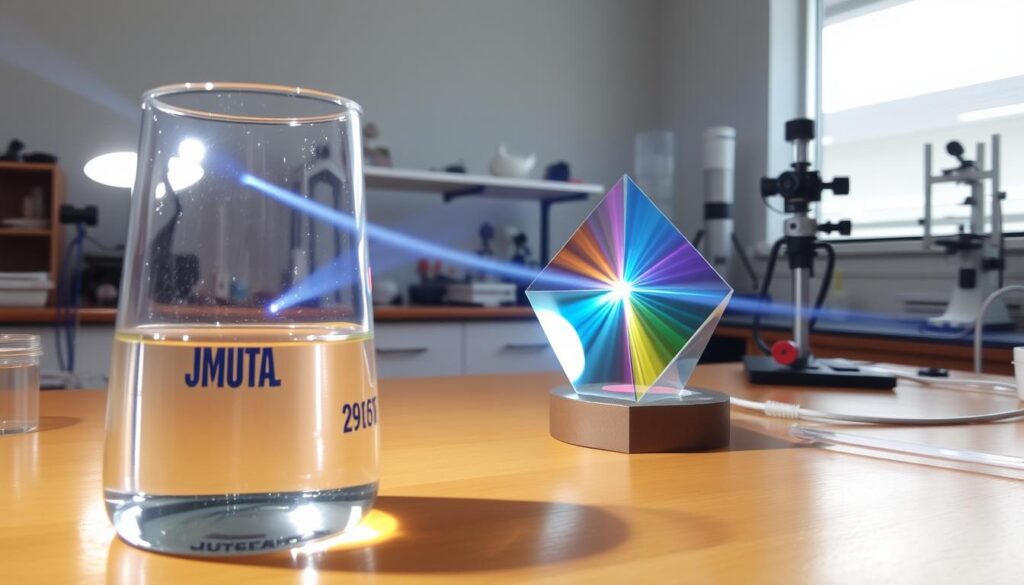
Try this simple experiment: place a straw in a glass of water. Look at it from the side. It seems bent at the water’s surface. This is because light from the straw bends as it goes from water to air.
To do this refraction experiment, you need a glass, water, and a straw. Fill the glass with water and put the straw in. Look at the straw from different angles. This shows how refraction works.
Learning about light bending in water is interesting. It also helps in fields like optics and marine biology. These simple experiments help us understand how light interacts with our world.
Everyday Examples of Refraction
The bending of light, or refraction, is not just a scientific concept. It’s something we see every day. A classic example is when a straw looks bent or broken in a glass of water.
Light moves at different speeds in air and water. This makes light rays bend when they move from one to the other. Refraction helps eyeglasses work by bending light to focus it on the retina.
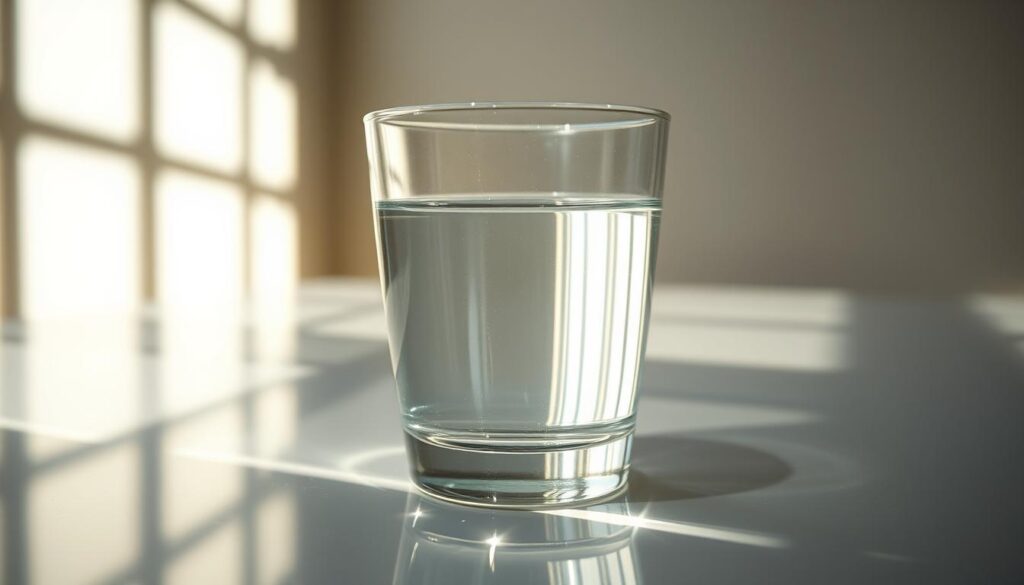
Another common example is how objects underwater seem closer than they are. This is because light bends as it leaves the water. This makes objects appear closer to the surface than they really are.
Light bending is key in many optical tools, like microscopes and telescopes. These tools use lenses to focus and magnify light. Rainbows are also a result of refraction, where sunlight bends through water droplets, creating colors.
These examples show how refraction is part of our daily lives. It’s not just in simple observations but also in complex technology. Understanding refraction and light bending helps us appreciate the world and the technology that depends on these principles.
The Importance of Refraction in Optics
Refraction is key in optics, making many optical devices possible. It’s essential for optical instruments like eyeglasses, microscopes, and telescopes. These tools have changed how we see the world, from fixing vision to exploring distant galaxies.
The science of refraction helps us grasp how light moves between mediums. This knowledge is vital for making lenses that focus light well. A famous physicist said, “Studying refraction is vital for better optics and technology.”
“The bending of light as it passes from one medium to another is a fundamental aspect of optics, enabling the creation of a wide range of optical instruments.”
In optics, refraction helps make tools that magnify, correct, or change light. For example, eyeglasses fix vision by bending light right to the retina. Also, microscopes and telescopes enlarge objects that are too small or far away.
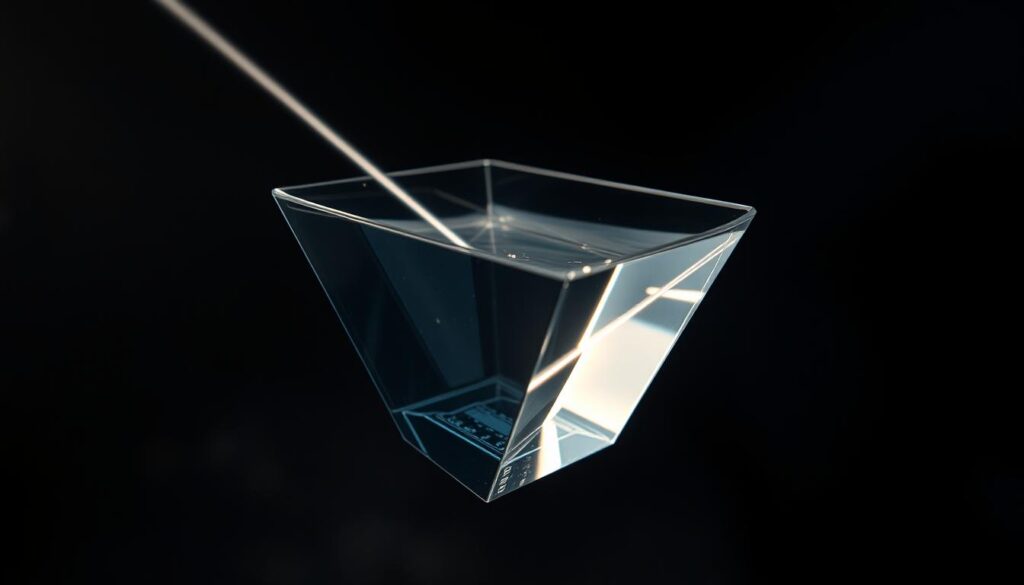
Refraction’s role in optics goes beyond making tools. It also helps us understand natural wonders like rainbows and light’s journey through different materials.
In summary, refraction is vital in optics. It helps make important tools and deepen our light understanding. As research grows, we’ll see more optical innovations.
Fun Experiments to Demonstrate Refraction
Explore the magic of refraction with easy experiments at home or school. Refraction is a cool phenomenon seen in daily life. It’s both fun and educational to learn about it.
One easy refraction experiment is with a straw in water. Place a straw in a water-filled glass. It looks bent or broken where it meets the water. This happens because light moves differently in air and water, bending the light rays.
Another fun experiment is bending light with a prism. Passing white light through a prism shows the light’s colors, called dispersion. Each color bends at a slightly different angle as it goes through the prism.
These refraction experiments show how refraction works and make science fun. They’re perfect for teachers or parents wanting to make learning interactive. These experiments help us understand light and its behavior in mediums like water.
How Refraction Affects Marine Life
Underwater, refraction changes how marine life sees its surroundings. This bending of light happens when it moves from one medium to another. It greatly impacts how marine animals perceive their environment.
Impact on Underwater Vision
Light bends when it moves from air into water. This bending, or refraction, makes objects appear larger or closer. For marine life, this means their visual information is different from what humans see on land.
Many marine animals have adapted to refraction. Some have bigger eyes to gather more light in the dim underwater world. Others change their behavior, like feeding times, to match when light is best.
Understanding refraction’s impact on marine life shows their amazing adaptations. It also reveals the complex interactions between light, water, and life. By studying these effects, scientists learn more about marine ecosystems and how life interacts with its environment.
Real-World Applications of Refraction
Refraction is more than just a scientific concept. It changes how we live and use technology every day.
The science of refraction is key in optics. It helps make lenses for glasses, cameras to capture moments, and microscopes to see tiny things. This shows how important refraction is in our daily lives.
In optical communications, refraction helps send data as light through fiber optic cables. This technology is behind the internet we use today, making data transfer fast and reliable worldwide.
Refraction is also vital in medical imaging. Ultrasound and some MRI scans use refraction to show detailed images inside our bodies. This helps doctors diagnose and plan treatments.
Research keeps improving how we use refraction in technology. It aims to make optical devices better and find new uses for refraction.
In summary, the science of refraction and its uses in optics are essential for many modern technologies. They help us communicate, diagnose, and understand the world better.
Common Misconceptions About Refraction
Refraction is often misunderstood. Many people don’t fully grasp its causes and effects. This lack of understanding can make us overlook its importance in many areas.
One common myth is that refraction only happens in water or glass. But, refraction happens whenever light moves from one medium to another with a different optical density. This includes air, water, glass, or any other clear material. For example, light bending as it moves from air into a prism shows refraction clearly.
Another myth is that refraction always causes a big bend in light. But, how much light bends depends on the angle it hits and the difference in refractive indices. Sometimes, the bend is small, and other times it’s big.
Refraction experiments can clear up these myths. For example, a simple straw-in-water experiment shows how refraction changes what we see. When the straw is partly in water, it looks bent because of light bending as it moves from water to air.
Clarifying Misconceptions Through Experiments
Experiments like the straw in water or using a prism to bend light can help clear up misconceptions about refraction. Seeing refraction in action helps us understand it better.
In conclusion, to truly understand refraction, we must debunk common myths. Recognizing that refraction is not just for certain materials and that its effects vary helps us appreciate its role in our lives and science.
The Future of Refraction Research
Research into refraction is always finding new things. It’s changing how we see light bending.
Scientists are making new discoveries. These could lead to cool technologies and a better understanding of our world.
New materials and optics are letting us control light in amazing ways. This is opening doors in fields like communication, medicine, and space study.
Studies on refraction are also helping us understand light in tricky places. Like underwater or near strong gravity.
As we learn more about refraction, we’ll see even more breakthroughs. These will help us in many areas and deepen our knowledge of the world.