

Ever wondered why some things float and others sink? It’s all about a key physics concept called density. Density is how much mass is in a given volume of a substance.
Think of it like how tightly packed an object’s mass is in its volume. For instance, water has a mass of about 1 gram per cubic centimeter (g/cm³). On the other hand, lead has a mass of roughly 11.34 g/cm³, making it much denser. This is why lead sinks in water.
Grasping this idea is vital in science and engineering. It helps us tell materials apart and predict how they’ll act in different settings.
What Is Density?
Density is a key physical property that shows how much mass is in a certain volume. The formula for density is simple: it’s the mass of an object divided by its volume. This idea is vital for understanding many things in physics and engineering.
The density definition means it’s a way to measure how packed the mass of an object is. For example, air at sea level has a density of about 1.2 kilograms per cubic meter (kg/m³). This is much less than the density of solids like metals.
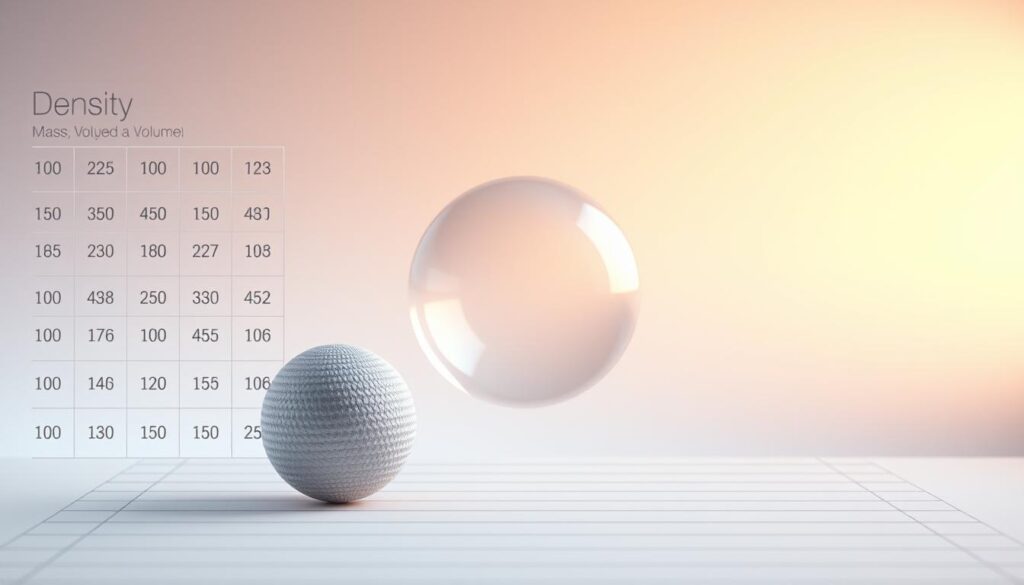
Knowing about density helps us understand more complex ideas. It’s key in figuring out how objects behave under different conditions. For example, it helps us know if an object will float or sink in a fluid. Density is closely linked to physics and is a basic part of many scientific and engineering fields.
By understanding density, we can see the world in a new light. It’s a simple yet powerful idea that affects our lives and scientific studies in many ways.
How to Calculate Density
Density calculation is key in physics. It needs measuring mass and volume. First, you must know what mass and volume are.
Measuring mass is easy with a balance or scale. These tools give a direct mass reading. This is vital for density calculations.
Measuring Volume
There are two ways to measure volume. For shapes like cubes, you use formulas. For example, a cube’s volume is the side length cubed.
For irregular shapes, water displacement works. You measure the water volume displaced by the object. This tells you the object’s volume.
With mass and volume known, you can find density. The formula is: density = mass / volume. This formula is basic but powerful for understanding materials.
Let’s say we’re finding a metal cube’s density. If it weighs 100 grams and has a volume of 20 cubic centimeters, its density is 5 grams per cubic centimeter.
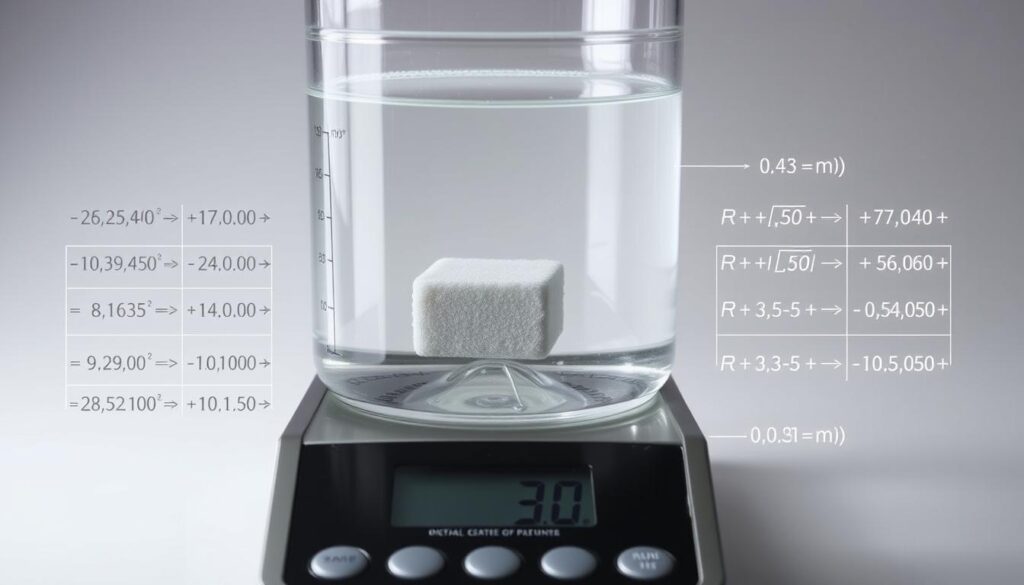
In summary, finding density is simple. You just need to measure an object’s mass and volume. This helps us understand the properties of different materials and objects.
Factors Affecting Density
Knowing what factors affecting density is key in science and engineering. Density, a basic property of matter, changes with temperature and pressure.
Temperature greatly affects a substance’s density. Most substances get less dense as they warm up. This is even more true for gases, where density changes a lot with temperature.
The role of temperature and pressure on density differs for solids, liquids, and gases. In solids, temperature changes density less than in gases. But, warming up a solid does make it less dense. For liquids, density drops with temperature, but not as much as in gases.
Pressure also affects density. Pressing harder on a substance makes it denser by squeezing molecules together. This effect is big in gases, where density changes a lot with pressure.
In summary, knowing how factors affecting density like temperature and pressure work is vital. It’s important for many fields, from engineering to environmental science.
Density in Everyday Life
Density is key in many everyday things. It’s very important in designing ships and submarines. Knowing about density helps figure out if something will float or sink in water. This idea, called buoyancy, is vital for making ships and subs work.
Things that are less dense than water float, while denser things sink. That’s why ships made of heavy materials like steel can float. They’re designed to weigh less than the water they push aside. Submarines work the same way, changing their weight to stay afloat.

Buoyancy isn’t just for water; it’s also in the air. Helium balloons float because helium is lighter than air. Knowing about density and buoyancy helps us guess how things will act in different places. It’s a big deal in everyday life.
Density also affects other parts of our daily lives. It’s in how liquids stack up and in making life jackets. Learning about density helps us understand and move through the world better.
Understanding Specific Gravity and Density
Specific gravity, or relative density, is key in figuring out if something will sink or float. It’s the ratio of a substance’s density to water’s. This number is important in mining and construction, where knowing material properties is critical.
The specific gravity shows how dense something is compared to water. If it’s less than 1, it’s less dense and will float. But if it’s more than 1, it’s denser and will sink. This is important for engineers and scientists to predict how materials will act in different places.
Experts say, “Understanding specific gravity is key for designing and running industrial processes.”
“The measurement of specific gravity is a fundamental aspect of quality control in many manufacturing processes.”
It’s used in labs and industries to check solution concentrations and identify substances.

In short, specific gravity is a vital concept for understanding substance density compared to water. It’s used in many fields, from industrial processes to scientific research.
Measuring Density: Methods and Techniques
Density measurement is key in science and industry. It’s used for different states of matter. Density is a basic property that matters a lot.
Liquids are often measured with a hydrometer. This tool floats in the liquid and shows its density. The float’s level tells us the liquid’s density.
Solids need special ways to measure density. Hydrostatic weighing is one method. It compares the solid’s weight in air and water. This helps find the solid’s density.
Another way is using a pycnometer. It finds the solid’s volume by seeing how much fluid it displaces.
Gases are different because they’re less dense and can be compressed. To measure them, scientists look at how fast they flow through a small hole. This flow rate tells us the gas’s density.
Each method has its own uses and how accurate it is. The right method depends on the substance, how precise we need to be, and the situation.
In short, measuring density is complex. It needs various techniques for different substances. Knowing these methods is vital for precise density measurements in many fields.
The Role of Density in Various Industries
Industries around the world depend on density for many uses. Density is important for choosing materials and designing products. It also affects how well things work in different fields. Knowing about density helps make things better.
In the construction industry, density is key for building strength and lasting power. Builders pick materials based on their density to make sure buildings can handle weather and more. For example, the density of concrete is important for its strength and how long it lasts.
In engineering, density helps design parts that need to be light or float. Engineers change the density of materials to get the right properties. This is important for making lighter cars and planes.
The mining industry also uses density to find valuable minerals. By knowing the density of minerals, miners can separate them from waste. This is done through methods like dense medium separation.
Density is also important in manufacturing and energy production. In manufacturing, density affects how well products work. In energy, knowing the density of materials helps make processes more efficient, like handling fuels.
To wrap up, density is very important in many industries. It affects how things are made and how well they work. Understanding density is essential for improving materials and processes in construction, engineering, mining, and more.
Density and Buoyancy
Archimedes’ Principle connects density and buoyancy, showing why some objects float and others sink. It says the buoyancy force on an object in a fluid is the same as the fluid’s weight it displaces.
Understanding Buoyancy
An object in a fluid feels an upward buoyant force equal to the fluid’s weight it displaces. If the object is less dense than the fluid, it will float. This is because it displaces a weight of fluid equal to its own before fully submerging.
“Give me a place to stand, and I shall move the Earth,” Archimedes once said. This quote shows the huge impact of his principle on our understanding of physical forces.
Objects denser than their fluid will sink. This is because they can’t displace enough fluid to balance their weight. For example, a rock sinks in water because it’s denser than water. But a piece of wood might float if it’s less dense.
The effects of density and buoyancy are huge. They help in designing ships and submarines. They also help us understand natural events like icebergs floating.
Applications of Density and Buoyancy
Density and buoyancy have many uses. For instance, ships are made to displace a lot of water. This, according to Archimedes’ Principle, creates a strong buoyant force. This force lets the ship float, even if it’s made of heavy materials like steel.
In summary, the link between density and buoyancy is key in physics. It tells us why objects float or sink in fluids. By using Archimedes’ Principle, we can understand the world better. We can also come up with new ideas in many areas.
Future Innovations in Density Measurement
New technologies are changing how we measure density. These advancements make measurements more accurate and efficient. They are helping industries like manufacturing and construction.
We will soon see even better ways to measure density. These new methods will be cheaper and more reliable. This will greatly help industries that need precise density measurements.
Emerging technologies are making density measurement more advanced. This leads to better decisions and higher quality products. As these techniques improve, they will drive innovation in many areas.