
The world is full of different substances. They exist in three main states with unique properties.
Solid objects keep their shape. Liquid takes the shape of its container. And gas fills its container completely.
These differences show up in our daily lives. Like the ice in freezers and the steam from hot coffee. Knowing about phase transitions helps us understand our surroundings better.
By learning about solid, liquid, and gas, we appreciate the world more.
What Are the States of Matter?
The state of matter depends on how particles are arranged and move. In physics, there are three main states: solid, liquid, or gas. Each state is defined by how its particles behave and arrange themselves.
In solids, particles are tightly packed and stay in one place. Liquids have particles that are close but can move past each other. Gases have particles that are far apart and can move freely in any direction. Knowing these differences helps us understand many physical phenomena.
The concept of states of matter is key in physics and has many uses in our daily lives. For example, knowing about solids, liquids, and gases is vital for designing and running industrial processes.
Understanding the definition of states of matter helps us see the world in a new light. It shows us the complex interactions that happen all around us.
Solid: Characteristics and Properties
Solids are a basic state of matter known for being rigid and having a fixed shape. The particles in a solid are packed tightly and stay in the same spot. This makes solids special.
Solids keep their shape and volume well. This is because the particles are strongly connected. Solids are hard to compress and have a set volume.
Crystalline and Amorphous Solids
Solids are divided into two types: crystalline and amorphous. Crystalline solids have a neat, repeating structure called a crystal lattice. This structure makes them have sharp melting points and flat surfaces.
Amorphous solids don’t have a regular structure. Their particles are arranged randomly. This leads to different properties, like softening gradually over temperature.

Scientist Richard Feynman said, “The fact that we have different properties in different states is very interesting.” This shows why knowing about solids is important.
“The structure of solids is a key factor in determining their properties.”
The difference between crystalline and amorphous solids is key. Crystalline solids are used in electronics because of their precise melting points. Amorphous solids, like glass, are used for windows and other places where they need to be clear and strong.
In summary, solids, whether crystalline or amorphous, are very important in technology and daily life. Knowing about their properties helps us improve materials science and related fields.
Liquid: Characteristics and Properties
Liquids have unique traits that set them apart from solids and gases. They take the shape of their container but keep a fixed volume.
The particles in a liquid are close but can move past each other. This lets liquids flow. It’s key to understanding fluid dynamics, the study of fluids under different forces.
Liquids’ viscosity shows how much they resist flow. Honey, with high viscosity, moves slowly. Water, with low viscosity, flows faster.
Liquids also have surface tension. This makes their surface act like a skin. It helps form droplets and bubbles, playing a big role in nature and industry.
Factors Influencing Liquid Properties
Many things can change a liquid’s properties, like temperature and pressure. Warmer temperatures can make a liquid flow better.
Knowing about liquids is vital for many fields. It’s important in engineering, chemistry, biology, and environmental science.
Gas: Characteristics and Properties
Gases are a basic state of matter. They can expand and fill any space. This happens because gas particles are far apart and can move freely in any direction.
The way gases behave is controlled by laws like Boyle’s and Charles’s. These laws explain how gases react to changes in pressure and temperature. They help us understand gas properties.
A key characteristic of gases is that they have neither a fixed shape nor a fixed volume. This makes them different from solids and liquids, which have more defined shapes and volumes.
Scientists have found that gas behavior can be complex. But, knowing their properties is key in science and industry. For example, the ideal gas law helps us understand real gases under specific conditions.
“The kinetic molecular theory of gases provides a complete view of gas behavior. It shows how important molecular motion and interactions are.”
In summary, understanding gas characteristics and properties is vital. It helps us see how gases work and their uses in nature and industry. By learning about gas laws and behavior, we can appreciate their role in many areas.
Changes in States of Matter
Matter can change its state through various phase transitions, including melting, boiling, and sublimation. These changes occur when the temperature or pressure of a substance is altered.
Melting is when a solid turns into a liquid. This happens when the solid’s temperature increases to its melting point. For example, ice melts into water at 0°C (32°F) under standard atmospheric pressure.
Boiling happens when a liquid is heated to its boiling point, turning it into vapor. This is a vigorous process where bubbles of vapor form within the liquid and rise to the surface. Water, for instance, boils at 100°C (212°F) under standard atmospheric conditions.
Richard Feynman once said, “The next great era of awakening of human intellect may well produce a method of understanding the qualitative content of equations.” This highlights the complexity and importance of understanding phase transitions.
“For every complex problem, there is an answer that is clear, simple, and wrong.”
Sublimation is a unique phase transition where a solid directly turns into vapor without going through the liquid phase. Dry ice (solid carbon dioxide) is a common example that sublimes at room temperature.
Understanding these phase transitions is key in fields like engineering and environmental science. It helps predict and control the behavior of substances under different conditions.
The Role of Temperature
Temperature greatly affects how fast particles move, which changes a substance’s state. When temperature changes, a substance can switch its state, known as a phase transition.
The link between temperature and a substance’s state is key to thermodynamics. When a substance gets hotter or cooler, its particles’ energy changes. This leads to changes in its physical state.

For example, when ice (solid water) heats up, the rising temperature gives particles enough energy to move freely. This turns ice into liquid water. More heat can make the water boil and turn into steam (gas). This shows how temperature changes can cause phase transitions.
Temperature and Kinetic Energy
The energy of particles in a substance is tied to its temperature. As temperature goes up, particles move faster. In solids, particles vibrate; in liquids, they flow; and in gases, they move freely.
Knowing how temperature affects a substance’s state is vital in science and engineering. It helps in designing materials and studying environmental phenomena.
Pressure and Its Influence on States
Changes in pressure can greatly affect a substance’s state, leading to phase transitions. This is a key part of thermodynamics. It shows how particles arrange under different conditions.
Applying pressure to a substance can make particles move closer. This can change its state from gas to liquid, or from liquid to solid. Lowering the pressure can reverse this change.
The link between pressure and a substance’s state is key to understanding many natural and industrial processes. For example, the pressure at deep-sea levels is very high. It affects the state of materials found there.
In thermodynamics, studying phase transitions under different pressure conditions is vital. It helps us understand how substances behave in various environments.
Phase Diagrams: Understanding Transitions
Phase diagrams show how substances change with temperature and pressure. They are key to knowing a substance’s states and when these states change.
These diagrams help us see the solid, liquid, and gas states of a substance. The lines on the diagram mark where these states change. For example, the line between solid and liquid shows the melting point.
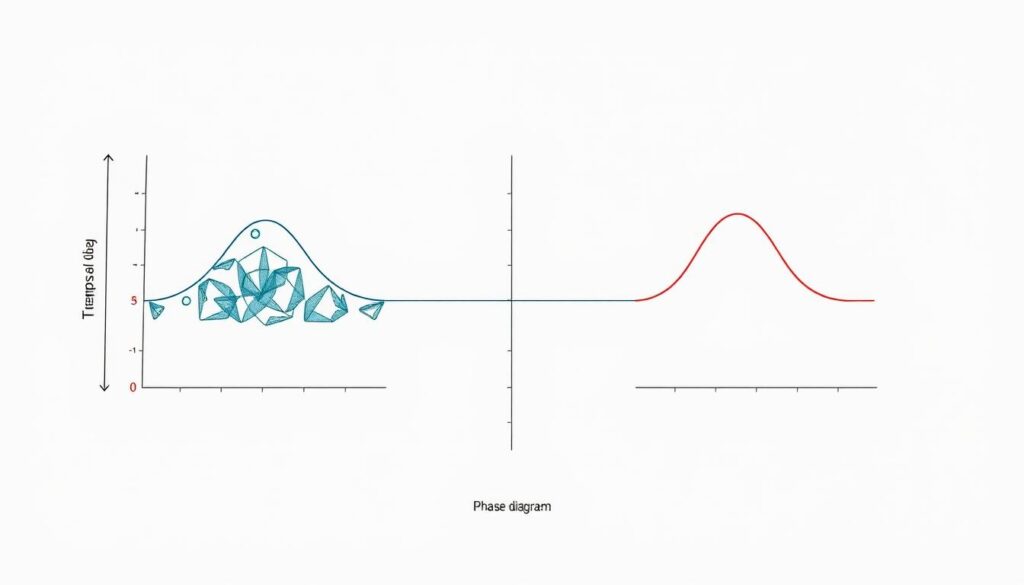
By looking at a phase diagram, we can guess a substance’s state at certain temperatures and pressures. This is very useful in chemistry and engineering. Knowing a substance’s state is important for designing and improving processes.
Phase diagrams rely on thermodynamics, which looks at heat, work, and energy. A phase diagram is a summary of a substance’s thermodynamic properties. It’s a vital tool for scientists and engineers.
In summary, phase diagrams are essential for understanding substance behavior under different conditions. They help us see phase transitions and the thermodynamic rules behind them.
States of Matter in Everyday Life
The states of matter are all around us, affecting everything from the air we breathe to the water we drink. Knowing about solids, liquids, and gases helps us understand our world better.
In our daily lives, we see solids, liquids, and gases everywhere. For example, chairs are solids, water is a liquid, and air is a gas. Understanding these states helps us see the world in a new light.
Water changing from liquid to gas (steam) or solid (ice) is a common sight. This change is key in how we use water at home and in industries.
States of matter are also vital in technology and industry. Refrigerators and air conditioners work because of how substances change states. This shows how knowing about states of matter is really useful.
There are more than just three states of matter, like plasma. While we don’t see these often, they’re important in tech, like plasma TVs.
In summary, states of matter are not just ideas; they’re part of our everyday lives and modern tech. By learning about them, we can better understand our world and how it works.
Educational Activities to Explore Matter
Hands-on learning is key for students to get matter. It helps them understand solids, liquids, and gases better. By doing activities, they learn in a fun and meaningful way.
One great activity is to do experiments with ice and boiling water. These experiments show how things change from solid to liquid and from liquid to gas. It makes hard ideas easier to see.

Hands-on experiments make learning fun and help students get the subject. By adding educational activities to class, teachers reach all kinds of learners. This way, everyone can grasp the states of matter.
Other fun activities include making phase diagrams and seeing how pressure changes matter. They also look at how matter is used in our daily lives. These activities help students really get and enjoy the subject.
Conclusion: The Importance of Understanding Matter
Knowing about the states of matter is key to understanding many natural and technological aspects. Solids, liquids, and gases have unique properties that affect science and industry. These properties are essential for many processes.
Understanding how temperature and pressure change matter is critical. It’s important for advancements in materials science and engineering. This knowledge impacts our daily lives, from drinking water to breathing air.
Seeing the value of matter helps drive innovation and solve big problems. Learning about matter can inspire the next generation of scientists and engineers. It deepens our appreciation for the world around us.