

Have you ever felt the ground shake violently? It’s as if the Earth itself was trembling. This happens because of earthquakes, powerful natural events that release a lot of energy.
The shaking comes from seismic waves moving through the Earth’s crust. These waves start when there’s a sudden movement or rupture in the Earth’s tectonic plates. This causes the ground to vibrate.
Ground shaking can be different in intensity. It can range from a gentle tremor to a violent motion that can cause a lot of destruction. Knowing how earthquakes work and their effects on the Earth’s surface is key to reducing the risks they pose.
Understanding Earthquakes: The Basics
To understand earthquakes, we need to know the basics of seismic activity. An earthquake happens when energy suddenly releases, making the ground shake. This is because two blocks of the earth suddenly move past each other.
The place where they move is called the fault or fault plane. Fault lines are cracks in the earth’s crust where rocks have moved. Knowing about fault lines helps us understand how earthquakes happen and why some places get more earthquakes.
Earthquakes are complex, involving the movement of tectonic plates under the earth. These plates can get stuck at their edges. When the stress is too much, they suddenly move, releasing energy as seismic waves.
Knowing about the earthquake definition and how seismic activity works is key to reducing earthquake risks. By understanding these basics, we can prepare better for earthquakes. This helps save lives and protect buildings.
The Science Behind Earthquakes
Seismic events are closely linked to the dynamics of the Earth’s mantle and crust. To understand earthquakes, it’s essential to dive into the structure of our planet.
The Earth is made up of four major layers: the inner core, outer core, mantle, and crust. The crust and the top part of the mantle form the lithosphere. This is broken into several tectonic plates. These plates move slowly but constantly.
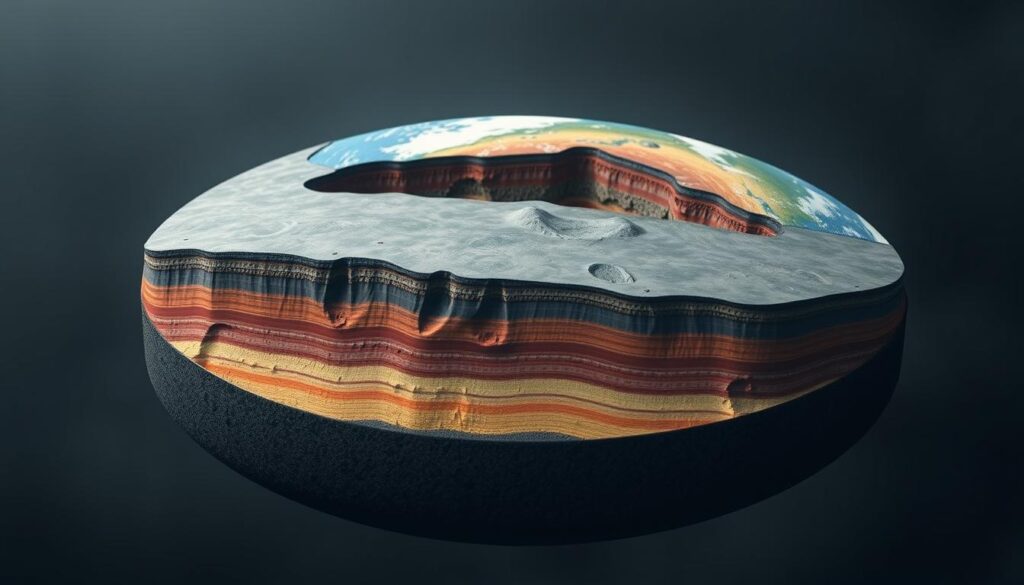
The mantle is a thick layer of hot, viscous rock beneath the crust. It’s key in moving the tectonic plates. The crust, being the outermost solid layer, shows the effects of these movements. Sometimes, this results in earthquakes.
As tectonic plates move, they can diverge, converge, or slide past one another. This interaction at the plate boundaries is a main cause of seismic activity. The Earth’s crust is fragmented. The stress built up as the plates move is released in seismic waves during an earthquake.
“The Earth’s crust is broken into several large plates that float on the semi-fluid mantle below, and their interactions are responsible for the majority of earthquakes.”
Understanding the dynamics of the Earth’s layers, like the interaction between the mantle and crust, is key to grasping earthquake mechanisms. By studying these elements, scientists can predict where and when earthquakes are likely to happen.
Earthquake Magnitudes and Measurements
Knowing about earthquake magnitude is key to understanding how severe an earthquake is. The size of an earthquake is measured by its magnitude. This is done using seismogram recordings.
Scientists have different ways to figure out earthquake magnitude. The moment magnitude scale is one of the most trusted and used. It looks at the size of the fault, how much it slipped, and the energy released.
Magnitude scales help us see how big an earthquake is. They measure different parts of an earthquake. This gives us a full picture of its strength.
The moment magnitude scale is great for big earthquakes. It’s a big help in seismology. It lets us compare earthquakes from different places.
Knowing about earthquake magnitude helps scientists understand the damage an earthquake can cause. This info is key for getting ready for disasters and reducing risks.
Common Causes of Earthquakes
The Earth’s surface is made up of large plates that move. Sometimes, this movement causes earthquakes. This movement is called tectonic plate movement.
Most earthquakes happen at the edges of these plates. When plates move, stress builds up in the Earth’s crust. This stress can lead to an earthquake. The process is linked to faulting, where the Earth’s crust cracks, allowing plates to move.

The theory of plate tectonics helps explain where earthquakes happen worldwide. By studying plate movement and faulting, scientists understand earthquake causes. This knowledge is key for managing earthquake risks and protecting communities.
Earthquakes are a natural event. While we can’t stop them, knowing why they happen helps us prepare. By looking at the Earth’s plates and how they interact, researchers learn about earthquake mechanisms.
The Impact of Earthquakes on Communities
Earthquakes can harm communities worldwide, causing a lot of damage and changing daily life. The main problem is the ground shaking, which is responsible for over 90% of earthquake damage.
Earthquakes affect communities in many ways, not just the immediate damage. They also impact the social structure, economy, and buildings. Damage assessment and loss estimation are key to understanding these effects.
Damage assessment looks at the physical harm to buildings and the environment. It helps find where to focus recovery efforts. Loss estimation counts the economic and human costs, like injuries and displaced people.
Many things can make earthquake impacts worse. These include the earthquake’s size, depth, and how close it is to the community. The type of ground and the strength of buildings also play a big role. Knowing these helps create better ways to lessen earthquake damage.
Good disaster management and preparedness plans can help a lot. By understanding risks and acting early, communities can be more resilient. This reduces the chance of damage and loss from earthquakes.
Earthquake Preparedness and Safety Tips
Being ready for earthquakes can greatly lower the chance of harm and damage. It’s all about understanding seismic design and following strict building codes.
Having a solid plan is key. Know your escape routes, stock up on emergency supplies, and practice drills. Public awareness and education are essential for community readiness.
Public Awareness and Education
Teaching people about earthquake safety is vital. They should know how to act during an earthquake, like Drop, Cover, and Hold On. It’s also important to learn how to lessen risks at home and in buildings.

Following the right building codes is another important step. Buildings made with safety in mind can stand up to earthquakes better.
Seismic design is also critical. It means designing buildings to handle earthquake forces, which helps prevent damage and collapse.
By using earthquake preparedness steps like education and following building codes and seismic design, communities can become more resilient to earthquakes.
Earthquake Prediction: Is It Possible?
Predicting earthquakes is a big challenge in seismology. Scientists have tried many ways to predict them, but none have worked.
On any fault, scientists know another earthquake will happen someday. But they can’t say when. The problem is understanding the complex processes that cause earthquakes.
Seismic forecastinglooks at many things. This includes past earthquakes, geological structures, and seismic patterns.
But earthquakes are hard to predict because they are so unpredictable. One big prediction challenge is not knowing what triggers earthquakes.
Scientists can spot areas likely to have earthquakes. But they can’t say when or if one will happen. This shows we need more research in earthquake prediction and forecasting.
Researchers are looking into new ways to predict earthquakes. They’re using advanced technologies and machine learning. These might help us forecast earthquakes better. But, there are many scientific challenges ahead.
Notable Earthquakes in History
Historical earthquakes give us insights into the Earth’s seismic activity. They show how these events affect human societies. By looking at major earthquakes, we learn about their causes and effects.
The 1906 San Francisco earthquake was a major event in U.S. history. It had a magnitude of 7.9. The earthquake caused a lot of damage and fires, changing building codes and emergency plans.
The 2004 Sumatran earthquake triggered a huge tsunami in Southeast Asia. It was the largest earthquake ever recorded, with a magnitude of 9.1. This disaster showed the need for tsunami early warning systems.

The 1964 Alaska earthquake, also known as the Great Alaska Earthquake, was the largest in U.S. history. It had a magnitude of 9.2. The earthquake and tsunami caused a lot of damage, leading to better earthquake science and preparedness.
These earthquake case studies show why we need to understand seismic activity. They teach us how to prepare for future earthquakes. By learning from the past, communities can better protect themselves.
In conclusion, significant earthquakes have taught us a lot about the Earth’s power and our vulnerability. We must keep researching and preparing to lessen the impact of future earthquakes.
Innovations in Earthquake Engineering
New breakthroughs in earthquake engineering are changing how we design and build for earthquakes. These changes help make buildings safer during earthquakes. They reduce the damage caused by these natural disasters.
Innovative construction methods are being used all over the world. They make buildings and roads stronger against earthquakes. New materials and technologies help absorb earthquake energy, protecting structures.
Advanced computer simulations are also playing a big role. They help engineers test and improve earthquake designs. This makes buildings more resilient against earthquakes.
It’s also important to include seismic design in building codes. This ensures new buildings can withstand earthquakes. Designers must consider the foundation and soil conditions too.
Innovative construction techniques like base isolation and seismic retrofitting are gaining popularity. Base isolation lets buildings move freely during an earthquake. Seismic retrofitting strengthens old buildings to make them safer.
The future of earthquake engineering is bright. Ongoing research aims to improve seismic design and construction. As we learn more about earthquakes, we’ll see even more creative solutions.
The Future of Earthquake Research
Earthquake research is always changing. New trends and technologies help us understand earthquakes better. Data analytics and machine learning are key. They help scientists predict earthquakes and lessen their damage.
Research is making us better prepared for earthquakes. New tools like advanced sensors and satellite images give us important data. This data helps us grasp the complex earthquake processes.
These new tools and methods will deepen our earthquake knowledge. They will also make us more resilient to earthquakes. As we learn more, communities around the world will get better early warnings and disaster responses.