
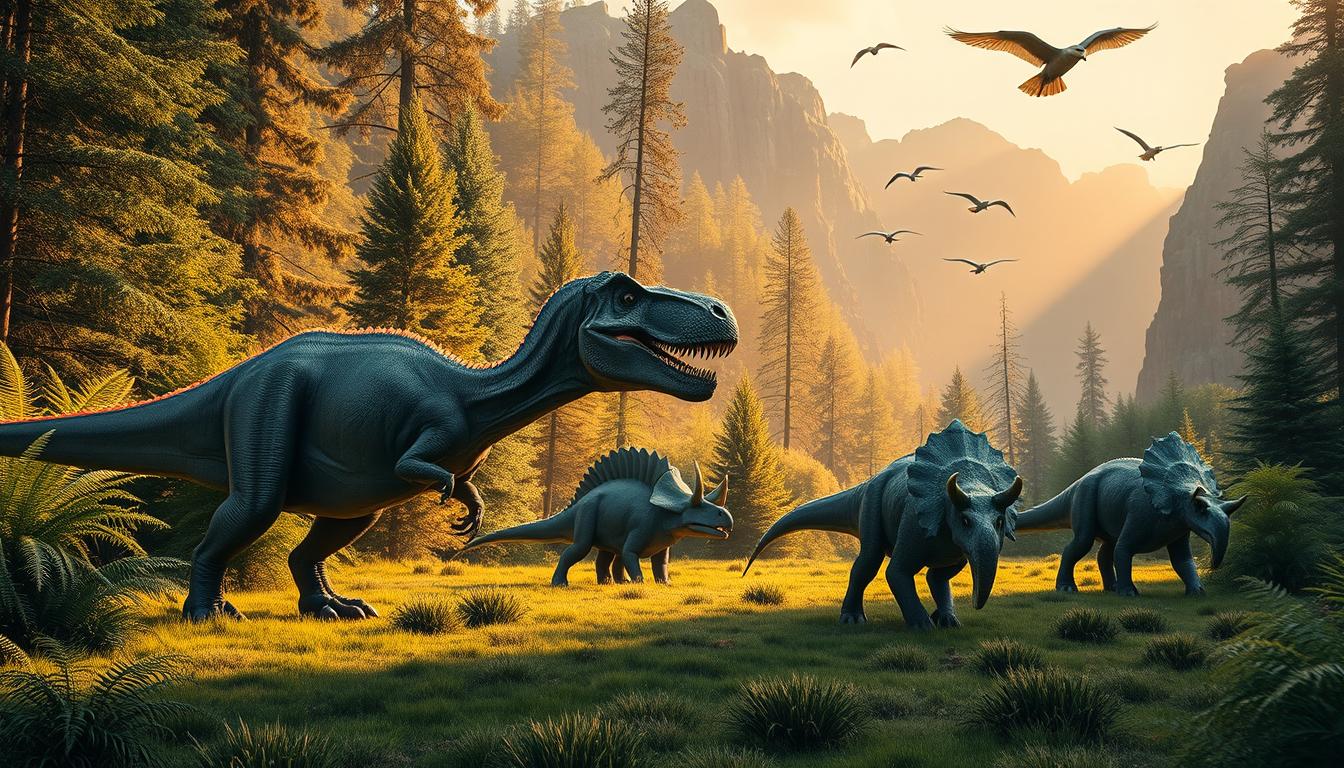
Imagine a world where prehistoric creatures roamed the earth. This was the Mesozoic Era, a time when dinosaurs were in charge.
The study of these fascinating beings is called paleontology. By learning about dinosaur facts, scientists can understand their lives and the worlds they lived in.
Dinosaurs ranged from fierce predators to gentle herbivores. Their variety shows the power of evolution. As we learn about dinosaurs, we travel back in time. We uncover secrets that have been hidden for millions of years.
What Are Dinosaurs?
“Dinosaur” means a group of reptiles that ruled Earth during the Mesozoic Era. They came in all sizes and shapes. Some were small and feathered, while others were huge and had long necks.
Defining Characteristics: Dinosaurs are known by their hip structure. They are split into two groups: those like lizards (saurischian) and those like birds (ornithischian). The Natural History Museum says dinosaurs were a key part of Earth’s history.
Dinosaur Classification: Classifying dinosaurs is a big job. They were first split into two orders: Saurischia and Ornithischia. Saurischians include the Tyrannosaurus rex and long-necked sauropods. Ornithischians are armored and horned dinosaurs.
Scientists have studied dinosaurs a lot. They look at their diets, how they moved, and how they nested. This helps us understand Earth’s past and how life evolved.
Different Types of Dinosaurs
Dinosaurs were incredibly diverse, with different types showing unique traits and behaviors. They ranged from mighty carnivores to gentle herbivores.
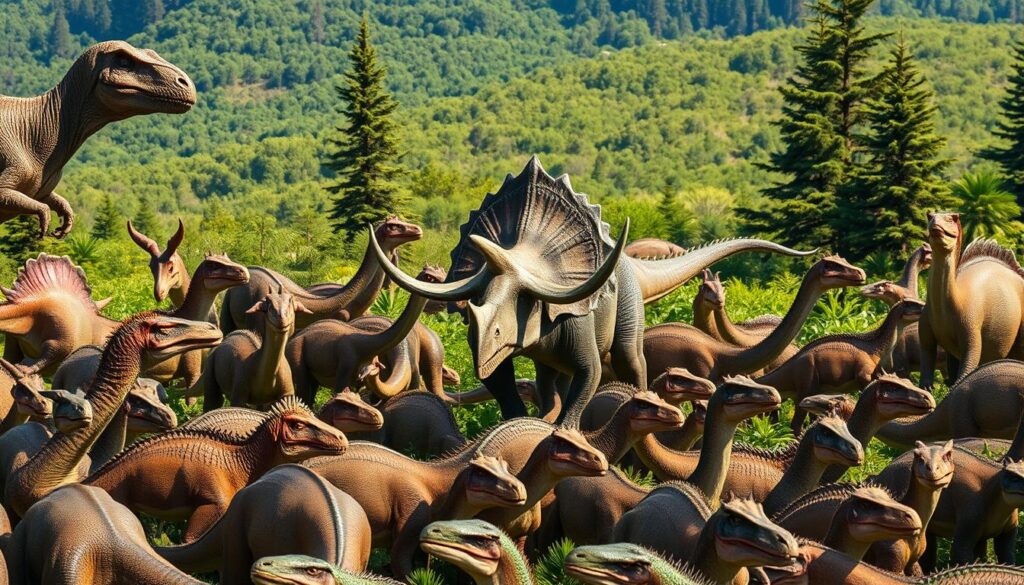
The main way to classify dinosaurs is by their diet. This puts them into herbivores, carnivores, and omnivores. Herbivores, like the Iguanodon, ate plants. They had special teeth and digestive systems for this.
Herbivores and Carnivores
Carnivores, like the Tyrannosaurus rex, were predators. They had sharp teeth and strong limbs. This shows how adaptable and diverse dinosaurs were.
Paleontologist Robert Bakker said, “Dinosaurs were not just giant lizards; they were a diverse group of animals that dominated Earth’s landscapes during the Mesozoic Era.” This diversity shows the complex ecosystems of that time.
“The variety of dinosaurs is a reflection of the ever-changing environments and ecosystems of the Mesozoic Era.”
Within these categories, there was a lot of diversity. Herbivores like the Stegosaurus had unique defenses. Others, like the Diplodocus, had long tails and necks. Carnivores ranged from the massive Spinosaurus to the agile Velociraptor.
This diversity highlights the complexity and richness of dinosaur biology. It gives us insights into their evolution, behavior, and extinction.
Dinosaur Habitats
Dinosaurs lived in many places, from dry deserts to green forests. This adaptability helped them survive and grow.
The ancient world had many different places for dinosaurs to live. They were found in deserts, forests, and wetlands. These diverse ecosystems helped shape the dinosaurs we know today.
Some dinosaurs were made for the desert. They could save water and handle the tough weather. Others loved the green, wet forests, where they could eat lots of plants.
As scientists say,
“The diversity of dinosaur habitats played a key role in their evolution and growth.”
This shows how important it is to learn about where dinosaurs lived.
The Mesozoic Era, known as the Age of Reptiles, was full of different places for dinosaurs. They lived in everything from hot deserts to cool forests.
In short, dinosaurs’ ability to live in many places was key to their success. Learning about these prehistoric environments helps us understand these amazing creatures better.
How Dinosaurs Lived
Exploring the world of dinosaurs gives us interesting insights into their lives. We learn about their behavior, social groups, and how they nested. The discovery of dinosaur nests and eggs shows they cared for their young, a surprising find.
Dinosaur Behavior and Social StructuresDinosaurs had complex social lives, with some living in groups. Some species herded together, showing their social complexity. Trackways, or fossilized footprints, reveal how these ancient creatures moved. Sometimes, they show groups of dinosaurs traveling together.
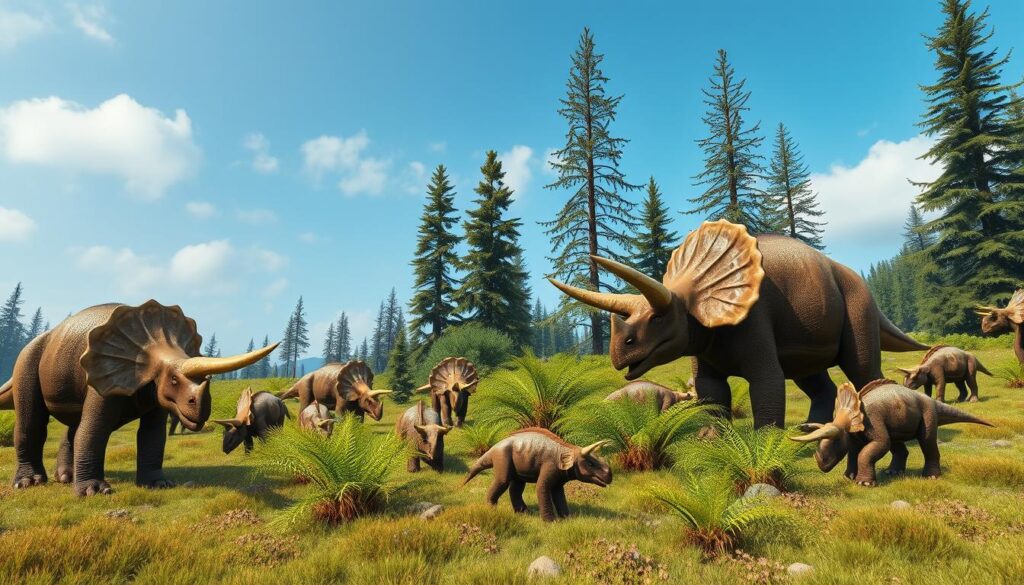
Studying dinosaur nesting sites has shown us their nesting habits and reproductive strategies. Some built complex nests, like modern birds, their closest relatives. The way eggs were arranged and the presence of young dinosaurs in nests suggest they cared for their young.
Reproductive Strategies
Dinosaurs’ reproductive strategies are quite interesting. The discovery of eggs and nests suggests they laid many eggs. This strategy helped their young survive in a tough environment. The structure of eggs and nesting sites also tells us about dinosaur young’s development and care.
In conclusion, studying dinosaurs’ lives gives us a peek into their complex world. Their behavior, social structures, and reproductive habits help us understand these amazing creatures and their role in Earth’s history.
The Anatomy of Dinosaurs
Modern technologies have changed how we study dinosaurs. They help us see these creatures in a new light. We now know more about their bones, muscles, and how they lived.
The use of CT scans has been key. The Natural History Museum says CT scans let scientists look inside dinosaur fossils without touching them. This has given us new insights into their skeletons and muscles.
Thanks to these scans, we can now guess how dinosaurs moved better. This helps us understand their physiological adaptations and how they lived in their world.
Studying dinosaur anatomy is a big job that keeps getting more interesting. As we learn more, we see just how amazing and varied these ancient animals were.
The Extinction Event
A huge event led to the end of these ancient creatures, changing Earth forever. The Cretaceous-Paleogene extinction event, about 65 million years ago, ended the dinosaur era. This mass extinction not only killed dinosaurs but also changed life on Earth a lot.
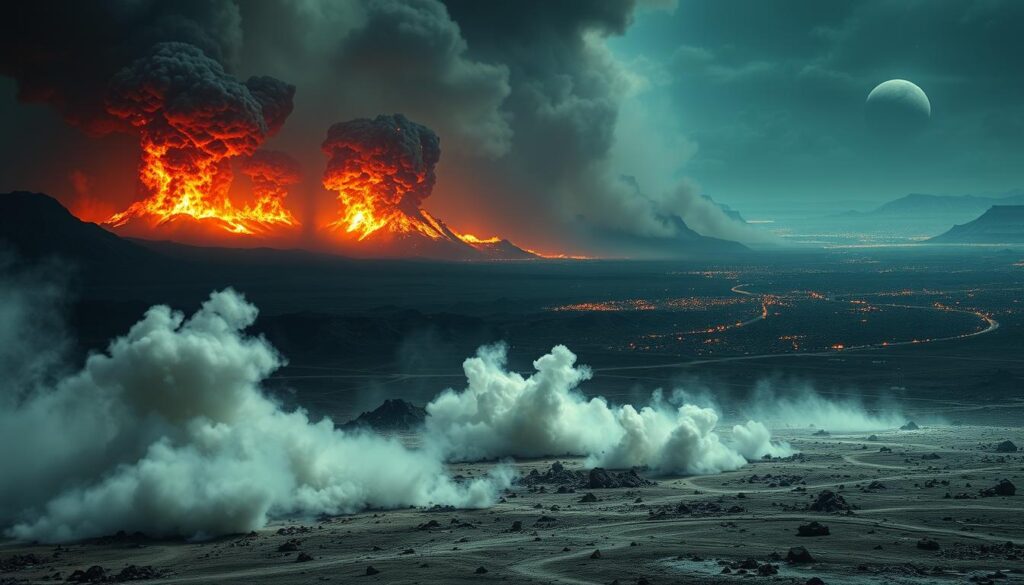
Scientists debate what caused the dinosaur extinction. But most think it was a mix of things. A big asteroid hit, volcanic eruptions, and climate changes made it hard for dinosaurs to survive.
The Cretaceous-Paleogene extinction didn’t just kill dinosaurs. It also made more than 75% of all species disappear. This shows how fragile life is and how quickly things can change.
Learning about the extinction event that killed dinosaurs helps us understand Earth’s history. It also shows why we need to keep studying the past to know what the future might hold.
Fossils: A Window into the Past
Through fossils, we learn about dinosaurs that lived long ago. Fossils are the remains or imprints of ancient plants and animals. They connect us to Earth’s history.
The field of paleontology helps us uncover dinosaur secrets. Scientists study fossilized bones, tracks, and eggs. This lets them know how dinosaurs lived and evolved.
One amazing thing about fossil discoveries is finding feathered dinosaurs. Creatures like Archaeopteryx and Microraptor show dinosaurs and birds are closely related. These finds have changed how we see dinosaurs.
“The discovery of feathered dinosaurs has revolutionized our understanding of the evolution of birds and the biology of theropod dinosaurs.”
Fossilization is rare and needs special conditions to happen. Yet, the fossil record tells us a lot about Earth’s history. It shows us how dinosaurs lived and their environments.
In summary, fossils are key to understanding dinosaurs. They give us clues about their biology, behavior, and evolution. More fossil discoveries and paleontology research will help us learn more about these creatures.
Dinosaur Discoveries of Recent Years
New fossil finds have greatly improved our knowledge of dinosaurs. They challenge old theories and start new debates. Discoveries in China have given us unprecedented insights into dinosaur biology and behavior. These findings show how complex and diverse dinosaur life was.
Well-preserved fossils have let scientists study dinosaur anatomy in new ways. For example, recent finds show details about dinosaur feathers, scales, and digestive systems. These discoveries help us understand how dinosaurs lived and interacted with their environments.
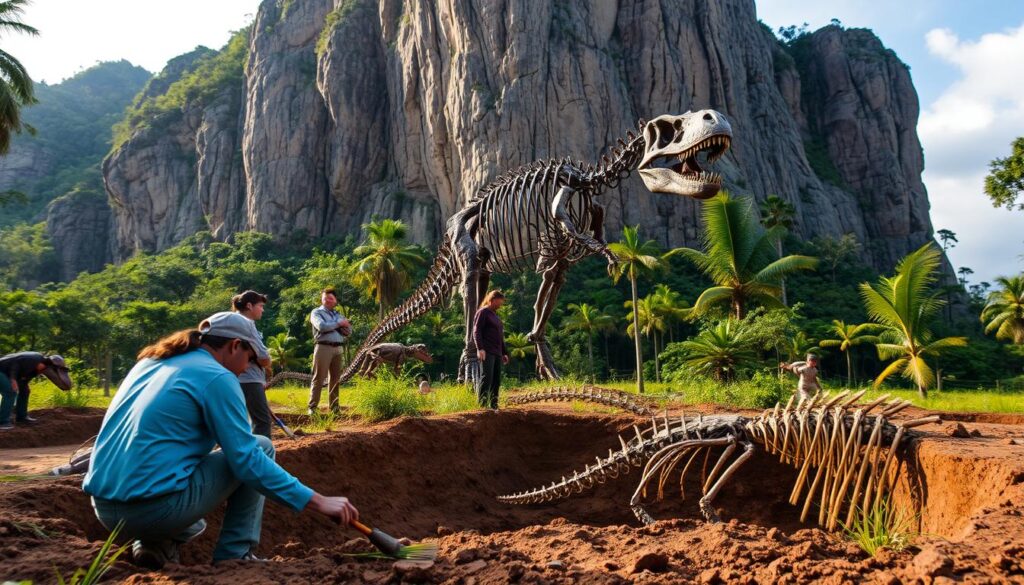
Cutting-edge research techniques have also helped us learn more about dinosaurs. Advanced imaging and computational modeling allow researchers to analyze fossils in new ways. This has revealed information about dinosaur movement, eating habits, and social structures.
These discoveries have also caught the public’s attention. They inspire new generations of paleontologists. As paleontological advancements keep coming, we’ll learn even more about dinosaurs.
In conclusion, recent dinosaur discoveries have greatly advanced our understanding of these creatures. By using new fossil finds and cutting-edge research, scientists are uncovering dinosaur secrets. This is changing our view of the ancient world.
Dinosaurs in Culture
Dinosaurs capture our imagination, beyond just science. They are everywhere in popular culture. You can find them in movies, books, and even museums.
Dinosaurs symbolize the thrill of discovery and the quest for knowledge. They show us what we value and worry about today. This makes them a great topic for cultural studies.
Dinosaurs in Film and Literature
Movies like “Jurassic Park” and “The Land Before Time” have amazed people everywhere. They make dinosaurs seem real and teach us about them. Books about dinosaurs also cover a wide range, from kids’ stories to serious studies.
“The dinosaur is a creature of imagination, a symbol of the awe-inspiring power of nature, and a reminder of the mysteries that await us in the ancient rocks.”
Exhibitions and museums also show our love for dinosaurs. They display fossils and tell us about dinosaurs’ lives. These places help us understand their world and ours.
Why do we love dinosaurs so much? It’s because they spark our curiosity and inspire us. Dinosaurs connect us to the past, fueling our dreams and creativity.
In short, dinosaurs are a big part of our culture today. They show our interest in the world around us. Through media and society, dinosaurs keep teaching and inspiring us, for years to come.
Why Dinosaurs Matter Today
Dinosaurs fascinate people all over the world. But their importance goes beyond just being interesting. Studying dinosaurs helps us understand biology, ecology, and Earth’s history.
Dinosaurs give us clues about life on Earth’s past. By looking at their fossils, scientists learn about ancient environments and how our planet changed.
Dinosaurs also play a big role in education. They spark kids’ interest in science. They help teach about the natural world and evolution.
Studying dinosaurs keeps our knowledge of the world growing. They are key to modern science and education.