
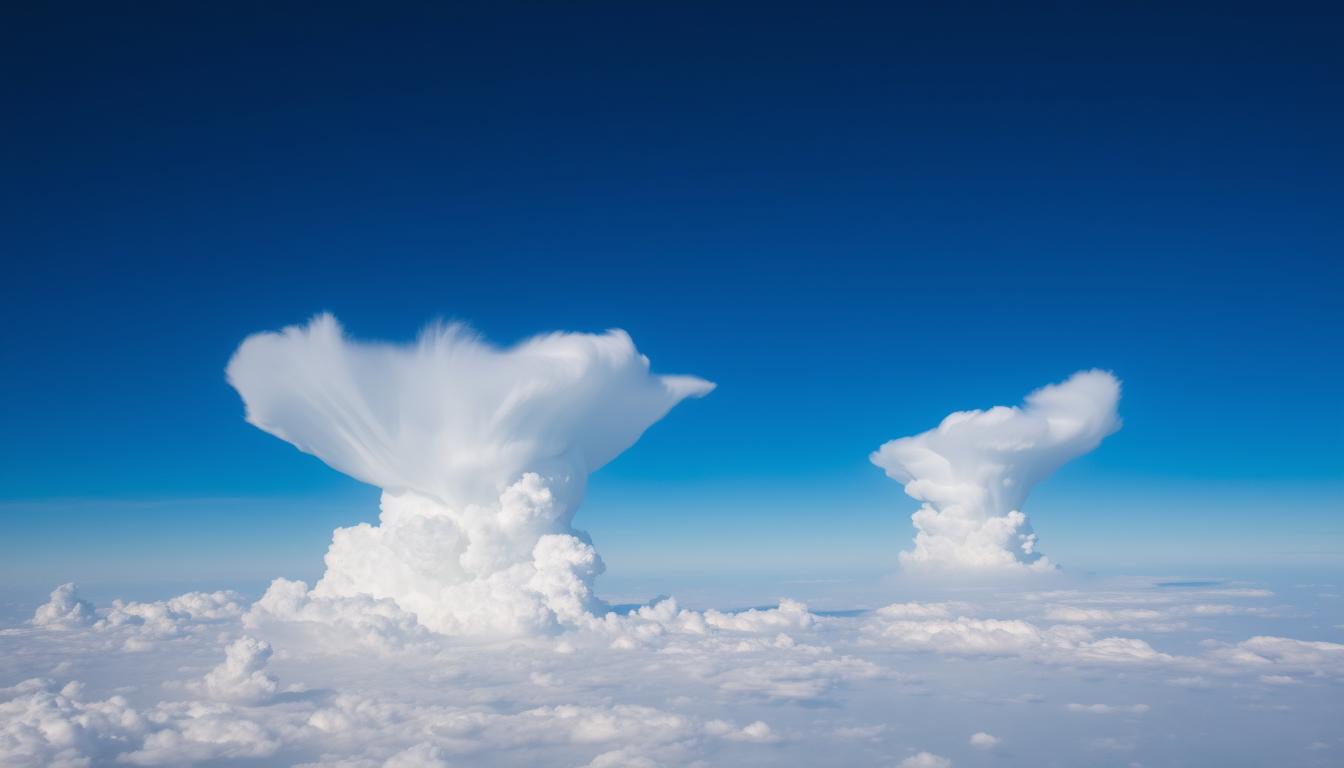
Ever wondered what clouds are made of? They’re made of tiny water droplets or ice crystals floating high in the air.
The National Oceanic and Atmospheric Administration (NOAA) says cloud formation happens when air water vapor turns into liquid droplets or ice crystals. This is key to understanding weather.
Water vapor is essential for cloud formation. When the air cools, this vapor turns into clouds we see in the sky.
What Are Clouds?
Clouds are made up of tiny water droplets or ice crystals floating in the air.
A cloud is defined as ‘a visible aggregate of minute droplets of water or particles of ice or a mixture of both floating in the free air.’
This definition shows that clouds can be all water droplets, all ice particles, or a mix of both.
The water droplets or ice particles in the air make clouds visible. They are key to Earth’s weather and climate.
Knowing what clouds are is the first step to understanding how they form and their role in our atmosphere.
The Science Behind Cloud Formation
The process of cloud formation starts with cooling and condensation. Clouds form when the air cools below the dewpoint. At this point, the air can no longer hold as much water vapor.
When the air cools, it hits its dew point. This is when the air is full of moisture and can’t hold more water vapor. At this moment, condensation happens. Water vapor turns into visible water droplets or ice crystals, creating clouds.
Cooling and Condensation
Cooling is key in cloud formation. Warm air rises and cools down. This makes it lose its ability to hold water vapor. Then, condensation occurs, turning water vapor back into liquid water. This liquid water forms droplets around dust particles or other nuclei in the atmosphere.

The mix of cooling and condensation is vital for cloud formation. Knowing these processes helps us understand the complex interactions in our atmosphere. These interactions lead to the creation of clouds.
The Water Cycle: A Key Element
The water cycle is vital for the Earth’s climate. It helps form clouds. This process moves water on, above, and below the Earth’s surface.
Evaporation is a key part of the water cycle. When it’s warm and humid, water from oceans, lakes, and rivers turns into water vapor. This happens because of evaporation.
This water vapor goes up into the air. There, it cools down and turns back into liquid water. This forms clouds. NOAA says water vapor mainly gets into the air through evaporation.
The water cycle is key for life on Earth. It’s connected to weather and climate. Knowing about evaporation and condensation helps us understand clouds and the Earth’s climate.
Different Types of Clouds and Their Formation
Luke Howard’s cloud classification system was created in the early 19th century. It is the base of today’s cloud classification. This system sorts clouds into several main types based on their shape, height, and other features.
Clouds are mainly split into three big groups: cirrus, cumulus, and stratus. Cirrus clouds are high up and made of ice crystals, looking like thin, wispy lines or tufts. Cumulus clouds are puffy and white, sometimes alone or in big groups. Stratus clouds are low and cover the sky like a blanket, often looking gray or white.

There are also alto clouds, which are mid-level, and nimbus clouds, which are dark and bring rain. Mixing these categories gives us cloud types like cumulonimbus. These are tall, dense clouds that bring heavy rain, thunderstorms, and strong winds.
The formation of these cloud types depends on many things like temperature, humidity, and wind direction. Knowing these factors helps us predict the weather and understand clouds’ role in our climate.
By knowing the different types of clouds and their features, we can see the complexity and beauty of our atmosphere.
The Role of Atmospheric Conditions
Understanding how clouds form starts with knowing atmospheric conditions. The atmosphere is always moving. As air goes up, it mixes with drier air. This mixing is key to cloud growth.
Temperature and humidity play big roles in cloud formation. Warm air rising cools down and can’t hold as much moisture. This leads to clouds forming. How much water vapor is in the air affects cloud formation.
Changes in atmospheric conditions can change cloud behavior. For example, a change in temperature or humidity can change cloud types and amounts. This can also change weather and climate.
Knowing about atmospheric conditions helps us understand cloud formation better. This knowledge is important for predicting weather and understanding our climate.
The Importance of Cloud Formation
Clouds are key to the Earth’s climate system. They help control temperature and bring us rain. They reflect sunlight and keep some heat from escaping.
Clouds are very important for our climate and weather. They make rain, which is vital for life. The kind and amount of clouds affect how much heat the Earth keeps.

Clouds also help move water around the world. Knowing how clouds form helps us predict the weather. It’s key to understanding the Earth’s climate.
Studying clouds helps scientists understand the Earth’s climate better. This knowledge is vital for dealing with climate change. It helps us prepare for extreme weather and changes in rain patterns.
In short, clouds are very important. They affect temperature, rain, and the climate. By learning more about clouds, we can better predict the weather and fight climate change.
How Human Activity Affects Clouds
Aerosols from human activities shape cloud properties. These include pollutants from cars and factories. They help form clouds by acting as extra places for water to condense.
When we release aerosols into the air, they mix with water vapor. This changes how clouds form and behave. Changes can affect how much sunlight clouds reflect, how long clouds last, and when it rains. For example, more aerosols can make clouds reflect less sunlight.
The effect of aerosols on clouds is complex. It depends on the type of aerosol, how much there is, and the cloud type. Some aerosols cool the planet by making clouds reflect more, while others might warm it by changing cloud life or being absorptive. Knowing this helps us predict climate changes and reduce environmental harm.
Scientists are always studying how human actions affect clouds. They use data, lab tests, and models to learn more. By understanding aerosols and human impacts on clouds, we can improve climate models and find better ways to fight climate change.
Observing Clouds: A Fun Activity
Watching clouds can be very rewarding. It teaches you about different cloud shapes and their roles in weather. By spending a few minutes each day cloud watching, you can learn a lot about clouds and weather.
First, find a good spot outside with a clear sky view. Lie down or sit back and watch the clouds. Look at their shapes, heights, and how they change. Use a cloud guide to learn about types like cumulus, stratus, or cirrus.

Cloud observation is more than just identifying clouds. It’s about understanding their behavior and weather connections. Regularly watching clouds helps you predict weather and enjoy the sky’s beauty.
Whether you love clouds or are just starting, cloud observation is fun for everyone. So, take a moment to look up and start your cloud watching today!
Cultural Significance of Clouds
Clouds have made a lasting impact on human culture, from art to literature. Their cultural significance is clear in their widespread use in creative works.
In art, clouds express emotions and themes, often symbolizing the sublime or divine. For example, J.M.W. Turner’s landscapes feature dramatic clouds that add depth and evoke awe. Clouds in art also set moods and atmospheres, affecting how we see the artwork.
In literature, clouds symbolize change, uncertainty, or introspection. Authors use clouds as metaphors to explore complex human feelings and experiences. This makes clouds in literature add depth to stories.
Clouds have different meanings in different cultures, showing local beliefs and values. This shows how clouds fascinate people worldwide and shape cultural stories.
Future of Cloud Studies
Technology and modeling are getting better, changing how we see clouds and their role in the climate. Cloud research is key to learning more about these complex topics. As we progress, we’ll discover new things about how clouds, the atmosphere, and climate interact.
Studying cloud formation and behavior will help scientists improve their models. This will lead to better predictions and a deeper understanding of our climate. Such knowledge will guide efforts to fight climate change, helping us build a more sustainable world.