
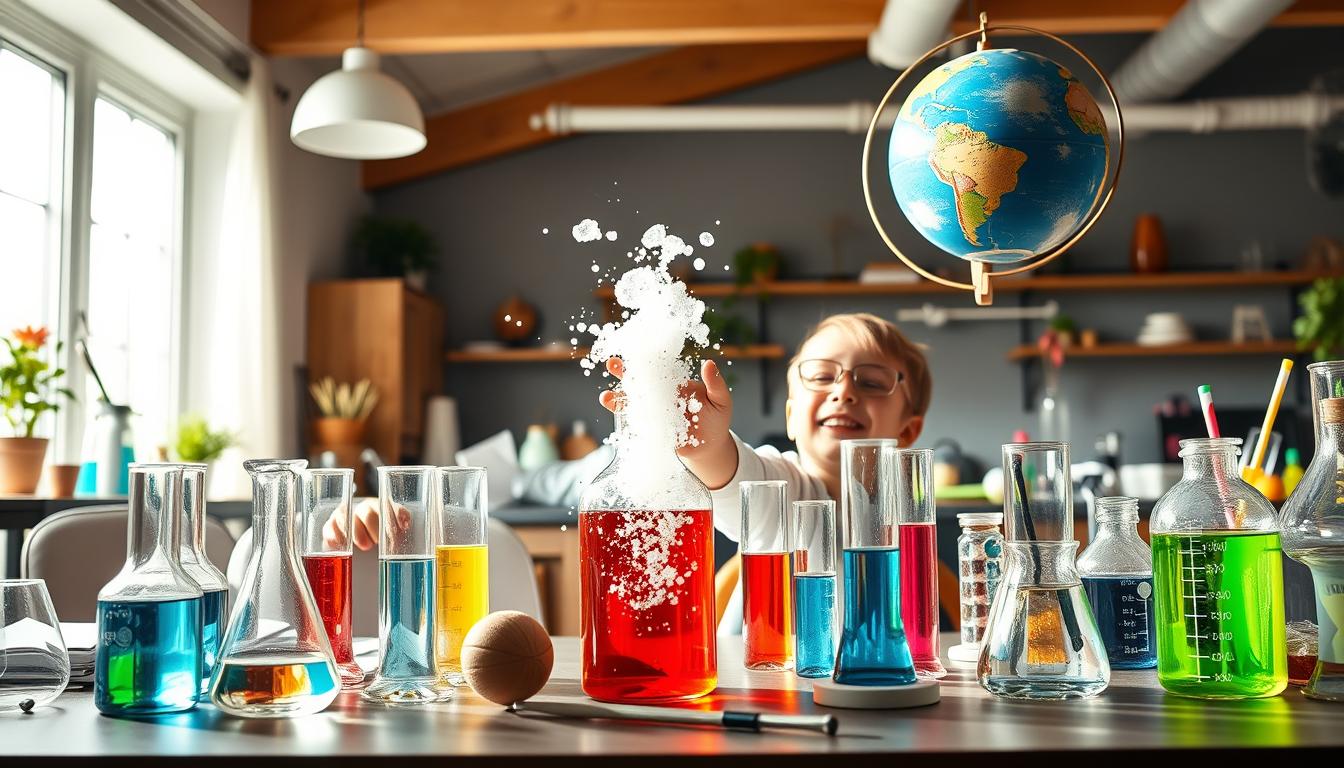
Are you ready to ignite curiosity and have fun while learning? Science is all around us. With a few simple materials, you can do fascinating science experiments at home.
Our collection of fun experiments is engaging and easy to understand. It’s designed for everyone, whether you’re a student, teacher, or science lover. You’ll find something that sparks your interest.
From simple home experiments with household items to more complex projects, we’ve got you covered. Explore the world of science and enjoy learning through science experiments.
Introduction to Fun Science Experiments
Children are naturally curious. Engaging them in science experiments can be both fun and educational. By doing fun science projects at home, parents can encourage their kids to explore and understand the world.
Science experiments are not just about complex theories and formulas. They can be simple, engaging, and a great way to spend quality time with your children. An introduction to science experiments can spark a lifelong interest in learning and discovery.
Through fun science experiments, children can develop critical thinking skills. They learn about cause and effect, and understand basic scientific principles. This article will provide you with a variety of easy and enjoyable experiments to try at home, covering topics from kitchen science to physics and biology.
By making science a fun and interactive experience, you can help foster a love of learning in your children. This love of learning will benefit them throughout their lives.
Kitchen Science: Easy Experiments at Home
Science experiments can be done at home, and the kitchen is full of ingredients for them. These ingredients make learning science fun and easy.
Creating a lava lamp is a cool experiment. You need vegetable oil, water, food coloring, and an Alka-Seltzer tablet. It shows density and buoyancy in a colorful way.

Making a volcano is another fun kitchen science project. Mix baking soda and vinegar to see a mini-eruption. It’s a classic acid-base reaction that shows how chemicals interact.
A Chemical Eruption in Your Mouth
The “Orange Fizz” experiment is also fun. Drop a gummy bear into soda to see a chemical eruption when you taste it. But, a safer way is to mix baking soda with lemon juice or vinegar. This shows the acid-base reaction in a safe way.
These easy science experiments make science fun and accessible. They show how simple ingredients can teach complex science. Doing these home experiments helps people appreciate science more.
Colorful Chemistry Experiments
Colorful chemistry experiments make science fun and engaging. They often show vibrant colors, making them eye-catching. These experiments are great for both classrooms and homes, teaching chemistry in an interactive way.
Using Skittles to Form a Rainbow
Creating a rainbow with Skittles is a simple yet colorful experiment. You’ll need Skittles, a white plate, and warm water. Place the Skittles in a circle on the plate.
Next, pour warm water over the Skittles. Watch as the colors mix and spread, forming a rainbow. This shows a basic chemistry principle of solubility.
The Skittles experiment works because of the sugar coating with food coloring. When warm water dissolves the sugar, the colors are released. This creates a rainbow, showing colorful science in action.
This experiment is both fun and educational. It teaches kids about solubility and density. It’s a fun way to learn about chemistry experiments at home.
Physics Fun: Simple Principles in Motion
Simple physics experiments, like making hovercrafts and testing inertia, are both fun and educational. They show us basic physics principles in a fun way.
One cool experiment is making a paper hovercraft. You can make one by folding and cutting a piece of paper. It glides smoothly because it floats on air, reducing friction. Start with a simple design, fold the paper, cut out a pattern, and unfold it. Then, place it on a smooth surface and watch it glide, showing how friction is reduced.
Another interesting experiment is the coin inertia test. Place coins on cardboard over a glass of water. When you flick the cardboard, the coins fall into the glass because of inertia. This shows Newton’s First Law of Motion, where an object stays in its state unless a force changes it.
These motion experiments are not just fun but also help us understand physics better. Doing these activities helps us see the science in our world.
Learning about simple principles through these experiments can make us curious about physics. Whether it’s making hovercrafts or testing inertia, these activities make learning physics fun.
Nature Experiments: Exploring Biology
Biology experiments in nature spark curiosity in everyone. They help us understand how plants and trees work, like how they “breathe.”
One cool experiment shows how plants “breathe” through their leaves. You can do this by putting a leaf in water and watching for bubbles. Dr. Jane Smith, a botanist, says, “Plants release oxygen and take in carbon dioxide, just like we do.”
To try this, you need a fresh leaf, water, and patience. Put the leaf in water and watch. You’ll see bubbles on the leaf’s surface. These bubbles come from the plant’s oxygen release during photosynthesis.
This experiment teaches us about plants and their role in our world. Richard Feynman said, “Nature is beautiful, and understanding it makes it even more so.” Simple experiments like this help us appreciate nature more.
Doing nature experiments makes us curious about our surroundings. It’s a fun way to learn about biology. We get to explore and discover through hands-on activities.
“The clearest way into the Universe is through a forest wilderness.”
By doing nature experiments, we learn biology and develop wonder for nature. This way of learning is key for raising scientists and nature lovers.
Exploring Magnetism and Electricity
Dive into the fascinating world of magnetism and electricity with simple yet intriguing experiments. These fundamental forces of nature are all around us, influencing our daily lives in numerous ways.
Magnetism is a force that arises from the interaction between magnetic fields. These fields are created by the motion of charged particles like electrons. One of the most engaging ways to explore magnetism is by making a DIY compass.
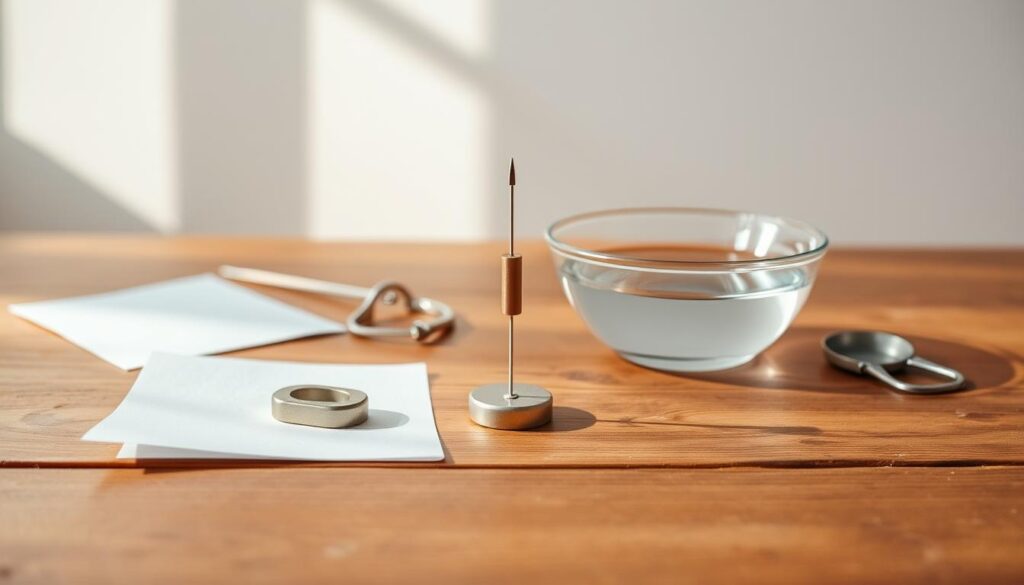
By magnetizing a needle and placing it in a water-filled container, you can create a simple compass. This compass aligns with the Earth’s magnetic field.
To make a DIY compass, start by stroking a needle with a magnet several times in the same direction. This magnetizes it. Then, place the needle on a small piece of cork or a leaf in a bowl of water.
Observe how the needle aligns itself with the Earth’s magnetic field. It will point towards the magnetic North Pole.
Electricity is another fundamental aspect of our physical world. It involves the movement of charged particles. Simple experiments, such as creating a homemade battery using a lemon or potato, can demonstrate the principles of electricity.
These experiments not only educate but also entertain. They make complex concepts accessible to everyone.
By exploring magnetism experiments and electricity experiments, you can gain a deeper understanding of the natural world. You can also develop a curiosity-driven approach to learning about science and technology.
Fun with Gases: Learn about Air Pressure
Explore the exciting world of gases and air pressure with these fun experiments. Air pressure is the force from the weight of air around us. It’s key in many natural events.
Try Exploding a Bag to see air pressure in action. Fill a bag with air or gas, and the pressure inside goes up. If it gets too high, the bag will burst, showing how air pressure can release energy.
The Invisible Extinguisher is another cool experiment. It shows how air pressure can make a candle flame go out without any visible reason. This happens by using carbon dioxide, which is denser than air, to cut off the flame’s oxygen. It’s a great example of how gases can change air pressure and our environment.
These experiments are not just fun; they teach us about air pressure and gases. By learning about these topics, we can better understand our world and the forces that shape it.
Seasonal Science: Holiday-Themed Experiments
From Halloween to Thanksgiving, each holiday season offers unique science experiment chances. Doing holiday-themed experiments makes learning fun and creates lasting memories.
For Halloween, try the “Jack-O-Cano” experiment. It turns a pumpkin into a volcano. You’ll see a chemical reaction that looks like a volcanic eruption. It’s both thrilling and educational.

As Thanksgiving nears, make a “Squishy Turkey” with simple items at home. This experiment teaches about different materials and adds a fun twist to holiday prep.
Doing seasonal science activities like these makes learning more interactive and fun. By adding holiday-themed experiments to your learning, you keep the spirit of learning alive all year.
These experiments are great for families, educators, and anyone wanting to make science fun. So, explore seasonal science and make this holiday season unforgettable!
Fun Experiments for Kids with Everyday Materials
Everyday materials can turn into a science lab, making learning fun for kids. They can do cool experiments with common household items. These activities are both fun and educational.
Making homemade play dough is a simple and fun experiment. Kids just need flour, water, and a few other items. They can also make snow with shaving cream and cornstarch. This is a great activity for any season.
These fun experiments for kids are not just entertaining. They also teach valuable lessons. By using everyday materials, kids learn about science and problem-solving. For example, making play dough teaches them about mixing materials.
Doing these activities with household items sparks kids’ creativity. It helps them see the world in a new way. It’s a fun way to learn, using things you already have at home.
Conclusion and Next Steps for Experimentation
Exploring science experiments can be both fun and rewarding. You can learn a lot from kitchen science, colorful chemistry, and nature experiments. There’s so much to discover.
Science experiments can be done with things you already have at home. This makes it easy to start. To learn more, check out the National Science Foundation’s website. You can also visit local science museums and libraries.
Next, find what really interests you and dive deeper. Try designing your own experiments. Use the scientific method to test your ideas and figure out what you’ve learned.
By keeping up with your experiments, you’ll learn more about the world. You’ll also get better at thinking critically and solving problems. So, keep exploring and who knows, you might find something amazing!