

Imagine waking up to the sweet chirping of birds or the gentle hum of your alarm clock. Sound is a big part of our daily lives. It shapes how we interact with the world.
From the moment we wake up, we’re surrounded by many sound waves. Our brains turn these waves into different noises. Whether it’s people talking, sirens wailing, or leaves rustling, sound propagation is key to how we see reality.
The journey of sound through the air is quite interesting. It’s a complex process. Energy travels through pressure waves, letting us hear a variety of sounds.
What is Sound?
Sound is a type of energy made by vibrations that move air particles. When something vibrates, it shakes the air around it. This makes the air particles move back and forth.
These movements are called sound waves. They travel through the air as waves of pressure. The sound’s frequency and amplitude are what make it different.
Frequency is how many times something vibrates in a second, measured in Hertz (Hz). It tells us the sound’s pitch. Amplitude is how far the particles move from their normal spot. It shows how loud the sound is.
Knowing about sound’s basic parts helps us understand how it moves and what we hear. The mix of frequency and amplitude creates all the sounds we hear every day.
The Science of Sound Propagation
The science of sound propagation shows how sound waves travel through the air. It’s about energy moving through a medium, like air.
Air has mass and acts like a spring. It can be compressed by force. This makes it possible for air to store and send vibrations, which we hear as sound waves.

When something vibrates, it moves air molecules around it. This creates compressions and rarefactions. Compressions are when air molecules are close together, and rarefactions are when they’re far apart. This movement of air is what we call a sound wave.
The way sound waves move through air depends on their frequency and wavelength. The frequency changes the pitch of the sound. The wavelength affects how the sound interacts with objects.
Knowing about sound propagation helps in many fields. It’s key for designing better concert halls and recording studios. It also helps in making noise reduction systems.
In summary, sound propagation is a complex but interesting field. It affects our daily lives. By understanding how sound waves move, we can appreciate the science behind what we hear.
Frequency and Pitch: The Sound Connection
Understanding the link between frequency and pitch is key to sound basics. The frequency of a sound is how many cycles per second, in Hertz (Hz).
This is important because it affects the pitch we hear. Higher frequency means higher pitch, and lower frequency means lower pitch.
For example, a 440 Hz sound is the musical note A above middle C. On the other hand, a 20 Hz sound is a very low rumble. This difference in frequency lets us tell apart different sounds.
The bond between frequency and pitch is not just a theory. It’s used in music and audio engineering. Musicians tune their instruments to certain frequencies for the right pitches. Audio engineers tweak sound waves for a balanced, clear sound.
In summary, the tie between frequency and pitch is vital in sound perception and interaction. Knowing this helps us enjoy the complexity and beauty of sound.
Amplitude and Loudness Explained
It’s important to know how amplitude and loudness work together. The amplitude of a sound wave shows how intense it is. This intensity affects how loud we hear it.
The loudness of a sound is something we feel, not just measure. The bigger the amplitude, the louder the sound. For example, a whisper is quiet because it has low amplitude. But a jet taking off is very loud because it has high amplitude.
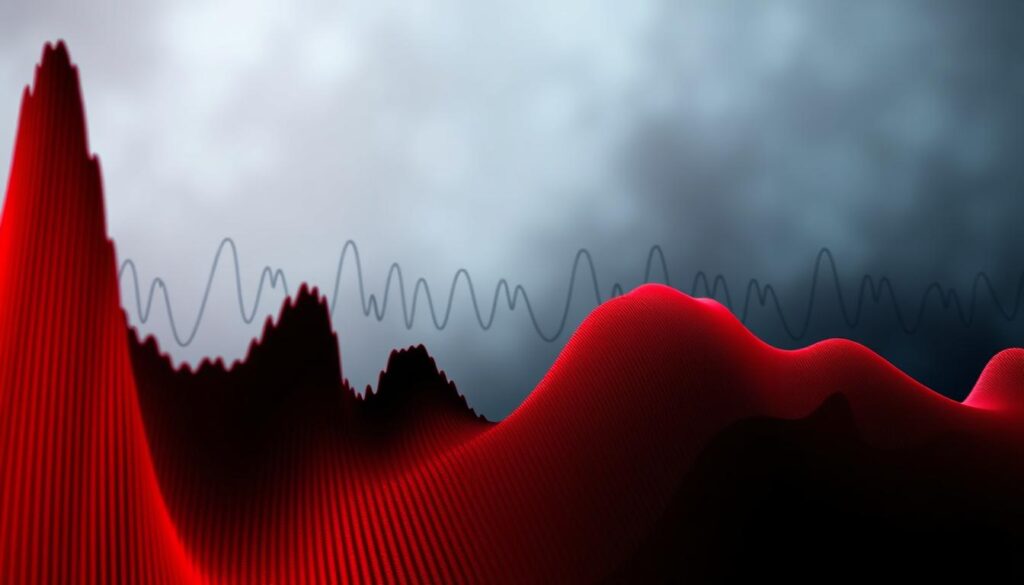
Amplitude is a real part of sound waves, but loudness is how we feel it. Sound intensity, measured in decibels, shows both amplitude and how loud we think it is.
In short, the amplitude of a sound wave decides its loudness. Knowing this helps us understand how we hear sounds.
The Speed of Sound in Various Conditions
The speed of sound changes based on temperature and air pressure. At sea level and room temperature, it’s about 343 meters per second.
But, this speed isn’t always the same. It can change a lot with different conditions. For example, temperature is very important. When it gets warmer, the air molecules move faster. This lets sound travel quicker.
A study found that the speed of sound goes up by about 0.6 meters per second for every degree Celsius. This shows how temperature directly affects sound speed.
Air pressure also plays a role, but it’s not as big as temperature. At higher altitudes, where it’s thinner, sound travels slower. This is because there are fewer molecules to vibrate, making sound move slower.
Knowing about these factors is key in many areas, like acoustic engineering and aviation. For example, in flying, understanding how sound speed changes with altitude and temperature is very important. It helps with supersonic flights and predicting sonic booms.
In summary, the speed of sound isn’t always the same. It changes with temperature and air pressure. Understanding these changes is important for many fields.
Sound Reflection and Absorption
When sound waves hit a surface, they can be reflected, absorbed, or transmitted. This depends on the surface’s characteristics.
Several outcomes are possible when sound waves hit a surface. The surface’s material, texture, and density are key. They decide if the sound is reflected back, absorbed by the surface, or goes through it.
Reflection Mechanisms
Reflection happens when sound waves bounce back. The surface’s properties affect how well sound is reflected. Hard, smooth surfaces reflect sound better than soft, irregular ones.
For example, sound reflects well off concrete or metal. The angle of incidence equals the angle of reflection, like with light. This is why concert halls and auditoriums are designed to direct sound to the audience.
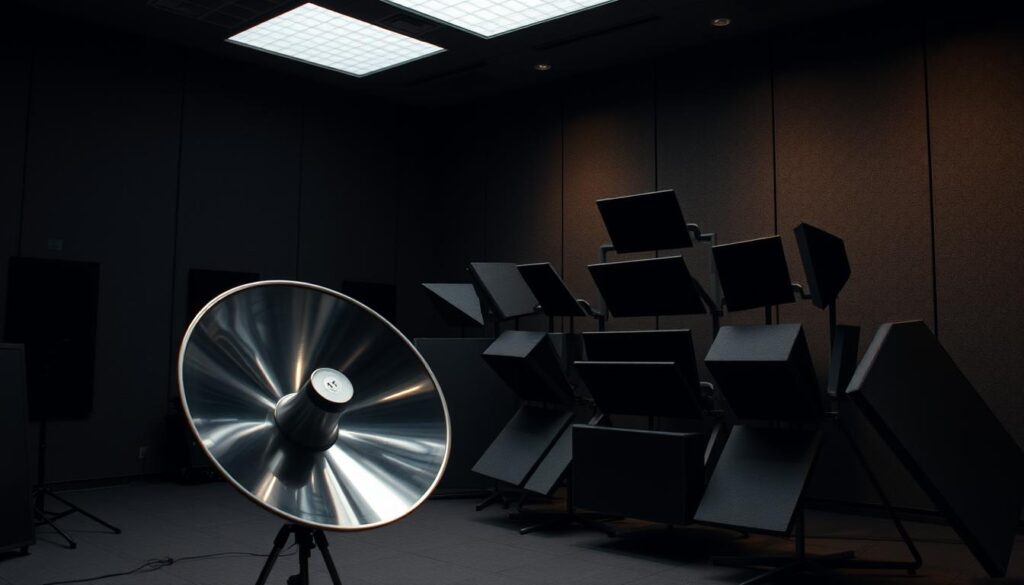
Sound absorption happens when sound energy is absorbed by a surface. This often turns into heat. Materials like acoustic panels are made to absorb sound, reducing echo and improving sound quality.
The effectiveness of sound absorption depends on the material and sound frequency. Porous materials are good at absorbing sound, mainly for higher frequency sounds.
Understanding sound reflection and absorption is key in many fields. From architectural design to audio engineering, professionals use these concepts to create the best sound environments.
The Doppler Effect: Sound in Motion
The Doppler effect is a cool phenomenon that happens when sound and its listener are moving. It was first thought of by Christian Doppler in the 19th century. It’s about how the sound changes when the source and the listener are moving.
Picture yourself at a train station. When a train comes with its horn, the horn sounds higher. Then, as it goes away, the sound gets lower. This change is because of the Doppler effect. When the train comes, the sound waves get closer together, making the sound higher. When it goes away, the sound waves spread out, making it lower.
The Doppler effect isn’t just for trains. It happens in any situation where there’s movement between the sound and the listener. For example, police car sirens change pitch as they speed by. Even in sports, a racing car’s engine pitch changes as it moves closer and then further away.
This effect is important in many areas. It helps in tracking weather, understanding space, and in medical imaging to see blood flow. The frequency shift from the Doppler effect tells us about the speed of moving things.
In short, the Doppler effect shows how sound changes when things move. It’s something we see every day, from car sirens to the universe expanding. Knowing about the Doppler effect helps us understand how motion, sound, and perception work together.
Sound Barriers and Their Impact
Sound barriers are structures made to block or absorb sound waves. They help reduce noise pollution. They are key in managing sound propagation in places like cities and nature.
The success of sound barriers depends on their design, material, and where they are placed. For example, barriers made from dense materials like concrete or brick work better than those made from less dense materials.
In cities, sound barriers are used along highways to lessen noise for nearby homes. This is a big part of noise reduction in city planning.
Also, knowing how sound barriers work is important for controlling noise. This is true in places like recording studios or outdoor concerts.
With good sound barriers, we can greatly reduce noise. This makes life and work better in many places.
The Role of Medium in Sound Transmission
Different media, like air, water, and solids, greatly affect how sound is transmitted. The medium’s properties change the speed and how sound behaves.
Sound moves through air as pressure waves. It travels at about 343 meters per second at room temperature. But, its speed can change with temperature and air pressure.
In solids, sound goes faster than in air because solids are denser and more elastic. For example, sound travels at about 6,000 meters per second in steel. This is why you can hear a train coming through the rails before it arrives.
Water also transmits sound, at a speed of about 1,483 meters per second. It’s faster than in air but slower than in solids. Water’s density and temperature affect sound speed.
The medium’s characteristics, like speed, frequency, and amplitude, influence sound transmission. Knowing these differences is key for fields like acoustic engineering and underwater communication.
In conclusion, the medium is essential for sound transmission. By understanding how different media affect sound, we can appreciate the complexity of sound and its uses in our lives.
The Importance of Sound in Nature
Sound is very important in nature. It affects how animals behave and keeps the environment balanced. It’s a key way for many animals to communicate.
Many species use sound to talk to each other. Birds sing to mark their territory and find mates. Dolphins and whales make clicks and whistles to chat underwater.

Sound also makes the natural world feel alive. The sounds of leaves, crickets, and waterfalls create a unique atmosphere in each place.
Sound can also tell us about the health of nature. Changes in sounds can show if something is wrong or if certain animals are around. For example, if there’s no bird song, it might mean fewer birds or poor habitats.
In short, sound is essential in nature. It shapes animal behavior and how we see the world. By protecting the sounds of nature, we help keep ecosystems healthy and diverse.
Conclusion: The Everyday Impact of Sound
Sound is a big part of our daily lives. It changes how we see things, feel emotions, and talk to others. Knowing how sound works helps us enjoy the world more.
The science behind sound is complex. It includes how sound moves, its strength, and how fast it goes. These things affect how we hear things around us.
Sound impacts us in many ways. It can change our mood, help us talk to others, and even keep us safe. By understanding sound, we can value our senses more.
In short, sound is very important in our daily lives. Knowing about sound makes our time in the world richer. Sound is always with us, shaping our views and feelings.