

Energy transfer is a key concept in physics. It happens through waves. These disturbances move through a medium, carrying energy from one place to another. There are many kinds of waves, each with its own traits.
The world is full of wave motions. We see them everywhere, like the ripples on a pond and the light from the sun. Knowing about different waves helps us understand many scientific ideas.
This article will look at the different kinds of waves. We’ll cover mechanical and electromagnetic waves, and their properties. By studying these, we can better understand how energy moves and is used in different ways.
Understanding Waves: A Basic Overview
A wave is a disturbance that moves through a medium, carrying energy. It’s defined as “A wave is a flow or transfer of energy in the form of oscillation through a medium – space or mass.” This shows how energy moves in waves.
Waves have Wave Properties that tell us how they behave. These include amplitude, wavelength, frequency, and speed. Knowing these helps us see how waves move in water, air, or even a vacuum.
Wave Motion is key to understanding waves. It’s how particles in a medium move when a wave goes through. There are different types of motion, like transverse and longitudinal waves. Each type shows how the wave and medium interact.

Waves can move through many materials, showing their importance in science. From pond ripples to earthquake waves, studying waves helps us learn about our world.
In summary, waves are vital in physics because they carry energy through mediums. By looking at their properties and motion, we learn more about our universe.
Mechanical Waves Explained
Exploring mechanical waves, we learn about their key traits and kinds. These waves are disturbances that move through a medium, carrying energy from one spot to another. This makes them different from other wave types.
Mechanical waves need a physical medium to move, which can be solid, liquid, or gas. The medium’s particles move back and forth as the wave goes by. This lets energy move without the particles actually moving.
Mechanical waves mainly fall into two types based on how particles move. These are longitudinal and transverse waves.
In longitudinal waves, particles move back and forth in the wave’s direction. Sound waves in air are a good example. Here, air molecules compress and expand in the wave’s direction.
Transverse waves have particles moving sideways to the wave’s direction. A string wave is a classic example. Here, the string’s particles move up and down as the wave travels sideways.
Knowing about these wave types helps us understand many physics and engineering concepts. This includes seismic activity and light behavior, even though light isn’t a mechanical wave.
The Nature of Electromagnetic Waves
Studying electromagnetic waves shows us how they are made and move. Electromagnetic waves come from charged particles vibrating. This is a key area in physics.
Electromagnetic waves can travel through empty space. This is different from mechanical waves. It lets us get sunlight and other radiation from far away.

Experts say, “Electromagnetic waves include many types, like radio waves and X-rays.” This range is important for many uses, like communication and medical imaging.
Charged particles making electromagnetic waves is basic. When these particles move fast, they send out waves. This idea helps make radio transmitters and particle accelerators work.
Knowing how fast electromagnetic waves go in a vacuum is key. They move about 299,792 kilometers per second. Research on these waves keeps uncovering new things about our universe.
The Role of Sound Waves in Communication
The importance of sound waves in communication is huge. They are a type of mechanical wave that needs a medium to move. This makes them key in our daily talks.
Sound waves start with a disturbance that makes the medium, usually air, compress and expand. This makes them longitudinal mechanical waves. The medium moves in the same direction as the wave.

Sound waves have many roles in communication. They let us hear and understand different sounds, from voices to music. Being able to hear and make sense of these waves is vital for talking to each other.
In communication, sound waves are very important. For example, in speech, they carry messages through changes in pitch and tone. In music, they make melodies and harmonies that stir emotions and share culture.
Knowing about sound waves and their nature as mechanical waves helps us create sound-based technologies. This includes audio gear and communication tools. By understanding the science of sound waves, we value their role in our lives more.
Exploring Water Waves
Surface waves, like those in oceans and lakes, have unique traits. They mix longitudinal and transverse motions, leading to a circular motion of particles.
Wind friction on water’s surface mainly creates these waves. As wind energy hits the water, it forms ripples that grow into waves. The waves’ wave characteristics, like wavelength and frequency, depend on wind speed and how long it blows.
Surface Waves
Surface waves move along the water’s surface. The circular motion of water particles in these waves gets weaker with depth. This is why they greatly affect coastal areas.
Knowing about surface waves helps predict coastal erosion and marine dynamics. It’s key for coastal safety.
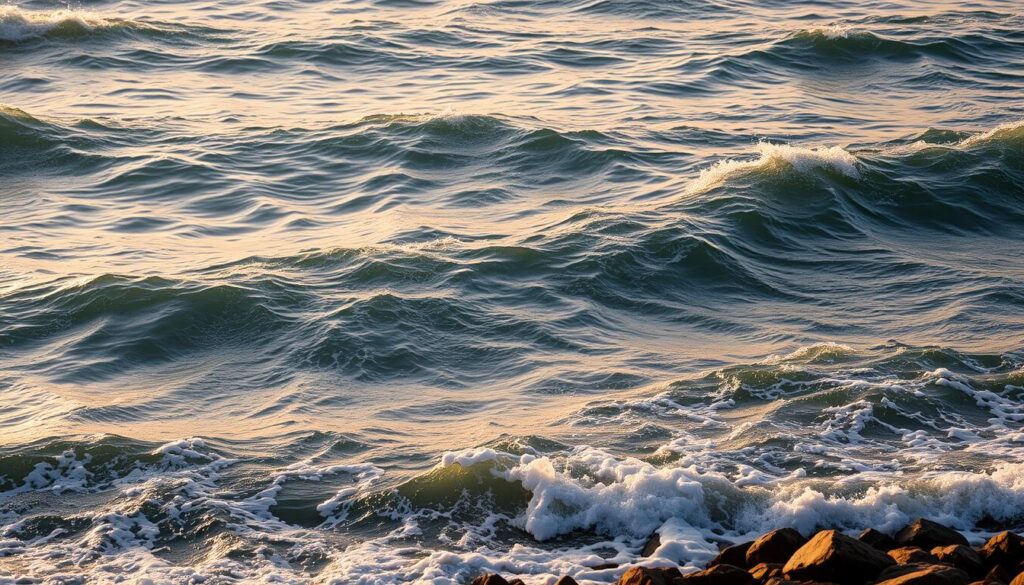
Studying water waves and their traits is important for oceanography and coastal engineering. By looking into these waves, scientists can understand and forecast ocean events better.
Seismic Waves: Understanding Earthquake Waves
Seismic waves are the energy waves that move through the Earth during an earthquake. They help us understand the Earth’s inside and how earthquakes happen.
Types of Seismic Waves: There are two main types – P-waves and S-waves. P-waves move through solid, liquid, and gas. S-waves only go through solid materials.
How fast these waves move through the Earth tells us a lot. For example, P-waves get faster in denser materials. But S-waves can’t go through the Earth’s liquid core.
Understanding Seismic Waves is key for scientists. They use it to find where earthquakes are and learn about the Earth’s inside. By studying seismic waves, scientists can figure out the Earth’s composition and temperature.
Insights into the Earth’s Structure: Seismic waves have taught us a lot about the Earth. We now know about the crust, mantle, outer core, and inner core. This knowledge helps us understand the Earth and predict earthquake risks.
Radio Waves: An Essential Communication Tool
Radio waves are a key part of electromagnetic waves. They are used in many ways, like broadcasting and mobile phones. They help connect people all over the world.
Radio waves can send information far without needing cables. This makes them very important for talking to each other over long distances.
Broadcasting uses radio waves to reach lots of people. For example, radio shows send sound to listeners everywhere.
In mobile phones, radio waves help send messages and calls. This is how phones talk to towers and each other.
Properties of Radio Waves
Radio waves are a kind of electromagnetic wave. They have longer wavelengths than microwaves. This makes them good for sending signals over long distances.
They can go through some materials and travel far. This is why they’re great for talking to people far away.
Applications of Radio Waves
Radio waves are used in more than just phones and radios. Radar uses them to find objects.
They also help in satellite communications. This is key for GPS and other services that rely on satellites.
In short, radio waves are essential for today’s communication. They are perfect for broadcasting, mobile phones, and more. Their ability to travel far makes them very useful.
The Science of Ocean Waves
The study of ocean waves looks at how they form, their traits, and how they affect coastlines. Ocean waves start when wind pushes its energy onto the water’s surface. This creates ripples that grow into waves.
As ocean waves move across the ocean, their traits like wavelength, frequency, and amplitude change. These changes happen due to wind speed, the distance the wind blows, and how long it blows.
The wave characteristics are key in figuring out their impact on coastlines. For example, high-amplitude waves can cause a lot of erosion, mainly during storms. On the other hand, waves with lower amplitude can help shape beaches and coastal areas.
Knowing about ocean waves and their traits is key for predicting coastal erosion and deposition. This knowledge is important for managing coastlines and planning. It helps lessen erosion’s effects and protect coastal ecosystems.
Also, studying wave characteristics like wavelength and frequency helps us see how ocean waves affect coastlines and structures built by humans. This is important for making coastal defenses and structures that can stand up to wave action.
Conclusion: The Value of Understanding Waves
Knowing about different types of waves is key in many areas. This includes communication, navigation, and understanding nature. Waves are all around us, and understanding them helps us see the world in a new light.
Studying waves like mechanical, electromagnetic, sound, water, seismic, and radio waves shows their impact. By looking into their properties, we learn more about how they work.
Understanding waves can lead to big tech advances and better ways to communicate. It also helps us understand nature better. As we keep learning about waves, we’ll find new ways to help society.