
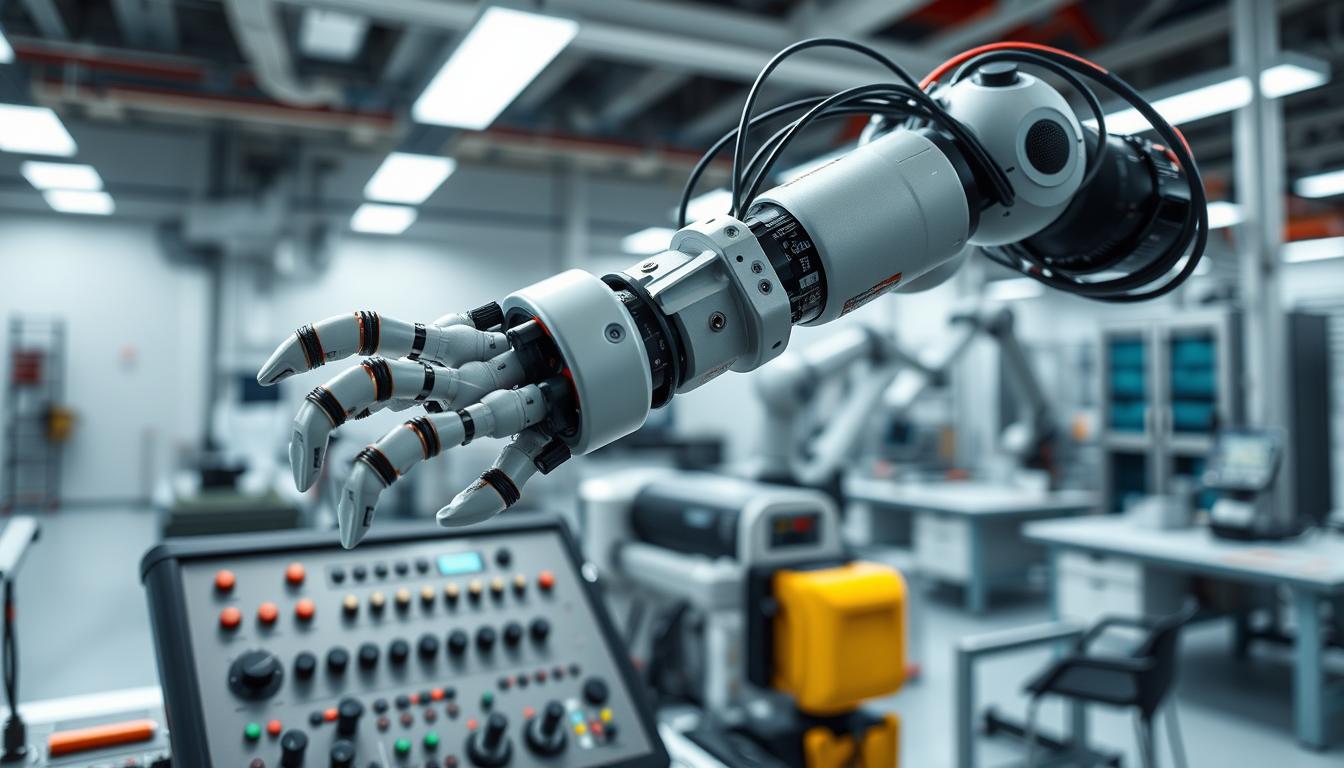
Controlling a robotic arm needs a deep understanding of its parts and how it moves. Knowing how to program and control a robot arm is key in many fields, like manufacturing and robotics.
To get a robot arm moving, you first need to know its basic parts. These include motors, actuators, and sensors. Robotic arm control means programming these parts to work together smoothly. This allows for precise and efficient movement.
Learning the basics of robot arm programming and control opens up many possibilities in robotics and automation.
Understanding the Basics of Robot Arms
Knowing the basic parts of a robot arm is key to its use. A robot arm has several main parts that work together. They help the arm move and function properly.
The main parts include servo motors, potentiometers, and Arduino boards. Servo motors are very important. They control the arm’s movement. In our project, we use three servo motors for the ‘base’, ‘arm’, and ‘forearm’ movements.
Servo Motors and Their Role
Servo motors are vital for a robot arm’s operation. They control the arm’s joints, allowing for precise movement. Each servo motor is guided by a potentiometer to reach the right position.
Servo motors are popular in robot arms because of their precision and reliability. By adjusting the servo motors, we can control the arm’s movement. This lets it do different tasks.
In our setup, the three servos control the ‘base’, ‘arm’, and ‘forearm’ movements. Each potentiometer controls one servo motor. This allows for precise and coordinated movement of the robot arm.
It’s important to understand how these parts work together for robotic arm control. By combining servo motors with potentiometers and Arduino boards, we get a lot of control over the arm’s movements.
The Science Behind Movement
The movement of robot arms is based on kinematics and motion planning. Kinematics studies how objects move without looking at the forces behind it. For robot arms, it’s key to know how each part moves together.
Motion planning is also vital. It figures out the steps an arm needs to take for a task, like picking up something. Good motion planning needs to know the arm’s kinematics well and avoid obstacles for smooth movement.
Converting between measurement units is important for robot arm control. For example, changing radians into degrees is essential. Radians and degrees measure angles, but radians are simpler for programming.
A code snippet shows how to convert radians to degrees for a robot arm. This is key for precise movement. For instance, if an arm is set to move a certain angle in radians, changing it to degrees helps understand the movement better.
To convert radians to degrees, you multiply the angle in radians by 180/π. This is important in robotics. It lets programmers use the most convenient units for their work while controlling the arm’s movement.
In short, robot arm movement science is about kinematics and motion planning. Knowing how to convert units like radians to degrees helps developers make arms that do complex tasks well.
Programming Your Robot Arm
To make your robot arm come to life, you need to learn programming with Arduino. Arduino makes robot arm programming easy, helping you control servo motors well.
First, you must understand how Arduino works and how it controls servo motor movements. You’ll write code that tells the servo motors exactly what to do.
Writing Code for Servo Motor Control
For servo motor control, your code must be exact. You’ll set the angles or positions for the servo motors. Arduino’s library makes this easier.
You can use potentiometers to control the robot arm’s movement. They let you input the desired position, giving you precise control.
By using Arduino and servo motor control, you can make your robot arm do complex things. It takes patience and practice, but it’s worth it.
As you get better at programming, you can add more features. You might use sensors or make more complex movements.
Powering Your Robot Arm
The right power supply is key for your robot arm’s smooth operation. A robot arm’s performance depends on the quality and fit of its power supply.
It’s best to use an external 5V power supply for the servo motors. This is because they need more power than a USB or internal source can provide. An external power supply keeps your robot arm running well without overloading it or causing voltage drops.
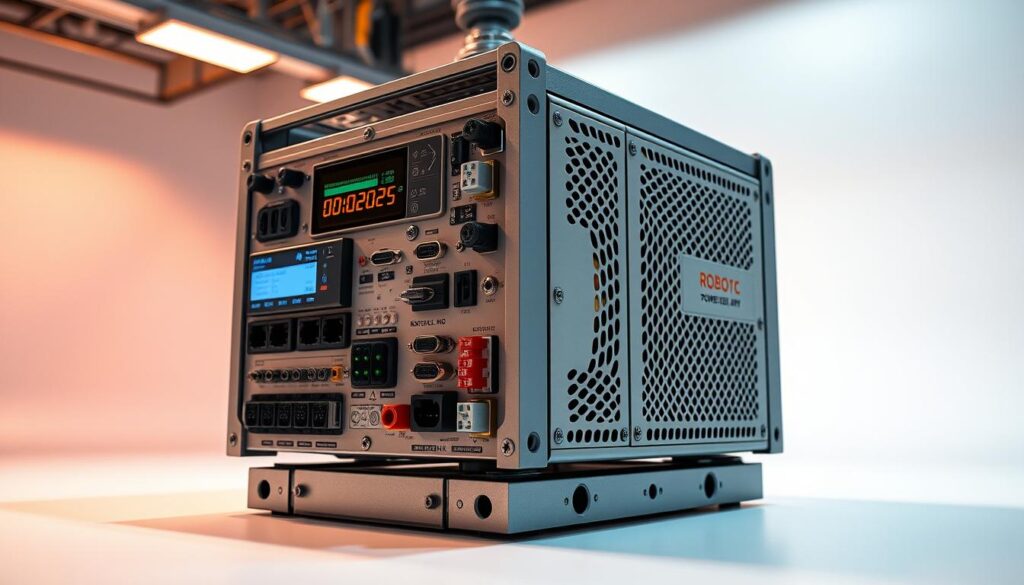
When picking a power supply, consider a few things. First, figure out how much power your robot arm needs. This includes all motors, sensors, and control systems. Choose a power supply that can handle this power need with extra for unexpected demands.
Experts say, “The power supply is the heart of any robotic system. Without a reliable power supply, even the most advanced robot arm can’t do its job.”
“A good power supply is like a solid foundation for a building; it’s vital for the stability and function of the whole thing.”
Key Considerations for Power Supply Selection
1. Voltage and Current Rating: Make sure the power supply’s voltage fits your robot arm’s needs. Also, check that the current rating can power all parts at once.
2. Stability and Regulation: A stable power supply with good voltage regulation is key for reliable electronics.
3. Efficiency: Think about the power supply’s efficiency. A more efficient supply makes less heat and lowers overheating risks.
By choosing the right power supply, your robot arm will work well and do its tasks with precision.
Control Systems for Robot Arms
Control systems are key for robot arms, making them move precisely and efficiently. They are vital for how a robot arm acts, ensuring it does tasks well and reliably.
A major part of these systems is the feedback mechanism. It lets the robot arm adjust its moves based on current data. Feedback control is key for precise robotic actions.
Using Potentiometers for Feedback Control
Potentiometers are common in robot arms for feedback control. They measure the joints’ positions and send this info back to the system. This feedback loop helps the robot arm move smoothly and accurately.
Potentiometers are important in feedback systems because they are reliable and affordable. They help track the robot arm’s position and movement. This makes robotic movements more precise.
Adding potentiometers to a robot arm boosts its ability to do complex tasks. The feedback they give is vital for fine-tuning the robot’s movements. This lets it do tasks more accurately and reliably.
By using good control systems, developers can make robot arms work better. This makes robotic tasks more efficient and opens up new uses in many industries.
Making Your Robot Arm Precise
Precision is what makes a robot arm special. It’s not just about moving parts. It’s about doing it accurately. This requires calibration and adjusting servo motor settings.
Calibration means setting up your robot arm for accurate movements. It’s key for precise actions. You need to set its starting position, adjust its range, and fine-tune its actions.
Adjusting Servo Motor Settings
Servo motors are vital for a robot arm’s movement. By adjusting servo motor settings, you can improve precision. You can tweak the motor’s speed, acceleration, and deceleration.
Understanding how these settings affect the arm’s movement is important. Too fast, and it might overshoot. Too slow, and it could be delayed.
By calibrating and adjusting your robot arm’s settings, you can do complex tasks with precision. This boosts its performance and opens up more uses.
Tips for Achieving Precision include keeping your robot arm in good shape. Use top-notch servo motors. Also, practice and fine-tune its movements through trial and error.
Integrating Sensors for Better Functionality
Robot arms get more precise with sensors for feedback control. These sensors are key for better accuracy and reliability.
Sensors help robot arms know their position, speed, and how fast they’re changing. This info is key for making adjustments and keeping the arm on track.
Using Sensors for Feedback Control
Feedback control uses sensor data to tweak the robot arm’s performance. Sensors keep an eye on the arm’s status, helping the control system fine-tune its actions. This boosts the arm’s overall function.
There are many sensors like position sensors, force sensors, and vision sensors. Each gives different info for controlling the arm’s actions.
Sensors in robot arms do more than just control feedback. They also spot obstacles, handle environment interactions, and ensure safety.
With good sensor integration, developers can make robot arms better and more flexible. They’re now good for many tasks, from making things to helping in healthcare.
Building a Simple Robot Arm
Building a robot arm from scratch is a fun DIY project. It can help you learn more about robotics and mechanics.
To start building a robot arm, you’ll need some robot arm materials. You’ll need a microcontroller, motors (servos), a power source, and parts like aluminum or acrylic. The materials you choose will affect how well the arm works and how long it lasts.
Step-by-Step Assembly
The assembly process has several important steps. First, get your parts ready according to your design. You might need to cut or drill them to fit together.
Then, build the base and attach the motors. It’s important to make sure these parts are well-attached for stability and precision. Next, connect the motors to the microcontroller. Make sure to wire them up correctly, following the manufacturer’s instructions.
Once the mechanical parts are together, it’s time to program the robot arm. You’ll write code to control the servos and make the arm move as you want.
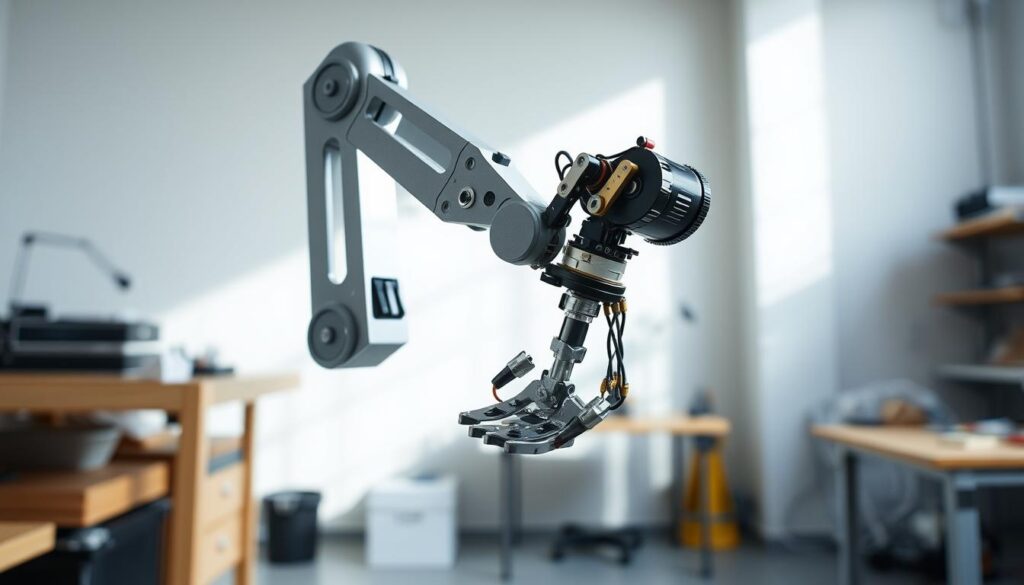
While you’re assembling, keep looking at your design plans and make changes if needed. Testing each part as you go can help find and fix problems early.
By following these steps and using the right robot arm materials, you can make a robot arm that works well. It’s great for learning or for fun projects.
Advanced Features to Consider
Exploring the capabilities of robot arms, we find advanced features that boost their use.
Programmable movements are a key feature. This lets the robot arm do complex tasks with great precision. By setting the arm’s path, you get exact results in tasks like assembly and welding.
Additional sensors are another big plus. They give feedback in real-time, helping the arm adjust its actions. This makes the arm better at working with its surroundings and doing tasks that need a lot of precision.
For example, vision sensors help the arm see and handle objects more accurately. Experts say, “Adding sensors and AI makes robot arms more flexible and effective.”
“The future of robotics is about using advanced sensors and AI. This lets robots learn and change on their own.”
Features like programmable movements and additional sensors really improve robot arms. They open up new ways to use automation and robotics in many fields.
Real-World Applications of Robot Arms
Robot arms are changing the world with their precision and flexibility. They are making industries better and improving lives.
In industrial automation, robot arms are key. They make manufacturing faster and cheaper. They help in many fields like cars, electronics, and food.

In the car world, robot arms weld, paint, and assemble. They work fast and accurately. This means better quality and safer workplaces.
Robotic Assistive Technology
Robot arms are also changing lives in assistive technology. They help people with disabilities live more independently.
In rehab centers, they help patients get their motor skills back. They also help with daily tasks like cooking and cleaning. This makes life easier for those with disabilities.
“The integration of robotic assistive technology has the power to change how we help people with disabilities. It gives them more freedom and confidence.”
The field of robot arms in assistive tech is growing fast. New AI and machine learning tech make robots smarter and easier to use.
In short, robot arm applications cover a wide range, from making cars to helping people with disabilities. As tech gets better, we’ll see even more cool uses for robot arms.
The Future of Robot Arms
The future of robot arms looks bright, with new trends and tech making them better. Advances in artificial intelligence, machine learning, and the Internet of Things (IoT) will shape their development.
Robot arms will soon be more advanced, flexible, and able to work on their own. They’ll do complex tasks with better precision and speed. This will make industries more productive and efficient.
New trends like collaborative robots (cobots) and advanced sensors are already changing industries. They’re being used in manufacturing, healthcare, and logistics. These changes will lead to more innovation and new ways to use robot arms.
As new tech is added, robot arms will have even more uses. This will open up new chances for businesses and industries to use them.