
Ever wondered why things fall down when dropped? It’s because of a key force in our universe: the force of attraction between masses.
The force of gravity keeps planets orbiting their stars and makes objects fall. Simply put, gravity is the pull a planet or body has on objects towards its center.
This universal force is key to understanding many things in our lives. From an apple falling to satellites orbiting Earth, it’s all about mass and gravity.
Understanding Gravity: The Basics
Gravity is an invisible force that pulls everything with mass towards each other. Gravity is a universal force that affects everything, from tiny particles to huge galaxies. Anything with mass has gravity, and more massive objects have stronger gravity.
The idea of universal gravitation was first explained by Sir Isaac Newton in the 17th century. Newton’s law of universal gravitation showed how every mass attracts every other mass. The force depends on the masses and the distance between them.
The history of gravity is filled with discoveries by many scientists. From Newton to Albert Einstein, our understanding has grown. Einstein’s theory of general relativity changed how we see gravity, as the bending of spacetime by mass and energy.
Knowing about gravity is key for many scientific and practical uses. It helps us predict planet orbits and understand black holes. Scientists keep studying gravity to improve our knowledge of this essential force.
The Laws of Motion
The laws of motion, as described by Newton and later by Einstein, are key to understanding gravity. Newton’s Law of Universal Gravitation says that every point mass pulls every other point mass towards it. This force acts along the line that connects both points.
This idea explains why things fall down and why planets go around stars. The force of gravity depends on the masses of the objects and how far apart they are. This idea changed how we see the world, linking the earth and the sky together.
Later, Einstein’s Theory of Relativity changed how we see gravity. Einstein said gravity isn’t a force between objects, but a result of spacetime’s shape. Mass and energy warp spacetime, which affects how objects move.
Einstein’s work built on Newton’s, giving a deeper look at gravity. It’s important for understanding the universe, from light bending around big objects to the universe’s expansion. Einstein’s theory has deeply influenced our view of the cosmos.
The mix of Newton’s laws and Einstein’s theory has greatly shaped our understanding of the universe. Newton’s laws work well for many things, but Einstein’s theory is more accurate for the big picture and high-energy events.
How Gravity Affects Everyday Life
Gravity shapes our daily routines and experiences. It’s not just about objects falling towards the ground. It affects many parts of our lives, from simple actions to complex activities.
Gravity directly affects our weight. It pulls us towards the Earth’s center, giving us our weight. As an anonymous physicist said, “Gravity is the glue that holds our universe together,” showing its key role in our lives.
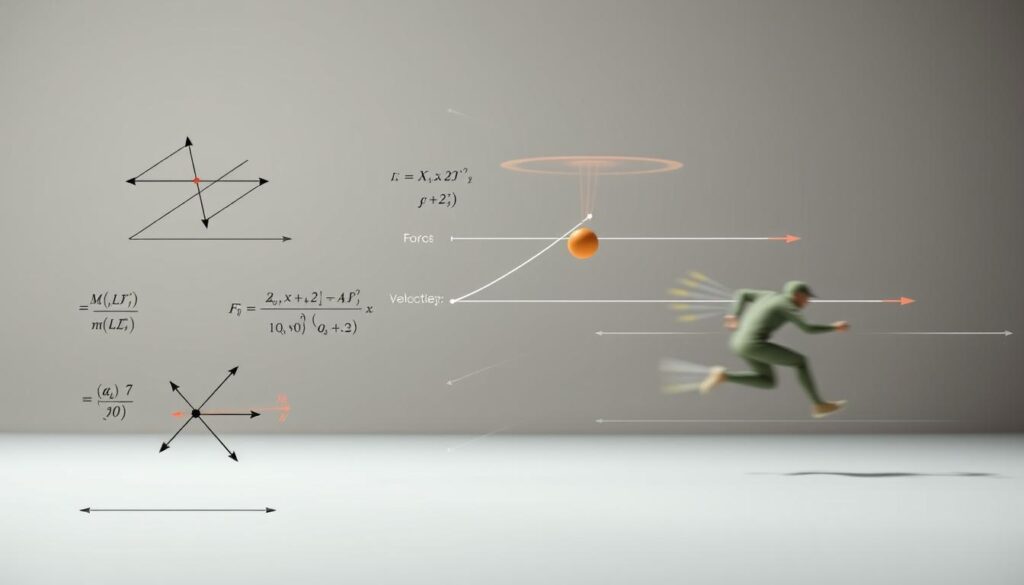
In sports, gravity is very important. It influences the path of a ball, an athlete’s jump height, and sports equipment design. For example, Earth’s gravity affects how high a basketball player jumps or how far a golfer hits a ball. Athletes must understand and adapt to gravity to perform better.
“The gravity of the situation wasn’t lost on the athletes as they prepared for the jump competition, where every fraction of a second counted due to the Earth’s gravitational pull.”
Gravity also impacts other everyday activities. Building and bridge designs consider gravity’s forces. Engineers must make sure these structures can handle gravity to stay safe and stable.
The everyday effects of gravity are wide-ranging and constant. Gravity influences everything from water flowing downhill to the operation of machinery that relies on it. It’s always there, affecting our daily lives.
The Role of Mass and Distance
The strength of gravitational force depends on the mass of objects and the distance between them. This principle explains why planets orbit stars and why things on Earth are pulled towards its center.
Mass and Gravity: The more massive an object is, the stronger its gravitational pull. Earth, being more massive than the Moon, has a stronger pull. This keeps us and objects on its surface firmly in place. The relationship is simple: more mass means stronger gravity.
Distance and Gravitational Force: But, the gravitational force weakens as objects get farther apart. This is seen in how Earth’s pull on an object lessens as it moves away. This effect is even more noticeable over long distances, like between stars.
The way mass and distance affect gravity is key to understanding the universe. Gravity’s influence is everywhere, from objects falling on Earth to planets and stars orbiting. By understanding how mass and distance impact gravity, we learn about the universe’s workings.
In summary, gravity’s effect on objects depends on their mass and the distance between them. This principle is essential for understanding many phenomena in the universe. It applies from the smallest scales on Earth to the vastness of interstellar space.
Gravity on Earth
Gravity on Earth comes from the planet’s mass. It pulls objects towards its center. This is because of all the mass in the Earth.
The gravitational pull gives objects weight. It keeps us on the ground and makes things fall. The strength of this pull depends on the mass and distance between objects.
Scientists use gravimeters to measure gravity. These devices are very sensitive. They can detect small changes in gravity.
Knowing about Earth’s gravity helps us understand many things. It affects tides, the atmosphere, and geological features. Studying gravity helps scientists learn about the Earth’s inside.
Research on Earth’s gravity is always growing. New findings help us understand this key force better. As we learn more, we get to know our planet and its role in the universe.
Gravity and the Universe
Gravity’s reach goes far beyond Earth, shaping the universe deeply. It keeps planets orbiting their stars and controls galaxy motion.
Gravitational forces shape the universe on a huge scale. Without gravity, the universe we know would not exist. Stars, planets, and galaxies would wander aimlessly.
Black holes show gravity’s incredible power. These areas are so dense that nothing, not even light, can escape once too close.
Gravity is key in how celestial bodies form and act. The pull between planets and moons can cause tidal heating, volcanic activity, and stabilize axes.
In space, gravity keeps everything in order. It’s the unseen force that connects the universe, from asteroids to galaxy clusters.
Understanding gravity in space and its effects is vital. By studying gravity and black holes, scientists learn about the universe’s laws.
The Effects of Gravity on Objects
Gravity pulls on objects everywhere, shaping our world. When objects fall, they speed up towards the ground because of gravity.
Physics teaches us that falling objects get faster until air resistance slows them down. Air resistance is key in changing the object’s speed.
When gravity’s pull equals air resistance’s push, the object hits terminal velocity. At this point, its speed stops growing. Terminal velocity shows how gravity and other forces work together on falling objects.
Knowing about free fall and terminal velocity is important in many areas. For example, skydivers use it to control their fall and land safely.
Studying gravity’s effects helps us understand the physical world better. It also leads to practical uses like safer equipment and better weather forecasts. By learning about these concepts, we see how gravity and other forces impact our lives.
Gravity in the Solar System
Gravity is key in the solar system, shaping the orbits of planets and other bodies. The Sun, being the massive center, pulls planets into their paths. This keeps them in orbit.
The Sun’s gravitational pull holds the solar system together. Without it, planets would wander off into space. The Sun’s gravity affects all objects in the solar system, from Mercury to Neptune.
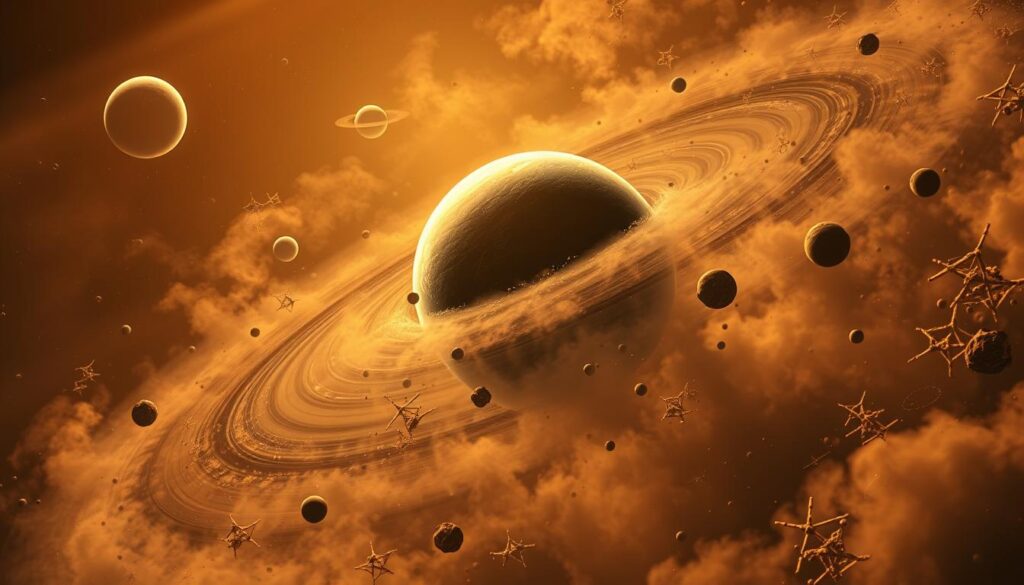
Planets orbit due to a balance between their speed and the Sun’s gravitational force. This balance keeps them moving in elliptical paths. The gravity between planets also plays a role, but the Sun’s is much stronger.
Understanding gravity in the solar system shows us the complex dynamics at work. It not only keeps planets orbiting but also guides comets, asteroids, and other objects.
Gravity in Different Environments
The gravitational force varies across the universe. In space, astronauts face microgravity. This is much weaker than Earth’s gravity.
Microgravity impacts astronauts’ bodies in many ways. It can cause muscle loss and vision problems. This is why scientists study it for long space trips.
Gravity changes on other planets because of their mass and size. Mars’ gravity is one-third of Earth’s. Jupiter’s is much stronger. Knowing gravity on other planets is key for space travel and settlements.
Studying different gravitational environments helps us understand the universe. It also helps with space travel and finding life elsewhere.
As we explore space, knowing about gravity is vital. It’s essential for our mission success.
Myths About Gravity
Gravity is more than what we see, and it’s time to clear up some common myths. This universal force is often misunderstood. It’s a key part of our world.
Many think gravity is the same everywhere on Earth. But, gravity actually changes slightly based on where you are. This is because of the Earth’s shape and the presence of mountains and valleys. For example, gravity is weaker at the top of a high mountain than at sea level.
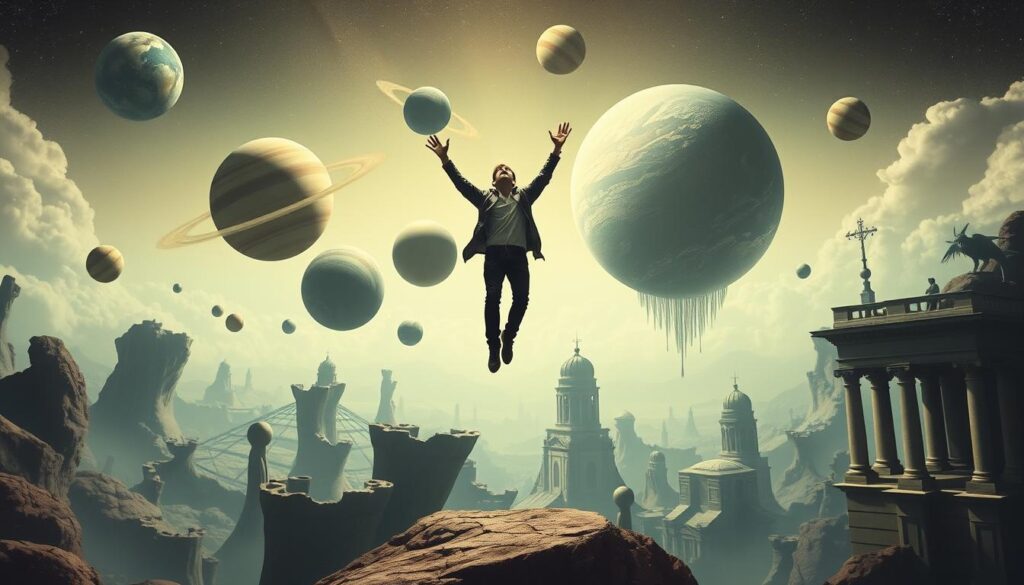
Some believe gravity doesn’t work in space or during free fall. But, gravity is always there, even in space. Astronauts in orbit around Earth are in a state of continuous free fall. They never get closer to the ground because of their forward speed.
Debunking Common Misconceptions
Some think gravity doesn’t matter in small situations or in microgravity. But, gravity pulls on everything with mass, no matter how tiny. Even in places like the International Space Station, gravity is present. The station and its people are always falling around Earth.
Scientists are always trying to understand gravity better. They work to correct these myths. By studying gravity, we learn more about the universe and the laws of physics.
Knowing the truth about gravity helps us see the world in a new light. By debunking myths about gravity, we get a clearer view of this fundamental force. It shows us the beauty and complexity of nature.
Future of Gravity Research
Scientists are on the verge of major breakthroughs that could change how we see gravity. The future of gravity research looks bright. Many current studies are working to uncover gravity’s secrets.
Gravitational waves are a big focus in research today. These waves, predicted by Einstein, show us new ways to understand the universe. Experiments like LIGO are helping us learn more about gravity’s role in the cosmos.
The discoveries in gravity research could be huge. For example, understanding gravity better could help us learn more about dark matter and dark energy. These make up a big part of the universe. Also, studying gravity at the quantum level could merge quantum mechanics and general relativity, a big goal in physics.
New technologies might come from our growing knowledge of gravity. This could lead to new ways to explore space or even control gravity for different uses.
In summary, the future of gravity research is full of hope. With more work on current studies and exploring discoveries, we’re set to make big leaps in understanding gravity and its place in the universe.
Fun Facts About Gravity
Gravity is a fascinating force that affects everything on Earth and in the universe. There are many fun facts about gravity that show its importance and how it impacts our lives.
Gravity plays a key role in shaping the universe. The heaviest objects, like black holes and neutron stars, are controlled by gravity. These massive objects bend spacetime, influencing the motion of nearby stars and galaxies.
Gravity also affects everyday objects in subtle but significant ways. For example, it makes objects fall towards the ground when dropped. Learning about gravity and its effects helps us understand the complex mechanisms of our daily lives.
Exploring fun facts about gravity is a journey into the complex nature of this fundamental force. By learning more about gravity, we can appreciate the world around us more deeply.