

Ever wondered why some things float on water and others sink? It’s all about density and buoyancy. Knowing these ideas is key in many areas, like engineering and our daily lives.
Density is how much mass is in a certain volume. It’s shown as D = m/v, where D is density, m is mass, and v is volume. This property decides if something floats or sinks in a liquid.
Buoyancy tells us why things float or sink. It’s the force a liquid pushes up on an object. If this force is stronger than the object’s weight, it floats. If not, it sinks.
Understanding Buoyancy: The Basics
Buoyancy is the upward force a fluid gives to an object in it. It’s why things float or sink. Buoyancy helps us understand many natural and man-made things.
“Buoyancy is the upward force a fluid gives to an object less dense than itself; the ability to float.” This idea ties closely to Archimedes’ Principle. It says an object in a fluid is pushed up by a force equal to the fluid’s weight it displaces. Knowing these ideas helps us see how buoyancy works.
The buoyant force comes from the pressure difference on an object in a fluid. The denser the fluid, the stronger the buoyant force. For example, things float better in seawater than in freshwater because seawater is denser.
Take a ship in the ocean as an example. The ship pushes water aside equal to its own weight. If the ship’s weight is less than or equal to the water’s, it floats. This shows Archimedes’ Principle in action.
In summary, knowing buoyancy and Archimedes’ Principle is key to understanding why things float or sink. These ideas are important in engineering, physics, and our daily lives.
The Role of Density in Buoyancy
The density of an object compared to the fluid around it determines if it will float or sink. This basic idea is key to understanding buoyancy.
Density is the mass of a substance per unit volume. It’s measured in kilograms per cubic meter (kg/m³) in the metric system. When an object is in a fluid, it feels an upward force. This force is equal to the weight of the fluid it displaces.
Comparing Densities of Different Substances
Substances have different densities. For instance, water’s density is about 1,000 kg/m³, and iron’s is around 7,900 kg/m³. This big difference is why iron sinks in water.
“An object that has a higher density than the liquid it’s in will sink. An object that has a lower density than the liquid it’s in will float.”
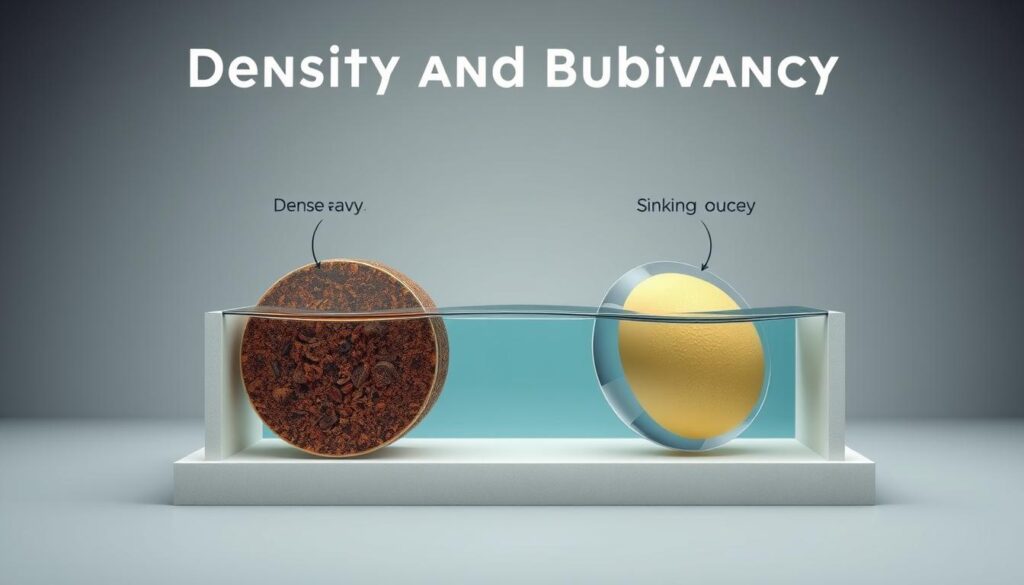
Knowing the densities of different substances is vital for understanding buoyancy. This knowledge is useful in engineering, physics, and daily life.
Archimedes’ Principle Explained
Understanding buoyancy starts with Archimedes’ Principle. It shows how the buoyancy force on an object relates to the fluid it displaces. This principle explains why some objects float and others sink.
Archimedes’ Principle says that any object in a fluid is lifted by a force equal to the fluid’s weight it displaces. This principle is key to understanding how objects behave in different fluids, like water or air.
Let’s look at a ship on the ocean. The ship pushes water aside equal to its own weight. If the ship’s weight is less than or equal to the water’s, it floats. This is because the buoyant force pushing it up is equal to the water’s weight.
On the other hand, objects that sink do so because they are denser than the fluid. For example, a stone thrown into water displaces water equal to its volume. But if the stone is heavier than water, it sinks because its weight is more than the water’s.
The implications of Archimedes’ Principle are vast. It affects the design of ships and submarines. It also helps us understand natural phenomena, like icebergs floating.
In short, Archimedes’ Principle is a basic idea in physics that explains buoyancy. By understanding it, we can see how objects and fluids interact.
Factors Influencing Floatation
The floatation of an object is determined by a combination of its physical properties.
One of the primary factors is density. The density of an object relative to the liquid it is placed in determines whether it will float or sink.
The shape and size of an object also play a big role. As noted by a second source, “the volume of the object, which can often be altered by changing the shape, will affect the size of the upward push on the object.”
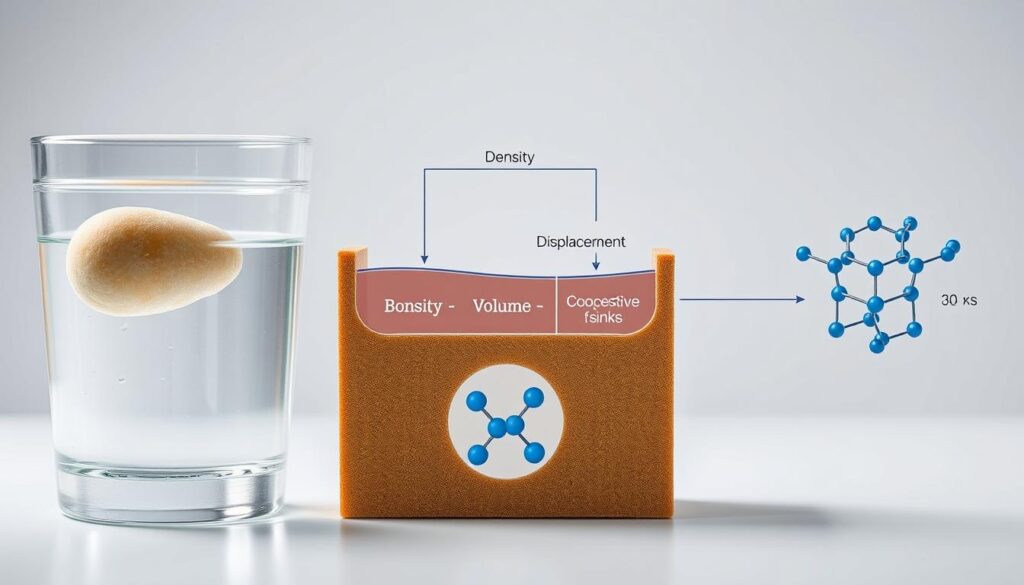
The material of an object is another significant factor. Different materials have different densities, which affect the object’s ability to float.
Understanding these factors is essential for predicting how objects will behave in various liquids.
Examples of Buoyant Objects
Beach balls and wax candles are just a few examples of objects that float. This happens because of buoyancy. Buoyancy is the force that lets objects float or rise in a liquid.
A beach ball floats because it’s less dense than water. The same goes for a wax candle. They float because they weigh less than the water they displace.
Life jackets and certain woods also float. Life jackets help people stay afloat. Woods like cedar and redwood are naturally less dense, so they float too.
The reason behind this is Archimedes’ Principle. It says the buoyancy force is equal to the fluid’s weight displaced. This is why less dense objects float in denser fluids.
Knowing about buoyancy and buoyant objects is fascinating. It’s also useful in engineering, marine biology, and activities like swimming and boating.
Why Some Objects Sink
Objects sink because of their density compared to the liquid around them. When an object is in a liquid, it feels an upward force called buoyancy. This force is equal to the weight of the liquid it pushes aside. If the object is denser than the liquid, it will go down.
Density is key here. As the first source says, “an object with a higher density than the liquid it’s in will sink.” This rule shows why some objects, no matter their shape or size, sink in water or other liquids. For example, a stone sinks in water because it’s denser than water.
The weight of an object is also important. Weight is the force of gravity on it. If an object’s weight is more than the buoyant force from the liquid, it sinks. That’s why heavy objects like metal sink in water.

To sum up, objects sink based on their density and weight compared to the liquid. Knowing this helps predict if something will sink or float in a liquid.
Buoyant Forces in Different Liquids
Different liquids exert different buoyant forces on objects. This is key to understanding many natural and industrial processes.
Archimedes found that “the buoyant force on an object is equal to the weight of the fluid that is displaced by the object.” So, the liquid’s density is very important in how much buoyant force an object gets.
An object will feel more buoyant in denser liquids than in less dense ones. For example, something in seawater feels more buoyant than in freshwater. This is because seawater is denser because of its salt.
“Any object, wholly or partially immersed in a fluid, is buoyed up by a force equal to the weight of the fluid displaced by the object.”
In conclusion, the buoyant force an object feels changes with the liquid. It depends on the liquid’s density. Denser liquids push harder. Knowing this helps in many areas, like making ships and understanding nature.
Applications of Buoyancy in Everyday Life
Everyday life is full of buoyancy examples, showing its key role. Ships sail on oceans, and submarines dive deep, all thanks to buoyancy.
Ship and boat design is a big application of buoyancy. Engineers use buoyancy to make vessels efficient and safe. They design hulls to maximize buoyant force, so ships can carry heavy loads.
Submarines also rely on buoyancy. They can dive, stay underwater, or come up by controlling their buoyancy. This is done with ballast tanks that can hold water or air.
Offshore platforms and floating bridges also use buoyancy. They stay afloat and support their weight, showing buoyancy‘s wide use in everyday life.
In summary, buoyancy is more than a scientific idea. It has many practical applications that shape our daily lives. By understanding and using buoyancy, we can design and operate various structures and vehicles. This helps us explore and use our aquatic environments better.
Measuring Buoyancy
The buoyancy of objects in fluids is key to understanding their behavior. Buoyancy is the force from pressure differences between an object’s top and bottom when submerged.
There are many methods to measure buoyancy. Each method is suited for different situations. One way is to weigh an object in air and then underwater. The weight difference shows the buoyant force.
Archimedes’ Principle helps calculate the buoyant force. It says the force is the weight of the fluid displaced. The formula is \(F_b = \rho V g\), where \(F_b\) is the force, \(\rho\) is fluid density, \(V\) is volume displaced, and \(g\) is gravity.
A source notes, “density shows how heavy something is compared to its size.” Knowing this is key when using Archimedes’ Principle. The fluid’s density greatly affects the buoyant force on an object.
Measuring buoyancy has many uses. It’s important in designing ships and submarines and studying nature. It’s a big deal in engineering and physics.
By using these methods and principles, we can find the buoyant force on an object. This is important for many scientific and engineering projects.
The Impact of Pressure on Buoyancy
The link between pressure and buoyancy is key to understanding fluid dynamics. The buoyant force on an object depends on the fluid’s weight it displaces. This weight is tied to the fluid’s pressure.
When an object goes deeper into a fluid, the pressure it feels goes up. This is because more fluid weight presses down. Yet, the buoyant force stays the same if the fluid’s volume displaced doesn’t change. This is because the buoyant force depends on the fluid’s density and the displaced volume, not the object’s depth.
It’s important to remember that while pressure goes up with depth, buoyancy isn’t affected much. This is true unless the object can change shape under pressure. For most things, the volume change is small, so the buoyant force stays pretty steady.
Some say, “the upward push of the water on the object doesn’t change with depth.” This shows that buoyancy mainly depends on the fluid’s density and the object’s size. The pressure around it doesn’t play a big role.
Fun Buoyancy Experiments to Try
Exploring buoyancy can be a fun and interactive experience. Try making a Cartesian diver using a plastic bottle, water, and a dropper. Fill the bottle with water, and then squeeze it to observe how the dropper sinks or floats.
Another hands-on activity is to create a homemade lava lamp. Use vegetable oil, water, food coloring, and Alka-Seltzer tablets. This experiment shows density and buoyancy in a cool way.
These experiments encourage hands-on learning. They help you understand buoyancy better. By trying these activities at home, you can appreciate the principles that affect objects in different fluids.