
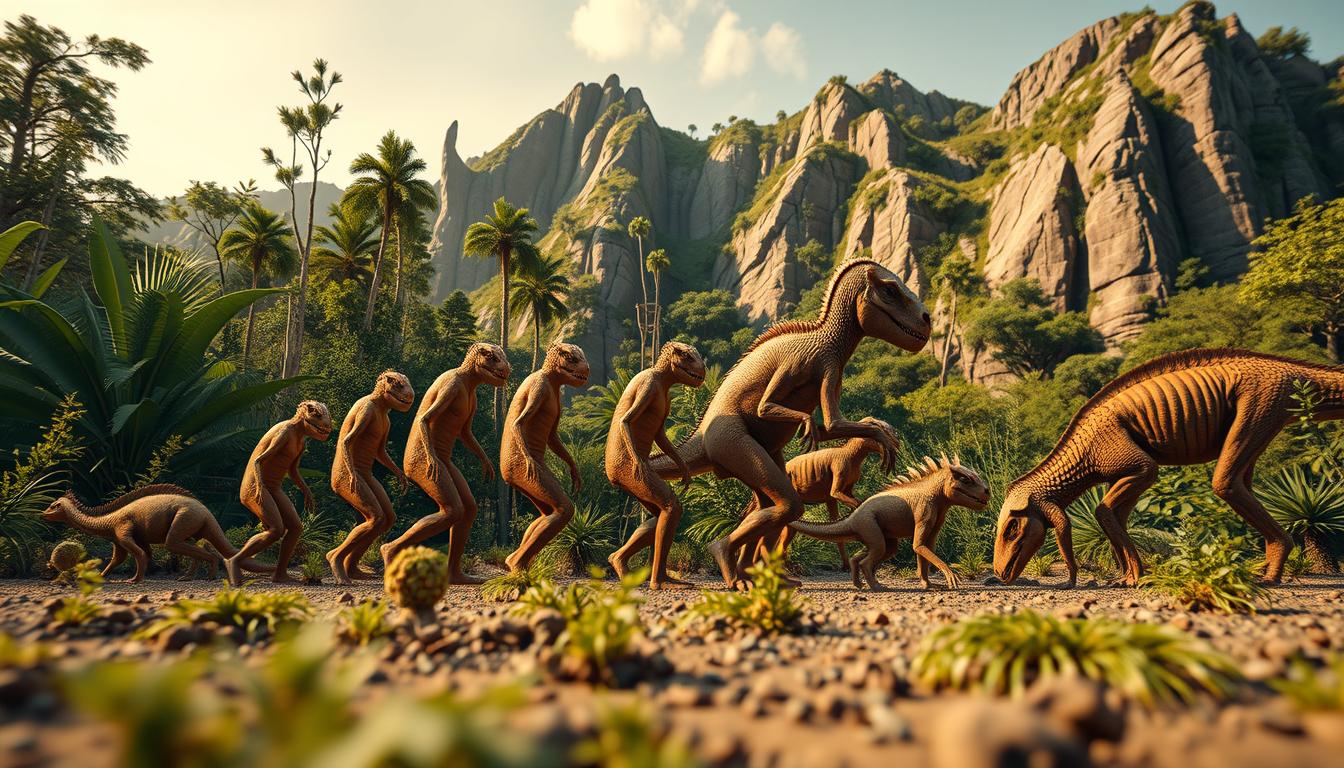
The story of animal evolution is both complex and captivating, spanning millions of years. It’s a tale of adaptation, transformation, and survival. These changes were shaped by the forces of natural selection.
Over time, animals have developed unique characteristics and traits. These have helped them thrive in different environments. This evolution has led to the wide variety of species we see today, each with its own special features.
By studying evolution, we can better understand the connections between animals and their environments. We also see the incredible diversity of life on Earth.
Understanding Evolution: A Quick Overview
Evolution happens through adaptation and natural selection. This key idea in biology shows how animals have evolved to fit their environments better.
Evolution is all about getting better over time. This means developing traits, behaviors, or changes that help an organism survive and have offspring.
Natural selection plays a big role in evolution. It picks the best traits in a group, helping those traits spread. This leads to big changes in species over time.
Evolution doesn’t stop at any level or time. It keeps going, from bacteria adapting to antibiotics to species changing over millions of years.
Getting evolution helps us understand life on Earth. It shows us how life has changed, the complexity of ecosystems, and how changes affect biodiversity.
The History of Life on Earth
The story of life on Earth is one of gradual complexity. It started with single-celled organisms and grew into diverse multicellular life. The earliest life forms, or microbes, left signs of their existence in rocks about 3.7 billion years ago.
These ancient microbes were the first to inhabit Earth. They thrived in environments much different from today’s. Over time, they evolved into more complex cells, leading to the variety of life we see today.
The Emergence of Multicellular Life
The shift from single-celled to multicellular life was a major milestone. It brought about greater complexity and diversity. This allowed life to adapt to more environments.
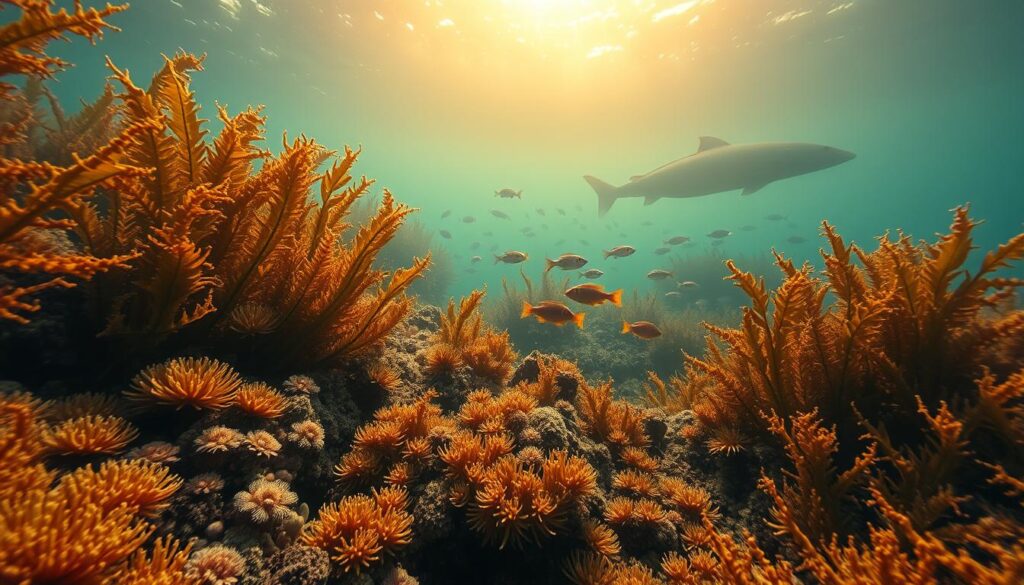
The rise of multicellular life led to complex ecosystems. Today, we see a wide range of flora and fauna. Understanding this transition helps us grasp the history of life on Earth.
By studying life’s evolution from simple microbes to complex organisms, we learn a lot. This knowledge deepens our appreciation of life’s history. It also helps us understand the relationships between life forms and their environments.
Types of Evolutionary Change
Evolutionary change happens in several ways, with adaptation and speciation being key. These processes shape how life on Earth changes over time.
Adaptation makes organisms fit better in their environment. It can happen through natural selection. Traits that help survival become more common in a population.
The peppered moth in England shows how adaptation works. Before the Industrial Revolution, these moths were light-colored. They blended in with lichen on tree bark.
But with more air pollution, trees got darker. A genetic change in the moth population made some dark-colored. These moths were better hidden on dark tree trunks.
Speciation: The Formation of New Species
Speciation is another important evolutionary change. It happens when a group of organisms can’t breed with others. This leads to a new species forming.
Geographical barriers or other factors can cause this. For example, the Galapagos finches evolved from one ancestor into different species. Each has a unique beak shape and size for different food sources.
In summary, evolutionary change is complex. It involves adaptation and speciation. Understanding these helps us see the amazing diversity of life on Earth.
How Environmental Changes Drive Evolution
Earth’s history shows how environmental changes shape species evolution. These changes put evolutionary pressure on animals, pushing them to adapt. This helps them survive and reproduce in new or changed environments.
The oxygenation of the atmosphere was a major change. It moved from no oxygen to lots of oxygen. This change helped more complex life forms evolve, as they could now use oxygen for breathing.

New habitats have also driven evolution. For instance, mountains forming can isolate populations. This leads to speciation as these groups adapt to their new homes.
Climate change is another big factor in evolution. As temperatures have changed, species have had to adapt to stay alive. This has led to many adaptations, like physical changes and new behaviors.
The ability to adapt to environmental changes shows evolution’s dynamic nature. As environments keep changing, understanding how environmental change drives evolution is key. It helps us predict the future of Earth’s biodiversity.
The Science of Speciation
Speciation is key to understanding how life on Earth has changed over millions of years. It happens when a group of organisms becomes a new species, separate from others. This is at the heart of evolutionary biology, showing us why we have so many different species today.
The ways speciation happens are complex. It often starts with a group being geographically or genetically cut off from others. Over time, these changes can lead to a new species that can’t breed with its old one.
There are different types of speciation, like allopatric, sympatric, and parapatric. Allopatric speciation happens when a species is split by geography. Sympatric speciation occurs without such barriers, often because of genetic or ecological differences. Knowing these types helps us understand the variety of life on Earth.
Significance of Speciation
Speciation is important because it shows how new species come to be. It also shows that species are not fixed but change over time. This change has shaped our planet’s biodiversity and keeps affecting ecosystems.
In summary, speciation is a key part of evolutionary biology. It helps us see how new species form and why life on Earth is so varied. By studying speciation, scientists learn more about our world and how living things interact with their environments.
Animal Adaptations: Survival of the Fittest
Animals have developed amazing adaptations to live in many different places. This includes the cold tundras and hot deserts.
The idea of survival of the fittest helps us understand how animals adapt. It means that animals with traits that fit their environment better are more likely to live and have babies. They pass these traits to their kids.
The polar bear is a great example of evolutionary advantage. Its white fur and thick fat help it hunt and survive in the Arctic. On the other hand, the camel can store water in its blood and handle high heat. This makes it perfect for the desert.
The penguin has a body made for swimming, thanks to its streamlined shape and flipper-like wings. The chameleon can change color, which is great for hiding. These examples show how amazing evolution can be.
These stories show how different animals have found unique ways to deal with their environments. They prove the strength of adaptation in helping animals survive. By looking at these adaptations, we learn more about how evolution works.
The Impact of Evolution on Biodiversity
The web of life on Earth is complex, thanks to evolution. Evolution has shaped the variety of life, affecting ecosystems worldwide.
Evolution has created complex ecosystems. Here, species interact and adapt to their surroundings in detailed ways. This biodiversity is key for ecosystem health and resilience.
Evolution leads to new species, changing ecosystem composition. This affects ecosystem functions like nutrient cycling and climate regulation. The evolutionary impact on biodiversity is vast, influencing both life variety and ecosystems.
Knowing evolution’s role in biodiversity is vital for conservation. It helps us see why preserving biodiversity and ecosystems is so important.
In summary, evolution deeply impacts biodiversity, making life on Earth diverse and complex. As we progress, studying and valuing the evolutionary impact on ecosystems is essential.
Human Evolution: A Special Case
Humans have had a unique journey in evolution. This journey was shaped by walking on two legs, growing bigger brains, and cultural advancements. These changes have helped us adapt to different environments and succeed.
The history of human evolution is filled with key moments. One was the development of bipedalism. This allowed early humans to walk upright. It freed their hands for tasks like tool use and carrying, improving their survival chances.
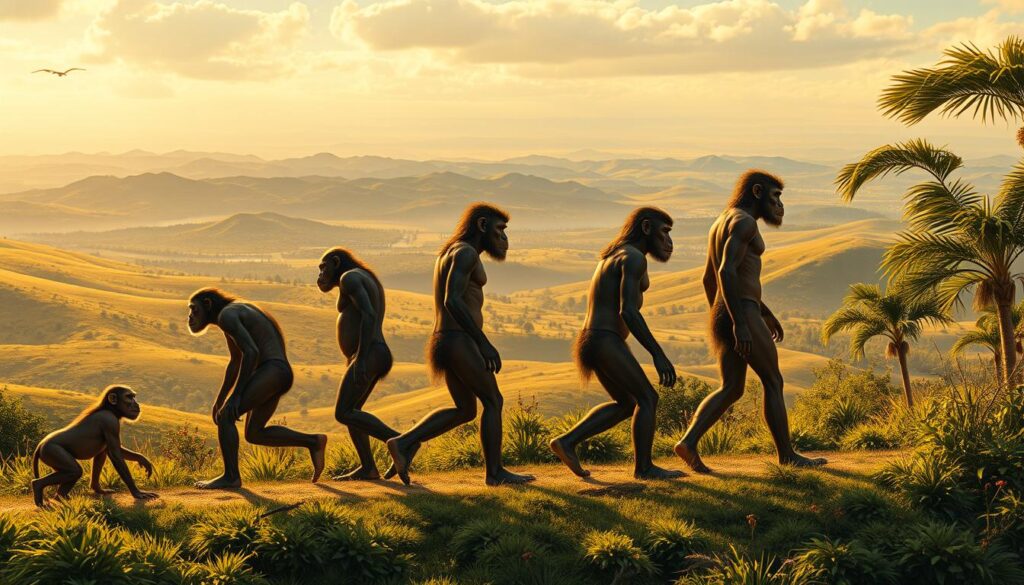
Brain growth has also been vital. Larger and more complex brains helped us solve problems, speak, and organize socially. These abilities have been essential for our survival and success.
Cultural innovation has greatly influenced human evolution. Our ability to create, learn, and share cultural practices and technologies has helped us adapt without major biological changes. This has been key in the spread and diversification of human populations worldwide.
The study of human evolution combines anthropology, genetics, and paleontology. By studying fossils, genetic data, and cultural artifacts, researchers can piece together our evolutionary history. This helps us understand what has shaped our species.
In conclusion, human evolution is a complex and ongoing journey. It has been shaped by both biological and cultural factors. By understanding this history, we gain insights into our present and future.
The Role of Scientists in Understanding Evolution
Evolutionary biology owes a lot to scientists. They’ve found fossils and created new research methods. These efforts have greatly helped us understand evolution.
The path to understanding evolution has been long and hard. Scientists have been key in solving its mysteries. They’ve done detailed research and experiments. This has revealed how life on Earth has changed over millions of years.
Scientists have made big strides in evolutionary biology. They’ve figured out how natural selection and genetic drift work. These discoveries have made us understand evolution better and shown us the variety of life on Earth.
Also, research in evolutionary biology has led to new theories. These theories explain how different species evolved. They’ve helped us build the tree of life, showing how all living things are connected.
The work of scientists in evolutionary biology is essential today. They’re studying how the environment affects evolution and the future of biodiversity. Their research helps us protect species and predict how they’ll adapt to new environments.
In summary, scientists have played a huge role in understanding evolution. Their research in evolutionary biology has greatly expanded our knowledge. They’ve helped us see the world in a new light.
Evolutionary Myths Debunked
Evolutionary biology is often filled with misconceptions that go against scientific facts. Despite the evidence supporting evolution, many myths have stuck around for a long time.
One myth is that evolution is just a theory, suggesting it’s not certain. But in science, a theory is a solid explanation for observed phenomena. Evolution is backed by a lot of evidence from genetics, paleontology, and comparative anatomy.
Another myth is that humans came from monkeys. But humans and monkeys share a common ancestor. Evolution is about gradual changes over generations, not a direct link from one species to another.
Some think evolution is random. While genetic mutations are random, evolution itself is not. Natural selection, a key part of evolution, chooses traits that help survive in the environment, guiding evolutionary changes.
The idea that evolution is only about survival of the fittest is too simple. While it’s part of it, evolution includes other mechanisms like genetic drift and gene flow. These help explain the variety of life on Earth.
By clearing up these myths, we can better understand evolution. It helps us see the natural world in a new light.
The Future of Evolution
Looking into the future of evolution means studying how species and their environments interact. As environmental change keeps happening, it will change the evolutionary trajectory of many species. This will shape the variety of life on our planet.
The future of evolution is not just about changes. It’s also about how these changes affect different species. Some might adapt fast, while others could struggle to survive.
Evolutionary biologists say, “The rate of environmental change will be a key factor in many species’ survival.”
“The speed and magnitude of human-induced changes are likely to outpace the ability of many species to adapt.”
This shows why we must think about how human actions affect nature and evolution.
The evolutionary trajectory of species will be shaped by many things. These include climate change, habitat loss, and invasive species. Knowing these factors and their effects on evolution is key to predicting the future of evolution.
In summary, the future of evolution is linked to environmental changes. By studying these changes and their effects, scientists can understand how life on Earth will evolve.
Resources for Learning About Evolution
If you’re eager to learn more about evolution, you’re in luck. There’s a lot of information out there. You can find scientific articles and educational websites to explore.
Places like the National Center for Biotechnology Information (NCBI) and the Smithsonian Institution have a lot to offer. They provide detailed information on evolutionary biology. You can also find research opportunities in journals like Evolution and the Journal of Evolutionary Biology.
By checking out these resources, you can learn even more about evolution. This will help you understand its importance in the natural world. It will also build on what you’ve learned so far.