
Understanding how motion changes is key to physics basics. At the core are Newton’s laws. They help predict how objects move under different conditions.
The idea of force is very important. It’s what makes an object change its motion. Newton’s laws say a force is needed to change an object’s speed, slow it down, or change its direction.
This article will dive into how forces impact motion. We’ll look at the key principles that shape our physical world.
Understanding the Concept of Force
To understand motion, knowing about force and its types is key. Forces are pushes or pulls that can change an object’s motion. They vary in strength and direction, affecting objects differently.
There are many types of forces, like friction and gravity. Each has its own role in how objects move or stay put. Friction opposes motion between surfaces in contact. Gravity pulls objects towards each other.
Measuring force is important to see its impact. Forces are measured in newtons (N). The size and direction of a force show how it affects an object’s motion.
Knowing about force helps us analyze and predict object motion. By understanding how forces work together, we grasp the physical world’s complex dynamics.
The Relationship Between Force and Motion
Force and motion are key in physics, as Newton’s laws show. Newton’s first law of motion says an object stays the same unless a force changes it. This law is tied to inertia, or how hard it is to change an object’s motion.
Inertia depends on an object’s mass. A heavy truck, for example, is harder to stop than a light bicycle. This shows how Newton’s first law works for different objects, showing how forces affect motion.
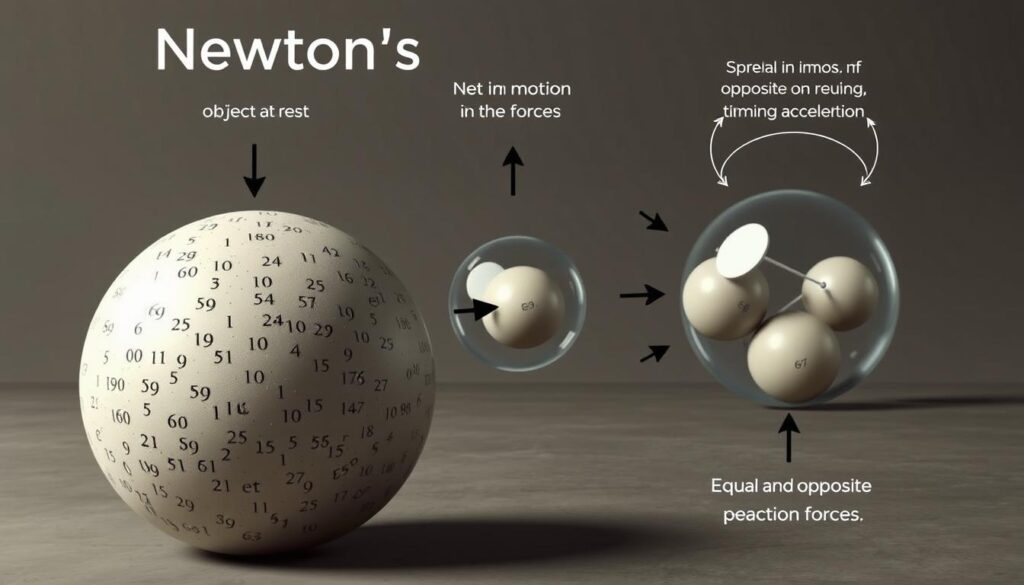
Let’s say you’re playing ice hockey. The puck keeps moving unless something like friction stops it. This shows Newton’s first law in action, where the puck’s motion changes only with a force.
In summary, Newton’s laws explain how force and motion are connected. Newton’s first law talks about inertia and how it keeps an object moving unless a force stops it. Knowing this is key to understanding how objects move under different forces.
How Forces Affect Speed and Direction
Forces are what make an object’s speed and direction change. When a force is applied, it can make an object speed up, slow down, or turn.
The idea of acceleration is key here. Acceleration is how fast an object’s speed or direction changes. For example, pressing the car’s accelerator makes it go faster because of the engine’s force.
Changing direction also comes from a force. Think of a tennis ball hit by a racket; the racket’s force changes the ball’s path. Or, when you turn a bike, the force on the handlebars makes it turn.
The link between force and direction change is vital. For instance, gravity’s force on a thrown object changes its path, making it curve.
In short, forces are essential for changing an object’s speed and direction. Knowing this helps us understand more complex physics and engineering ideas.
Gravity: A Universal Force
Gravity is a force we know and yet find mysterious. It affects the movement of objects on Earth and in space. It’s a force that pulls everything with mass, shaping the paths of planets, stars, and galaxies.
On Earth, gravity pulls objects towards its center. This is why things fall down when we drop them. It’s what gives weight to objects and guides the paths of thrown balls and satellites.

Gravity’s reach goes beyond our planet. It’s a universal force that works across the cosmos. In space, it shapes the orbits of stars and galaxies. The strength of gravity depends on the mass of objects and their distance apart, as Newton’s law explains.
Knowing about Earth’s gravity and its role in the universe is key. It helps in many areas, like predicting satellite orbits and understanding the universe’s structure.
In summary, gravity is a key force shaping our universe. It affects the movement of objects on Earth and in space. Studying gravity is vital in physics and astronomy.
Friction: The Force That Resists Motion
When two surfaces touch, a force called friction stops them from moving together. This happens because of how the surfaces interact, whether they are rough or smooth.
Friction comes from the tiny bumps on surfaces that touch. Even if a surface looks smooth, it has tiny bumps that can catch and resist movement.
There are different kinds of friction. Static friction is the force needed to start moving something. Kinetic friction is the force that keeps something moving once it’s started.
Static friction is stronger than kinetic friction. It’s harder to start moving something than to keep it moving. For example, it’s easier to keep a heavy box sliding than to get it moving in the first place.
Knowing about friction and its types is important in many areas. It helps in making better brakes, improving shoe grip, and understanding things like landslides.
Applied Forces in Everyday Life
Understanding applied forces helps us see the physics in everyday tasks and sports. We use forces in our daily lives for many tasks.
For example, pushing a shopping cart or pulling a door open uses forces. These everyday activities show how force works in simple ways.
In sports, forces are used in exciting ways. Athletes apply forces to move themselves, teammates, or the ball. A soccer player kicking a ball, for instance, uses a lot of force to control its speed and path.
Seeing how applied forces work in daily life and sports helps us understand physics better. It shows how physics is part of our daily experiences.
The Role of Mass in Motion Changes
Mass is key in changing an object’s motion. When a force is applied, its mass decides how much it will speed up. The more massive an object, the slower it will speed up with the same force.
Many confuse mass with weight, but they’re different. Mass is how much matter is in an object and how it resists motion changes. Weight, on the other hand, is the force gravity puts on an object. Mass stays the same everywhere, but weight changes with gravity.
Newton’s second law explains mass and acceleration. It says an object’s speed change is based on the force on it and its mass. So, a smaller mass will speed up more with the same force.
Take a tennis ball and a bowling ball for example. With the same force, the tennis ball will go farther because it’s lighter. The bowling ball, being heavier, will go less far. This shows how mass impacts an object’s motion.
In summary, mass is vital in changing an object’s motion with a force. Knowing the difference between mass and weight and how mass affects speed is key. It helps us predict and explain how objects move under different forces.
Net Force: The Combination of Forces
Net force is the total of all forces on an object, affecting its speed or stop. Forces can work together or fight each other. The net force is what happens when these forces combine.
Forces on an object are either balanced forces or unbalanced forces. Balanced forces mean no change in motion, following Newton’s First Law. This law says an object stays put or keeps moving unless a force changes it.
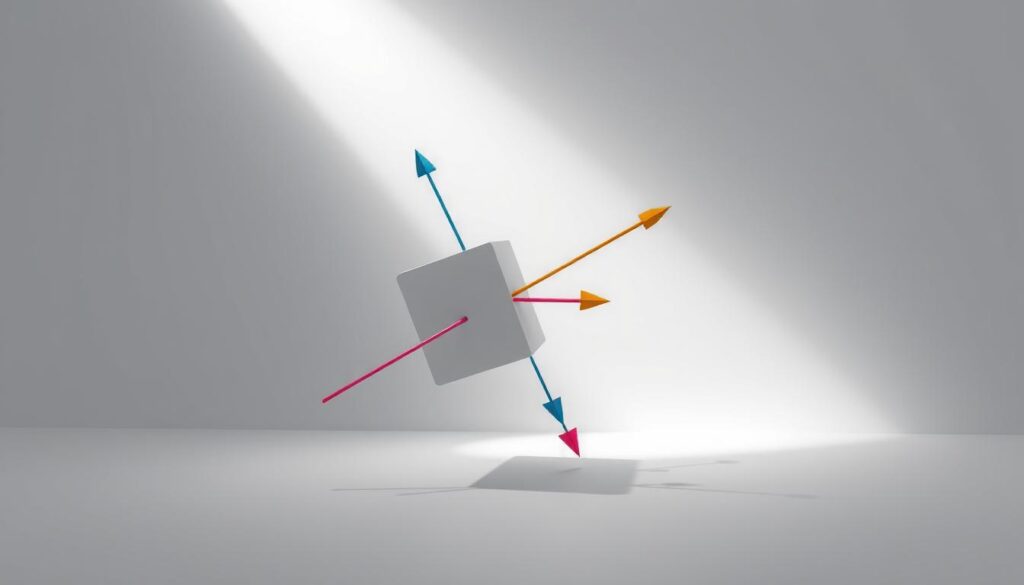
Unbalanced forces, on the other hand, cause motion to change. The net force’s direction and strength decide the object’s new speed and direction. For example, pushing a box forward and backward with equal force won’t move it. But pushing harder forward will make it move.
Calculating Net Force
To find the net force, add all forces together if they’re in the same direction. If they’re opposite, subtract the smaller force from the bigger one. Then, use the net force in Newton’s Second Law (F = ma) to find the object’s new speed.
Knowing about net force helps in many areas, like making safe cars or figuring out where things will land. By understanding forces and net force, we can guess how things will move in different situations.
Force and Motion in Engineering
For engineers, knowing about forces and motion is key. They use these principles in many engineering applications. This ranges from simple designs to complex systems.
Studying force and motion is vital in engineering. It helps ensure systems are safe, efficient, and perform well. By understanding how forces impact motion, engineers can optimize designs. This is to meet goals like better fuel efficiency in cars or more stable structures.
The design principles from force and motion are essential in engineering. In mechanical engineering, they guide the design of engines and gearboxes. Civil engineers use them to understand forces on buildings and bridges, making sure they can handle loads.
Force and motion principles are also key in advanced technologies like robotics and aerospace. Engineers apply these to design systems for extreme conditions. This includes the cold of space and the fast movements of robotic arms.
By using force and motion principles, engineers create new solutions. These solutions change industries and make life better. As technology grows, understanding and applying these principles will stay important in engineering.
Forces in Nature
Nature’s power is vast and complex. Natural forces shape our environment in profound ways. They often have significant impacts on our daily lives and the world around us.
Tectonic forces are a prime example of natural forces in action. These forces move the Earth’s crust, leading to earthquakes and volcanic eruptions. The impact of these events can be devastating, causing widespread destruction and loss of life.

Weather patterns are another manifestation of natural forces. Weather is influenced by atmospheric conditions, temperature gradients, and other factors. Understanding these forces is key for predicting weather and mitigating severe weather effects.
The study of natural forces, including tectonic forces and those driving weather patterns, is vital. It helps us advance our knowledge of Earth’s systems. It also helps us develop strategies to cope with natural hazards.
Conclusion: The Significance of Forces in Motion
Understanding forces and their impact on motion is key to grasping many things around us. We’ve looked at the key concepts that shape motion, from gravity to friction. These forces are everywhere, affecting how things move.
Knowing these basics helps us see the world in a new light. It’s not just about simple actions like walking. It’s also about the complex designs in modern engineering. This knowledge lets us solve problems better and innovate.
As we keep learning about forces, we get to know the world better. By using these key concepts to tackle real-world issues, we can make things better. In wrapping up, studying forces and motion is both important and intriguing.