

Creating a homemade compass is a fun and educational Magnet Experiment. It shows the power of magnetism. You can make a tool that explorers and travelers have used for centuries.
This Magnet Experiment teaches you about magnetism. It also shows why a compass is key for finding directions. Making your own compass helps you see how magnetism works.
Follow this guide to make your own homemade compass. You’ll learn more about magnetism and its role in our lives.
Introduction to Magnet Experiments
Magnet experiments are both fun and educational. They help us learn about magnetic fields and navigation. Doing these science experiments teaches us about magnetism and its uses.
Experiments like making a homemade compass show how magnets work in our lives. They make learning fun and help us understand complex ideas.
Exploring magnet experiments helps us appreciate the science of magnetic fields. They are great for learning and discovering new things. Whether for school or just for fun, they are very useful.
As we dive into magnet experiments, we’ll discover the amazing science behind them. This knowledge will improve our understanding of magnetism. It will also get us ready for more in-depth studies.
Materials Needed for the Compass
To make a homemade compass, you only need a few simple items. This science experiment shows how magnetism works using things you might have at home.
You’ll need a sewing needle, a bar magnet, a cork, and a glass of water. The sewing needle will be your compass needle. The bar magnet will make it magnetic.
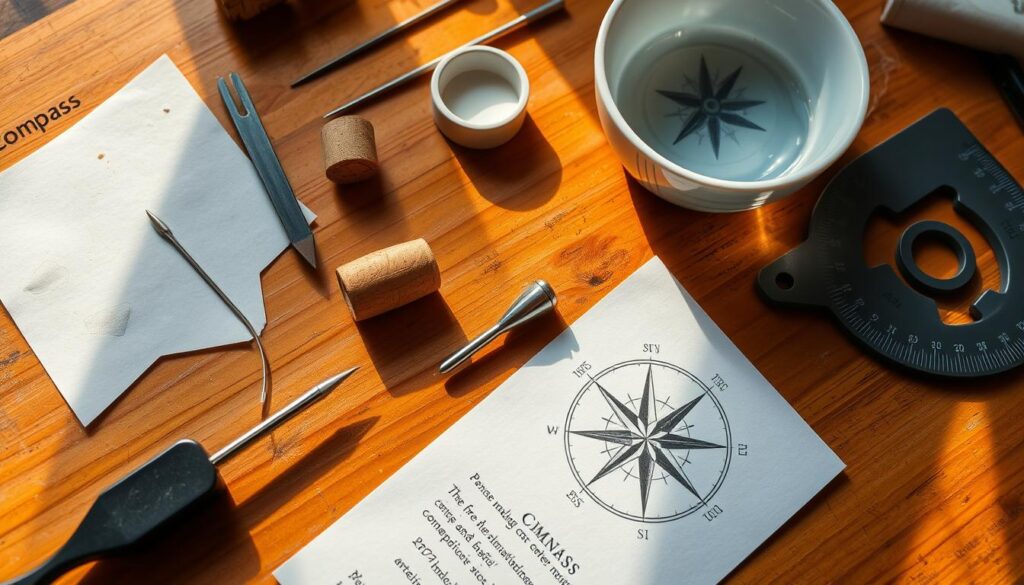
First, magnetize the sewing needle by rubbing it against the bar magnet a few times. This is key. It makes the needle magnetic, so it can work as a compass.
With your materials ready and the needle magnetized, you’re ready to create your homemade compass.
Understanding the Science Behind Magnetism
Magnetism is a fascinating force that surrounds us. It plays a key role in how a compass works. At its core,magnetism is a force created by moving electrical charges. This is why magnets can interact with other magnets and certain metals.
The Earth’s magnetic field is vital for a compass to function. It lets the compass needle point towards the magnetic poles. But what is the Earth’s magnetic field? It’s created by the movement of molten iron and metals in the Earth’s outer core.
This movement makes electric currents, which generate the magnetic field. The Earth’s magnetic field acts like a giant bar magnet. It has magnetic field lines that emerge from the South Pole and enter the North Pole.
The magnetic field is not perfectly symmetrical. It can change in strength and direction over time. A renowned geophysicist says, “The Earth’s magnetic field is not just a static entity; it’s a dynamic system that has been changing over millions of years.”
“The Earth’s magnetic field is essential for navigation, as it provides the directional information that compasses rely on.”
Understanding magnetism and the Earth’s magnetic field is key to knowing how a compass works. By learning these principles, we can better understand the complex mechanisms that guide navigation and orientation.
Steps to Create Your Own Compass
Creating your own compass is easy with a magnetized needle and water. This homemade compass is a fun science experiment. It shows how magnetism works.
To start, you need to magnetize a needle. This means rubbing the needle with a magnet in one direction. It takes patience, but it’s worth it.
“The key to successful magnetization is to stroke the needle in one direction only.”
Then, put the needle on a cork or leaf and into water. It will point to north and south, showing the Earth’s magnetic field.
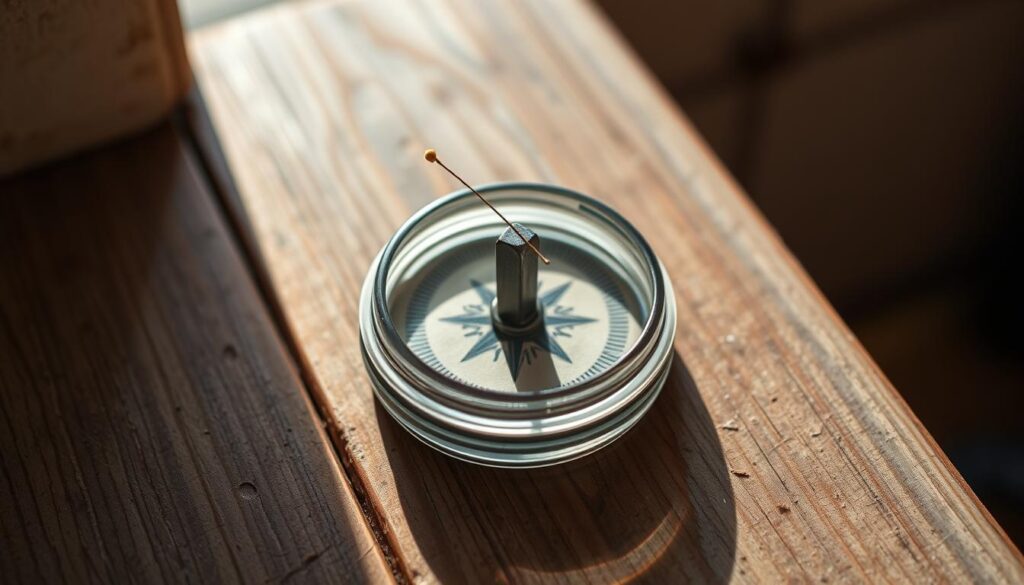
By following these instructions, you make a compass. It’s useful for finding your way and teaches about magnetism.
Testing Your Homemade Compass
Now that you’ve made your homemade compass, it’s time to test it. Testing is key to see how well it works and find any problems.
To start, place your homemade compass on a flat surface, away from magnets. Watch the needle. It should point to the Earth’s magnetic field, showing north-south.
Then, bring a magnet near your compass. The needle should move when the magnet is close. This shows how well your compass reacts to magnets.
If your compass doesn’t work right, don’t worry. First, check if the needle is stuck or blocked. Then, make sure the magnet you used is strong enough. If it’s not working, try remagnetizing the needle or adjusting the compass.
Testing your homemade compass proves it works and teaches you about magnetism. By seeing how it acts in different situations, you learn more about magnetism.
Fun Variations of the Compass Experiment
By changing materials and design, you can make many variations of the compass. Each one has its own special features. This makes the homemade compass a fantastic science experiment.
Try using different floats or needles to vary the experiment. For example, use a small magnetized metal piece, like a paperclip, instead of a needle. Or, use different materials for the float, like a cork or a leaf, to see how it changes the compass’s movement.
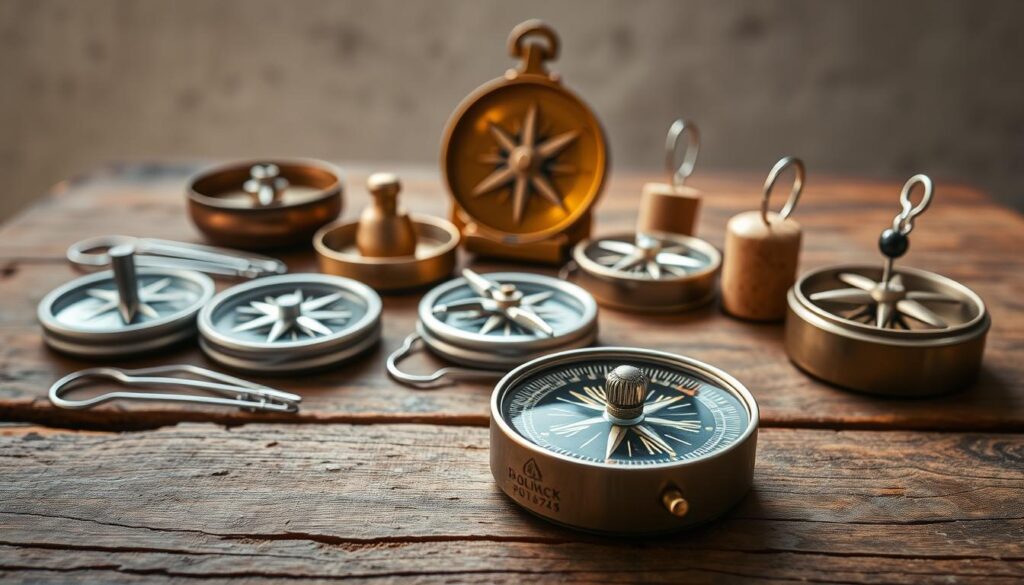
Change the container or liquid in the compass for another twist. Use different shapes or sizes of containers to see how they affect the compass’s accuracy. Try using oils like vegetable oil instead of water to see how viscosity impacts the compass.
These variations make the experiment more fun and help you understand magnetism and navigation better. By trying out different designs and materials, you’ll appreciate the science behind a homemade compass even more.
Educational Benefits of Magnet Experiments
Magnet experiments offer many educational benefits. They help us understand magnetism and navigation. By doing these experiments, we learn how magnets work and their uses.
Experiments like making a homemade compass are great for learning. They teach us about magnetic properties and navigation. We see how ancient sailors used magnets to find their way.
Albert Einstein loved magnets, showing how they can spark curiosity. These experiments can make us love learning about the world.
In school, magnet experiments teach many scientific ideas. They help us grasp complex physics concepts. These experiments make hard ideas easier to understand.
These experiments also improve our critical thinking and problem-solving. By studying magnetism, we learn to think deeply and question things. We start to make educated guesses.
In summary, magnet experiments are very educational. They mix hands-on learning with deep understanding. By using them in school, teachers can make learning fun and engaging.
Safety Considerations When Experimenting
To have a safe and fun time, it’s important to take some precautions. When you’re working with sharp objects like needles, be careful. They can hurt you if you’re not careful.
Safe Handling of Sharp Objects: It’s key to be careful with sharp objects in your experiments. Always think about where you put them when you’re not using them. Make sure to store them safely after you’re done.

Protecting Electronic Devices: Magnets can also harm your electronic devices. So, keep them away from things like smartphones, computers, and TVs. This will help prevent damage or problems with your devices.
By following these simple safety precautions, you can stay safe while learning about magnets. It’s a great way to have fun and learn at the same time.
Real-World Applications of Magnetism
Beyond the classroom, magnetism plays a key role in many areas.
One major use is in navigation. The Earth’s magnetic field helps compasses work, guiding us. This has been key for centuries in finding directions at sea and on land.
Magnetism is also vital for modern tech. For example, MRI machines use strong magnetic fields to create detailed body images. This helps doctors diagnose health issues.
Magnetic storage is another big use. It’s found in hard drives to store data. This tech uses magnetized areas on disks to hold digital info.
Research into magnetism is always growing. It’s leading to new materials and tech. This promises even more exciting uses in the future.
Conclusion and Next Steps
Making a compass with a magnet is just the start of a fun science journey. This simple project shows how magnetism works and its uses.
Now that you’ve made your compass, think about more science adventures. You can try many experiments, like studying different materials or exploring electricity and electronics.
Doing science experiments like making a compass boosts your knowledge and sparks curiosity. Keep exploring, discovering, and learning through hands-on science.