
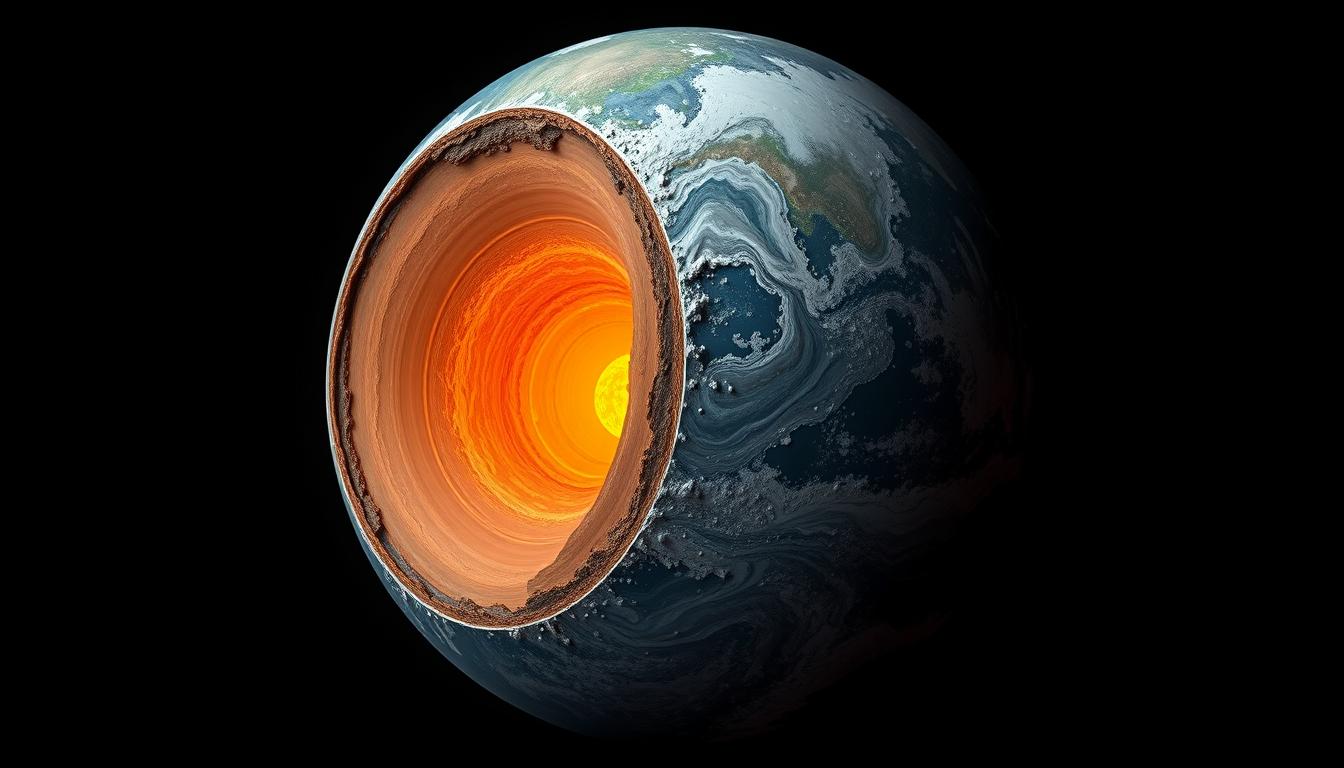
The inside of our planet is complex and fascinating. Scientists have studied it for centuries. New technology has helped us understand the Earth’s internal structure better.
The Earth has several layers, each with its own features. These layers are important for our planet’s surface and climate. The outermost layer is the crust, then the mantle, outer core, and inner core.
Knowing the geology of the Earth helps us understand how it works. By looking at the Earth’s layers, we learn about the forces that shape our world.
Understanding the Structure of Earth’s Layers
Earth’s structure is made up of several distinct layers, each with unique characteristics. The main layers of the Earth are the crust, mantle, outer core, and inner core.
The crust is the outermost layer, where human habitats and ecosystems exist. It’s broken into several large plates that float on the more fluid layers below. This sometimes results in earthquakes and volcanic activity.
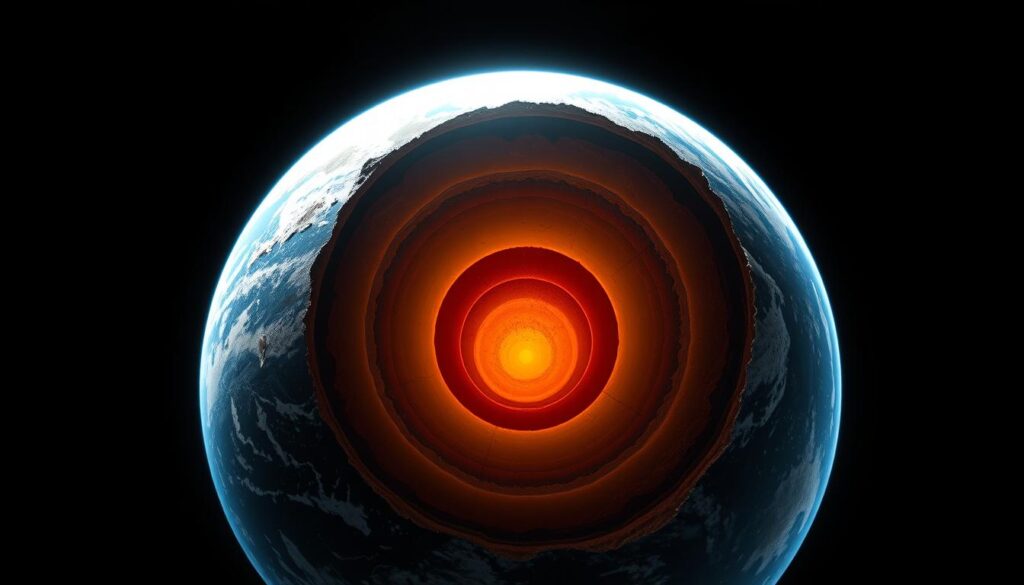
The mantle is the thickest layer, making up about 84% of the Earth’s volume. It’s a viscous layer that can flow over long periods, driving plate tectonics. The mantle’s high temperature and pressure conditions allow it to deform and flow.
The core is divided into two layers: the outer core and the inner core. The outer core is liquid and composed mainly of iron and nickel, along with some other elements. It’s responsible for generating the Earth’s magnetic field. The inner core is solid and also mainly made up of iron and nickel.
Understanding these layers is essential for geologists to grasp various geological phenomena. This includes earthquakes, volcanic eruptions, and the Earth’s magnetic field. The study of the Earth’s layers is a fundamental aspect of geology. It helps us understand the Earth’s history, its internal dynamics, and the processes that shape our planet.
The Composition of Earth’s Core
At the heart of our planet lies a complex and fascinating region known as the Earth’s core. This central part of our planet is mainly made of iron and nickel. The inner core is solid, while the outer core is liquid.
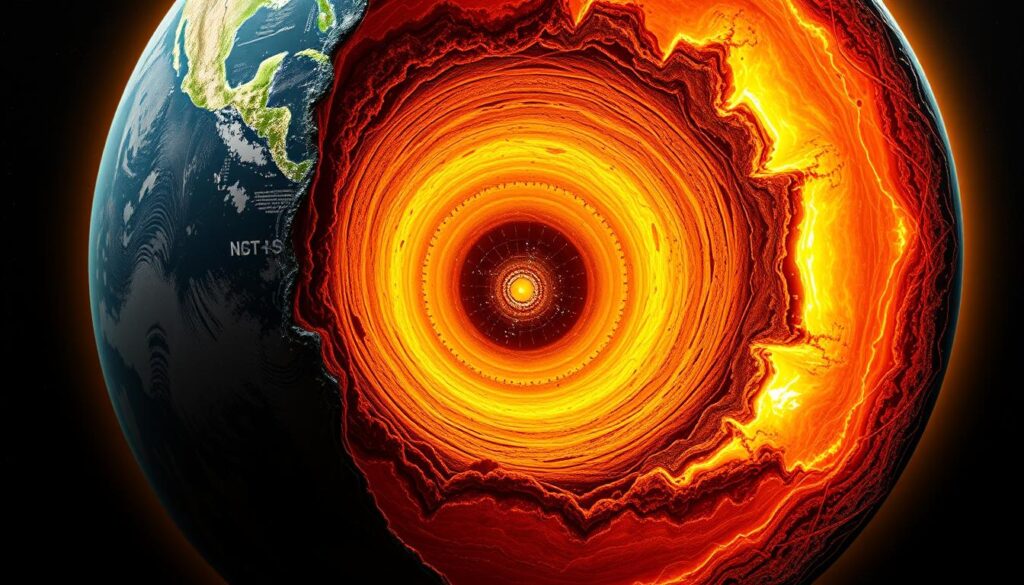
The inner core is about 1,220 kilometers in radius. The outer core is 2,260 kilometers thick. Together, they make up about 15% of the Earth’s volume. The core also has smaller amounts of sulfur and oxygen.
The Core’s Chemical Composition
The chemical makeup of the Earth’s core is key to understanding many geological phenomena. The core is mostly iron and nickel. But scientists are also looking into other elements.
Knowing what the Earth’s core is made of helps geologists and scientists. It helps them understand the Earth’s internal structure and its effects on the surface. The core’s makeup also affects the Earth’s magnetic field, which is important for navigation, climate, and more.
Studying the Earth’s core is a big deal in geology. New technology and research methods are helping scientists learn more. They are figuring out the core’s role in the Earth’s structure.
Exploring the Earth’s Mantle
The Earth’s mantle is a vast, complex region that makes up a big part of our planet. It’s made of hot, viscous rock that can flow slowly over time. This flow drives plate tectonics and shapes the Earth’s surface.
The mantle is split into the upper mantle and the lower mantle, with a transition zone in between. The upper mantle goes from the crust down to about 410 kilometers. It’s known for its slow flow, which helps move tectonic plates.
The lower mantle stretches from about 650 kilometers to 2,900 kilometers in depth. It faces immense pressure and temperature, making it unique. The transition zone between the upper and lower mantle sees a big change in mineral composition.
Here, minerals change due to increasing pressure and temperature. This affects the mantle’s properties. The Earth’s mantle is key to geological processes. Its composition and structure help us understand earthquakes, volcanic activity, and mountain range formation.
Understanding the Earth’s mantle is key to understanding our planet. By studying its composition and behavior, scientists learn about Earth’s history. They can also predict future geological events.
The Earth’s Crust: A Closer Look
The Earth’s crust is the outermost layer and is key to our planet’s geology. It’s the layer we touch every day, from the ground we walk on to the mountains and oceans. These features shape our landscape.
The Earth’s crust is made up of different rocks, like granite, basalt, and sedimentary rocks. Its thickness changes a lot, from 5 to 70 kilometers, depending on where you are.
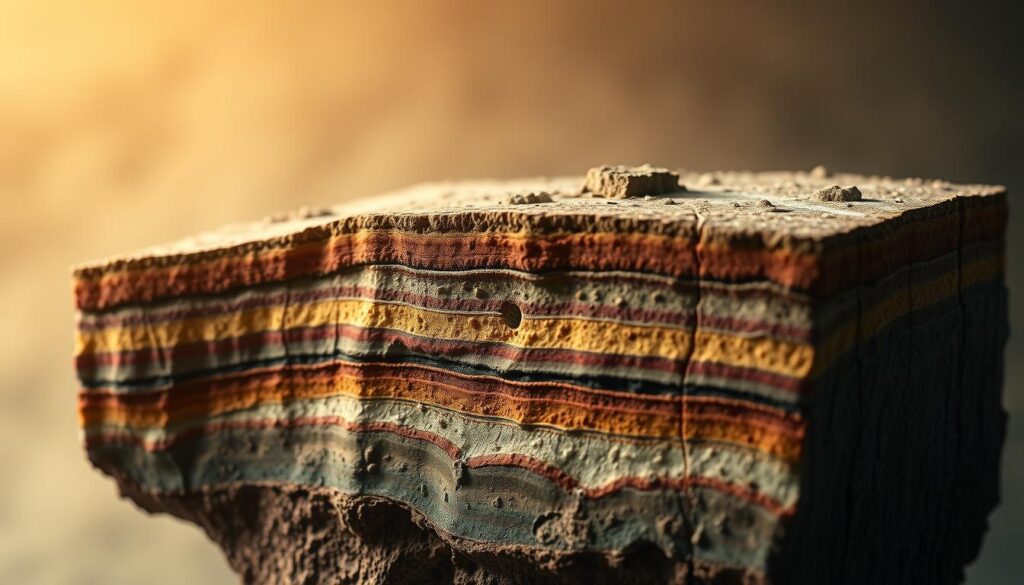
The crust is split into big plates that float on the mantle, driving plate tectonics. This movement creates mountains, volcanoes, and earthquakes. Knowing about the Earth’s crust helps us understand our planet’s geology better.
Studying the Earth’s crust is complex and always changing. It shows us the detailed processes that shape our planet. By looking at the crust’s makeup and actions, scientists learn about the Earth’s past and how it’s changing today.
The Role of Temperature in Earth Layers
Temperature is key in studying Earth’s layers. It greatly affects the properties and actions of each layer.
As you go deeper, the temperature rises. It starts at about 500°C at the crust-mantle boundary. It goes up to over 6,000°C at the core-mantle boundary. This temperature gradient changes with depth, impacting Earth’s inner workings.
Knowing about temperature gradients is vital. It helps us understand many geological events. For example, it affects the Earth’s mantle’s thickness, which influences plate tectonics and geological activities.
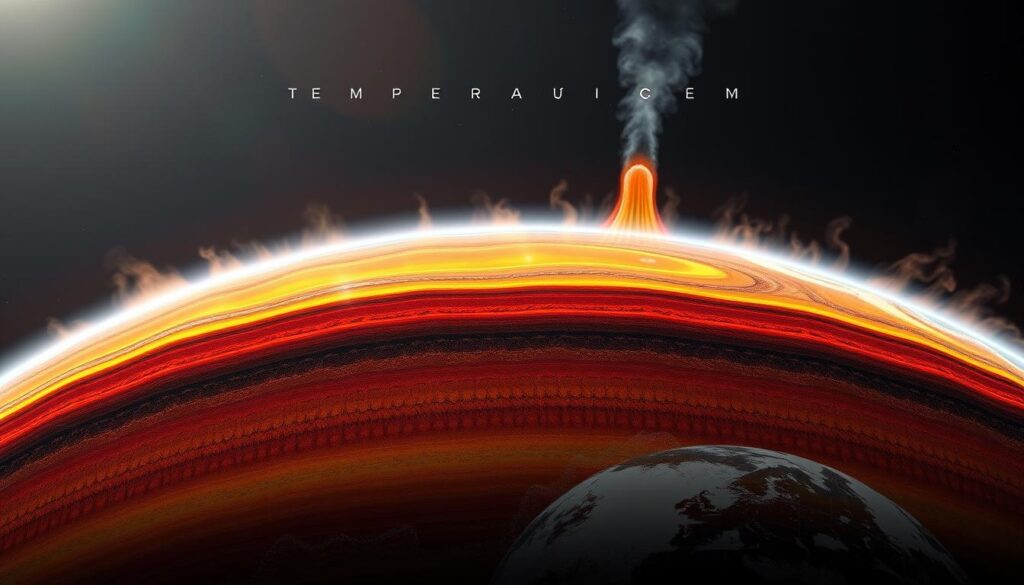
Studying Earth’s temperature and its gradients is a major part of geology. It lets scientists understand Earth’s internal structure and how it changes.
In summary, temperature plays a big role in Earth’s layers. It affects everything from the mantle to the core. By looking at temperature gradients, geologists can learn more about Earth’s inner workings and how it changes.
How We Study Earth Layers
Scientists use many ways to study the Earth’s layers. A key method is seismology, which studies seismic waves from earthquakes. These waves help scientists learn about the Earth’s inside.
Seismology gives us a peek into the Earth’s inside. Seismic waves move at different speeds through different materials. This lets scientists map the Earth’s interior. For example, P-waves can go through solid and liquid, while S-waves only go through solid.
Other important tools include gravity measurements and laboratory experiments. Gravity helps find density changes in the Earth. Lab experiments mimic the Earth’s high-pressure and high-temperature conditions.
Together, these methods give us a full picture of the Earth’s inside. By combining data from seismology, gravity, and labs, scientists create detailed models. This helps us understand Earth’s internal structure and its geological processes better.
The Importance of Earth Layers to Life
Earth’s internal structure is key for life to exist. The core, mantle, and crust work together. They help control our planet’s climate and geological activities.
The mantle drives plate tectonics. This process shapes continents and oceans. It also changes ocean currents and mountain ranges. A famous geologist said,
“The movement of tectonic plates is a key factor in shaping our planet’s surface and influencing long-term climate change.”
The Earth’s core is vital for its magnetic field. This field protects us from harmful solar radiation. This protection is essential for life on Earth.
Knowing about Earth’s layers helps us understand climate and geology. This knowledge is key for predicting geological events. The Earth’s layers show the beauty and complexity of our planet.
In summary, Earth’s layers are not just interesting to study. They are essential for life on Earth. By studying these layers, we learn more about our planet.
Fun Facts About Earth’s Layers
Exploring the Earth’s layers is like discovering a complex, dynamic world beneath our feet. The Earth has several layers, each with unique features. These features are key to shaping our planet.
The Earth’s core is fascinating, with temperatures up to 6,000°C. This heat is from radioactive decay and the Earth’s formation energy.
The mantle is another interesting layer. It’s made of rock that can flow slowly, a process called ductile flow. This flow drives plate tectonics, causing earthquakes, volcanic activity, and mountain formation.
The Earth’s crust, where we live, is the outermost layer. It’s divided into large plates that float on the mantle. The movement of these plates shapes our landscape over millions of years.
Learning about the Earth’s layers is fascinating. It shows the dynamic nature of our geology. It’s a reminder of the complexity and beauty beneath our feet.
Upcoming Research on Earth’s Layers
Scientists are using new technologies to learn more about the Earth’s inside. They are focusing on the boundary between the Earth’s core and mantle. This area is key to understanding the Earth’s magnetic field and its role in the climate.
New methods in seismic imaging and lab experiments are helping. These allow researchers to mimic the extreme conditions at the Earth’s core. This will help us understand how the Earth’s layers work together.
As we learn more about the Earth’s layers, we’ll understand our planet better. This knowledge will help us deal with climate change. It will also advance geology and guide us in protecting our planet.