
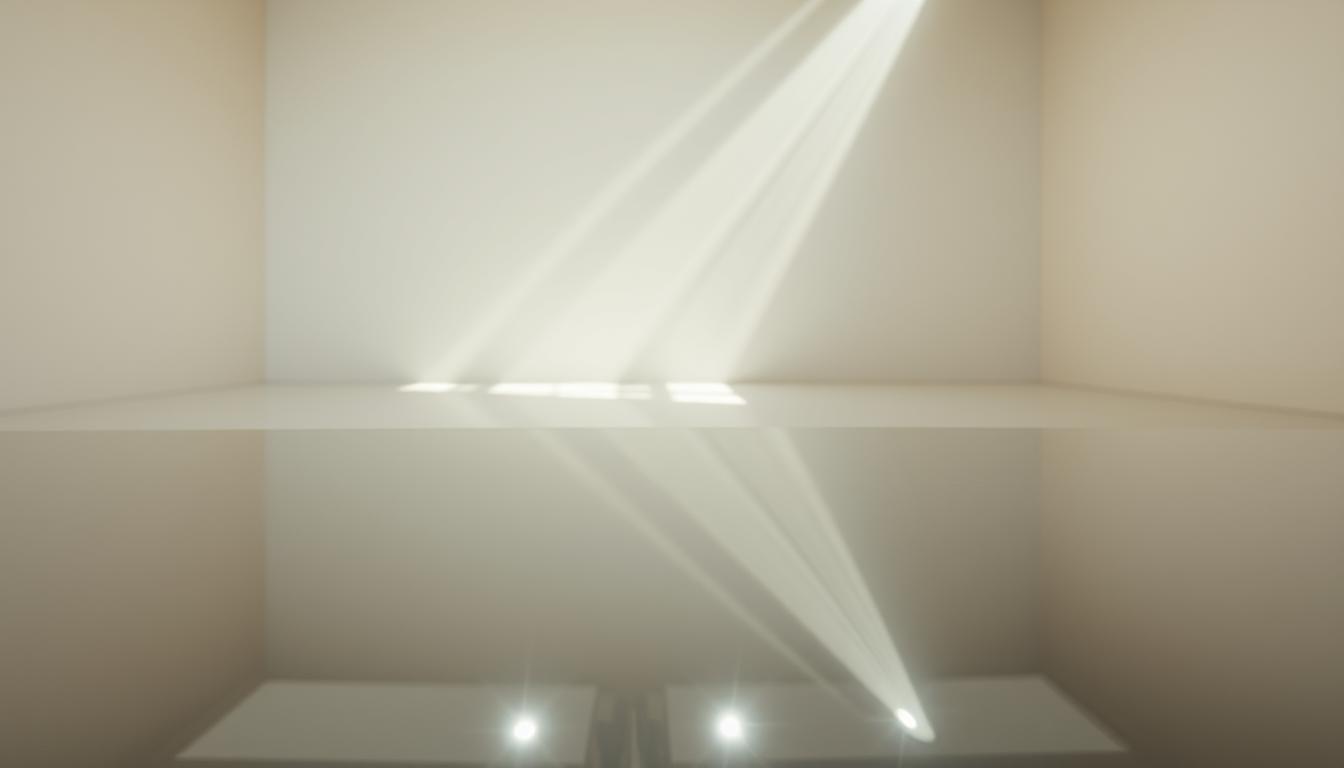
Have you ever thought about what happens when light hits a surface? It can bounce off, pass through, or get absorbed. Mirrors work by bouncing light off their surface, creating the images we see.
The process of reflection is key to how mirrors work. When light from an object hits a mirror, it bounces back. This lets us see the object’s image. This basic principle helps us understand more about mirrors and their uses.
Learning about how mirrors bounce light is more than just science. It’s also about the technology and innovation that make mirrors a big part of our lives.
Understanding Reflection: A Basic Overview
Reflection is everywhere, happening when light hits an object or surface. It’s when light bounces back, and how it does depends on the surface it hits.
There are two main types of reflection: Specular Reflection and Diffuse Reflection. Specular reflection happens on smooth surfaces, like mirrors or calm water. Here, light reflects at a fixed angle, creating a clear image. Diffuse reflection occurs on rough surfaces, scattering light in many directions. This lets us see objects from different angles.
A key rule of reflection is that the Angle of Incidence equals the Angle of Reflection. This means light hits a surface at the same angle it reflects back. This rule is key to understanding mirrors and is a basic concept in optics.
Physicist Richard Feynman said, “The principle that the angle of incidence equals the angle of reflection is a fundamental law of physics, governing not just light but also other forms of waves.” This shows how the physical world works in a predictable and orderly way.
“The study of reflection is not just about understanding a physical phenomenon; it’s about appreciating the intricacy of light around us.”
In our daily lives, knowing about reflection helps us appreciate the world more. From the shine on a car to the glare on a phone, reflection is part of our daily experiences.
Learning about reflection, including the differences between specular and diffuse reflection, helps us understand light and its interactions with surfaces.
Types of Reflection: Specular vs. Diffuse
When light hits a surface, it can result in two primary types of reflection: specular and diffuse. Specular reflection happens on smooth surfaces. Here, light rays reflect in the same direction, creating a clear and sharp image.
This type of reflection is common in mirrors or calm water. The surface is flat and even. This allows light to bounce back uniformly, resulting in a precise reflection.
Characteristics of Specular Reflection
Specular reflection preserves the image of the light source or object. This is because the light rays are reflected at the same angle. As a result, smooth surfaces like polished metal or calm water can act as mirrors, reflecting light and images clearly.
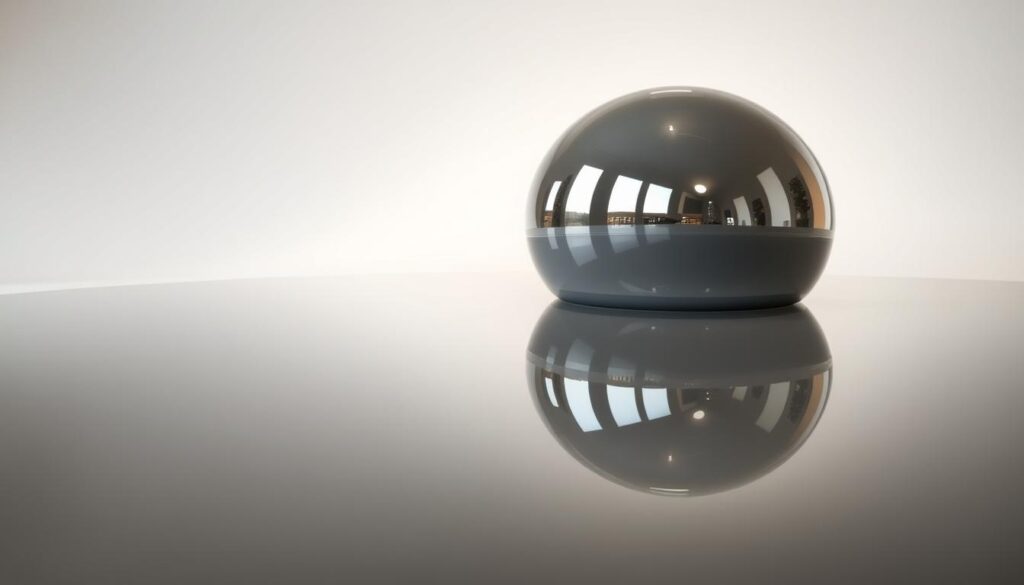
The clarity of specular reflection depends on the surface’s smoothness. Any irregularities can disrupt the reflection. This leads to diffuse reflection instead.
In summary, specular reflection is a phenomenon that occurs on smooth surfaces. Here, light is reflected uniformly, creating clear images. Understanding this concept is key to appreciating how light interacts with different surfaces.
How Mirrors Work: The Science Behind It
Mirrors work on a simple yet powerful principle called the law of reflection. This law says the angle of incidence is the same as the angle of reflection. This principle helps mirrors reflect images accurately.
The law of reflection explains how light behaves when it hits a mirror. It says the angle light comes in (the angle of incidence) is the same as the angle it goes out (the angle of reflection). This is key to understanding mirrors.
When light from an object hits a mirror, it bounces back at the same angle. Our eyes see this reflected light as coming from behind the mirror. This creates the illusion of an image behind the mirror.
The mirror’s smooth surface is why this reflection is so accurate. It makes sure the angle of incidence is the same as the angle of reflection for every point on the surface.
Knowing about the law of reflection is not just about science. It’s also about understanding the technology and physics behind mirrors. This knowledge helps us appreciate how mirrors work in our daily lives.
The Importance of Angle in Reflection
Understanding the role of angle in reflection is essential to know how mirrors work. The angle of incidence and the angle of reflection are key concepts here.
When light hits a mirror, it bounces back. The angle at which light hits the mirror is called the angle of incidence. The angle it bounces back is called the angle of reflection. These angles are measured against the normal (a line perpendicular to the surface) and are found to be equal.
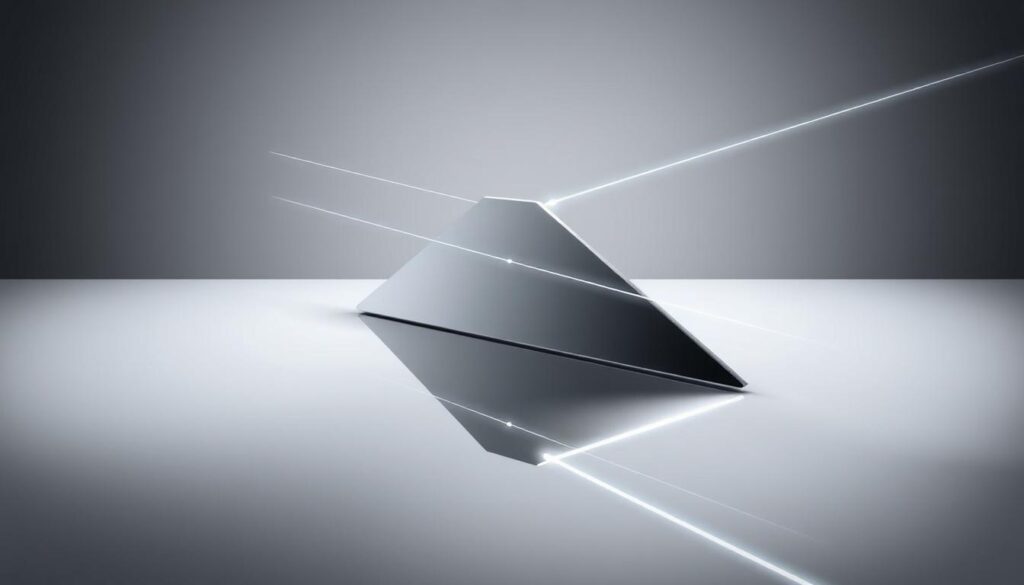
This equality is not a coincidence; it’s a principle that governs how reflection works. By understanding this principle, we can better appreciate the science behind mirrors and other reflective surfaces.
The normal acts as a reference point for measuring these angles. This ensures that the reflection behaves predictably. This predictability is what makes mirrors useful in various applications, from everyday use to scientific instruments.
Everyday Applications of Mirror Reflection
Mirrors are everywhere in our lives, from simple uses at home to complex tech roles. They’re key for personal grooming, helping us get ready for the day.
In security and surveillance systems, mirrors play a big part. They help prevent theft in stores and boost safety in public places. Also, they’re vital for optical instruments like telescopes and microscopes, which use reflection to enlarge objects.
In tech, mirrors are used in laser systems and optical communication tools. They guide laser beams accurately, essential for cutting and in medical work.
Mirrors also shape the world of entertainment, creating movie and theater magic. They’re used in interior design too, making rooms seem bigger and look better.
The many ways mirrors are used shows their value and flexibility. As tech grows, mirrors will likely play even more roles in our lives, bringing new uses.
Common Myths About Mirrors and Light
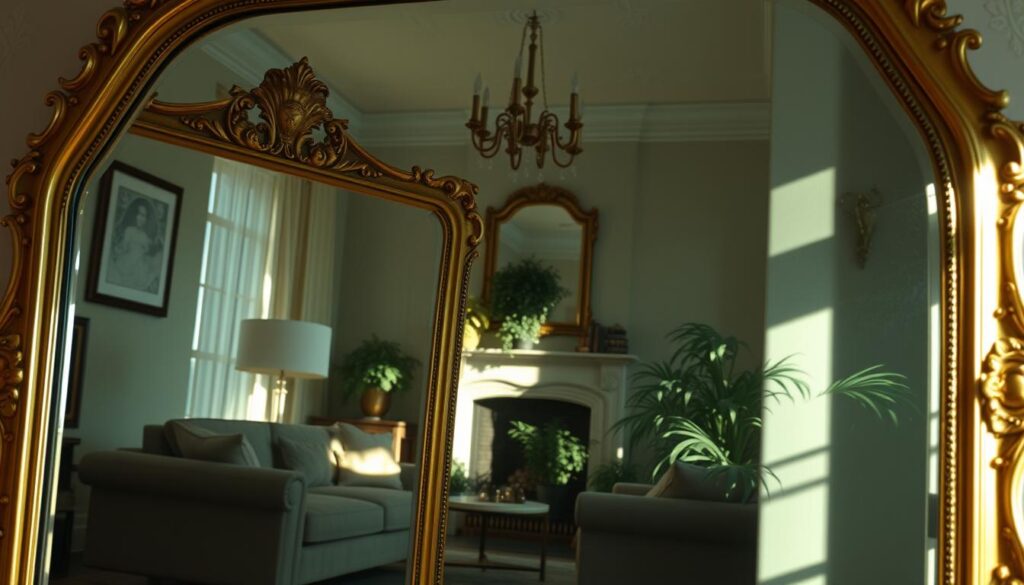
Mirrors reflecting light have led to many myths. One big myth is that mirrors swap left and right. But, mirrors actually swap front and back, not left and right. This confusion comes from how our images are reflected.
Looking into a mirror, you see a reversed version of yourself. But, this reversal is about front and back, not left and right. This illusion can confuse us about how mirrors work.
Many also think mirrors can change an object’s size or shape. But, the size and shape of a reflection depend on the mirror’s curve and the laws of reflection. Flat mirrors show images the same size as the object. Curved mirrors can make images bigger or smaller.
“The way we see is by light, and mirrors simply redirect that light to create an image.”
Learning about mirror reflection can clear up these myths. The law of reflection says the angle of incidence equals the angle of reflection. This principle explains how light behaves on a mirror, creating the reflection we see. Understanding this can help us appreciate mirrors and light more.
In summary, myths about mirrors and light are common but can be debunked by science. Knowing that mirrors swap front and back and that physics rules light behavior helps us understand mirrors better.
The Role of Mirrors in Astronomy
The use of mirrors in astronomy has greatly helped us learn about the universe. They are key in telescopes.
Mirrors are vital in telescopes because they collect and focus light from far away. Their concave shape brings light together, making it easier to see distant objects.
The design of telescopes depends a lot on their mirrors. Bigger mirrors can gather more light, showing us finer details. That’s why today’s astronomical telescopes have large, precise mirrors.
Mirrors do more than just gather light; they’re essential for telescopes to work. They help astronomers study the universe in different kinds of light, like infrared and ultraviolet.
In short, mirrors are key in astronomy. They help us make new discoveries and deepen our understanding of space through telescopes.
DIY Projects: Creating Your Own Reflective Surfaces
DIY fans can dive into the world of reflection by making their own mirrors. This hands-on learning is fun and teaches about light. It also boosts creativity and encourages trying new things.
One easy DIY project is to make a reflective surface. Use glass or acrylic and cover it with aluminum foil or mirror-finish tape. This shows how light reflects off the surface without scattering.
Another fun project is to build a periscope. Use cardboard or PVC pipes, mirrors, and glue. Arrange the mirrors at 45-degree angles to see around corners or over things, showing how reflection works.
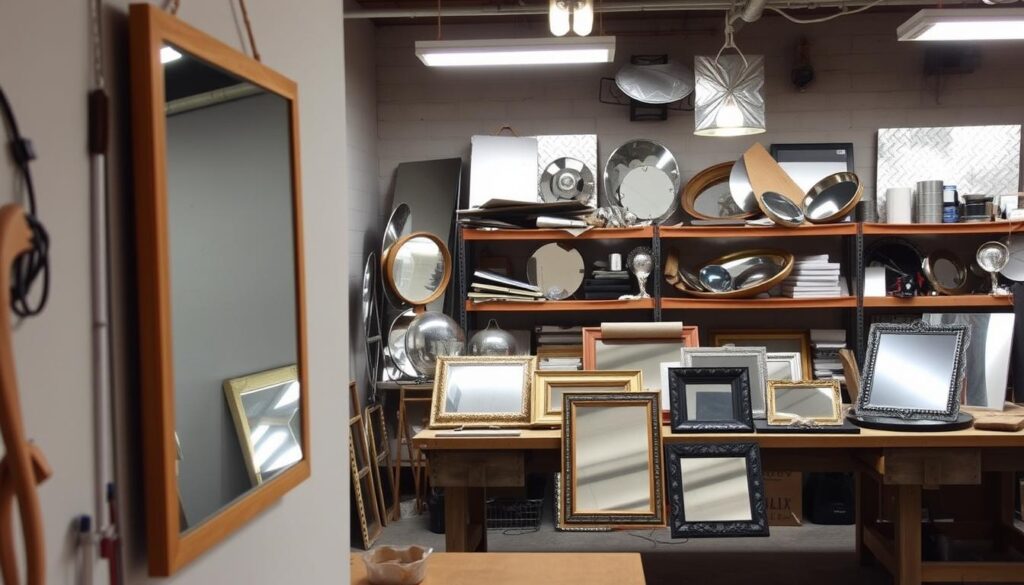
For a more challenging project, try making a mirror mosaic. Use small mirrors or reflective material to create a design. This project is beautiful and teaches about diffuse reflection, where light scatters.
These DIY projects are both fun and educational. They let people explore the science of reflection and mirrors. By doing these activities, you learn more about light and how it interacts with surfaces.
The Future of Mirrors and Light Technology
The future of mirrors and light technology is changing fast. This change comes from new discoveries in materials science and optics. It’s not just about making things better. It’s also about finding new uses in different fields.
Smart mirrors are a big step forward. They’re not just mirrors. They have LED lights, touch screens, and even health monitors. Smart mirrors are becoming a hit in homes and bathrooms. They can show the weather, news, and even let you try on makeup and clothes virtually.
Advances in materials science are leading to new kinds of mirrors. Scientists are making mirrors that can change how they reflect light based on their surroundings. These mirrors could be very useful in cars and planes.
Light technology is also getting a big boost from LEDs and lasers. These changes make lighting more efficient. They also open up new uses like LiDAR for self-driving cars and better ways to send data through light.
The future looks bright for innovative mirror designs too. For example, mirrors made from metamaterials can reflect light in ways that natural mirrors can’t. This could lead to new kinds of optical devices and systems.
Looking ahead, mirrors and light technology will keep bringing new ideas to the table. With advances in tech, we’ll see even more exciting uses for light and mirrors. This will change how we use and interact with these technologies.
Conclusion: The Magic of Reflected Light
Light reflected by mirrors is both useful and beautiful. We’ve seen how complex the science behind mirrors and reflection is. It involves light interacting with different surfaces.
The magic of reflection isn’t just in mirrors. It’s also in how light acts in different places. From the shiny reflection in water to the soft glow from rough surfaces. These principles have led to many uses in science and technology.
As we keep exploring light technology, the role of reflection will grow. By understanding reflected light, we open up new possibilities. We can create wonders that amaze and inspire us.