
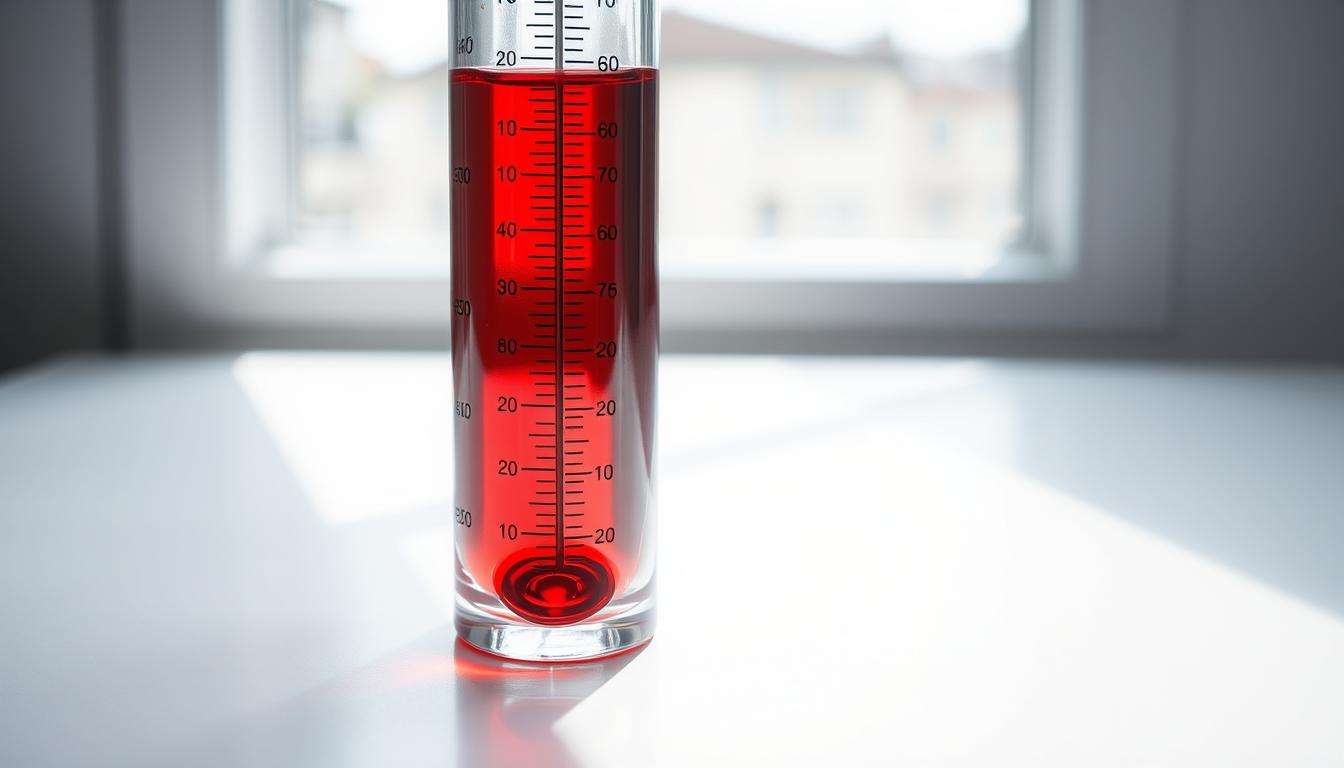
Knowing how to measure heat or cold is key in our daily lives. The thermometer is at the center of this, used for centuries to check the temperature around us.
A thermometer uses mercury, a liquid metal that grows when it warms up. As it grows, it fills a tube. This lets us see the temperature measurement on a scale, usually in degrees Celsius (°C).
Different temperature scales, like Celsius, help us talk about heat and cold in a common way. This is important for keeping things consistent in fields like weather and science.
Understanding Temperature
Temperature is a key concept that shows the average energy of particles in a substance. It’s vital for science and our daily lives.
Temperature Definition: It tells us how hot or cold something is. It shows the thermal energy. Heat moves from hotter to cooler until they’re the same.
The idea of thermodynamic temperature is key. It’s about the average energy of particles. The Kelvin scale measures this, with 0 K being absolute zero and 273.16 K being water’s triple point.
“Temperature is a measure of the average kinetic energy of the particles in a system, and it plays a critical role in determining the behavior of matter under various conditions.”
The Kelvin scale is important in science. It gives a fixed point for measuring. For example, water boils at 373.15 K and freezes at 273.15 K. It’s used a lot in physics and chemistry.
In summary, knowing about temperature means understanding its definition, the Kelvin scale, and its role in science and life. This knowledge is essential for many areas of science, technology, and everyday activities.
The Science Behind Temperature
Temperature is a key physical quantity tied to thermodynamic principles. It shows the average energy of particles in a substance. Knowing about these principles helps us understand how temperature is measured and what it means.
The idea of absolute zero is key in temperature science. Absolute zero is the theoretical temperature where particles have the least energy, almost zero. It’s the zero point for the Kelvin scale.
Absolute Zero and the Kelvin Scale
The Kelvin scale is used in physics and chemistry. It starts at absolute zero and is based on the triple point of water. This makes the Kelvin scale a fixed point, unlike other scales.
The Kelvin scale is defined by two facts. Zero kelvin is absolute zero, and one kelvin is a fraction of the triple point of water’s temperature. This makes it a vital tool in scientific research, where precise temperature control is needed.
In summary, the science of temperature is based on thermodynamic principles. Absolute zero and the Kelvin scale are central to this. Understanding these concepts is key to grasping the importance of temperature in science and daily life.
How Temperature Affects Our Daily Lives
Temperature plays a big role in our daily lives. It affects how comfortable we feel at home and the food we eat. Keeping the right temperature is key for a cozy home and good health.
Temperature greatly impacts our home comfort. Central heating and cooling systems help us stay cozy inside, no matter the weather outside. This makes our homes better and improves our health.
Temperature control is also important for food safety. We need to keep food at the right temperature to avoid spoilage. This shows how temperature measurement is a big part of our daily lives, from cooking to storing food.
Health Implications
Temperature affects our health a lot. Extreme temperatures can cause serious health problems, like heatstroke or hypothermia. Also, a comfortable temperature can help manage health issues.
Temperature is also critical for storing medicines and medical supplies. Many drugs need to be stored at certain temperatures to work well. So, controlling temperature is not just about comfort but also about keeping us safe.
In summary, temperature impacts our lives in many ways. It affects our home comfort, food safety, and health. Understanding and managing temperature is essential for a better life.
Methods of Measuring Temperature
Measuring temperature is key in science and daily life. It’s vital for fields like healthcare, manufacturing, and weather forecasting.
Many ways exist to measure temperature, with thermometers being the top choice. They come in types like mercury-in-glass, digital, and infrared.
Mercury-in-glass thermometers show temperature by mercury expansion. Digital ones give fast, accurate readings with electronic sensors. Infrared thermometers detect heat without touching, perfect for safe checks.
Other temperature measurement methods include thermocouples, RTDs, and thermistors. Each has its own strengths for different uses. Thermocouples, for example, are tough and work over a broad temperature range, making them great for industrial settings.
In summary, picking the right temperature measurement method depends on the task’s needs. This includes how accurate it must be, how fast, and the environment. Knowing these options helps choose the best one for the job.
Temperature and the Environment
Temperature affects the environment in many ways, including climate, weather, and habitats. The Celsius system helps us measure temperature easily. This is key for understanding our environment.
Temperature and Climate: Temperature shapes our climate. Changes in temperature can alter climate patterns, impacting ecosystems and biodiversity. For example, warmer temperatures are melting polar ice, raising sea levels.
Temperature and Weather: Weather is also influenced by temperature. Temperature differences drive weather, like hurricanes, droughts, and heatwaves. Knowing this helps us predict weather and deal with extreme events.
The link between temperature and the environment is complex. Temperature affects the environment, and environmental changes affect temperature. For instance, cutting down trees can make areas warmer because trees cool and shade the ground.
As we study temperature’s impact on our environment, we see why tackling temperature issues is vital. By using our knowledge of temperature, we can fight climate change and protect nature.
Temperature in Cooking and Food Safety
Temperature control is key in cooking to get the perfect dish and make sure it’s safe. Cooking at the right temperature helps prevent foodborne illnesses.
Understanding Safe Cooking Temperatures
To cook safely, knowing the temperature needs for different foods is important. For example, poultry and ground meats must be cooked to at least 165°F (74°C) to be safe.
Oven Temperature Equivalences
Recipes often ask for different oven temperatures. Knowing these equivalences is essential for cooking success. Here’s a guide to common oven temperature settings:
| Description | °F | °C |
|---|---|---|
| Cool | 200 | 90 |
| Very Slow | 250 | 120 |
| Slow | 300 | 150 |
| Moderate | 350 | 175 |
| Hot | 400 | 200 |
Using the right oven temperature ensures your dishes are cooked evenly and safely. For instance, roasting vegetables at 425°F (220°C) can make them taste better and feel softer.

In conclusion, mastering cooking temperatures is essential for both the quality and food safety of your meals. By following safe cooking practices and knowing oven temperature equivalences, you can make delicious and safe food.
The Importance of Temperature in Industry
Keeping temperatures under control is key to making sure products are safe and of good quality. Temperature is very important in many industrial processes. It can change how materials behave and how well things get made.
In metalworking, it’s important to get very hot to melt metals like iron. This happens at about 2,800 degrees Fahrenheit. Once melted, the metal can be shaped into different forms. This is a big part of making steel and casting.
Temperature control is about more than just getting things hot. It’s also about keeping temperatures just right. In making electronics or medicines, small changes in temperature can cause big problems.
The role of temperature in manufacturing is huge. It helps make sure products are consistent and reliable. By keeping temperatures right, manufacturers can avoid mistakes, cut down on waste, and work more efficiently.
Also, controlling temperature is a safety must. Too high, and you might get fires or explosions. Too low, and materials can break easily. So, managing temperature well is vital for keeping everyone and everything safe.
Temperature Measurement in Medicine
In medicine, checking body temperature is more than just a routine task. It’s a key tool for diagnosing health issues. A body temperature that’s off can signal infections, inflammation, or other serious conditions.
Clinical thermometry has come a long way. We’ve moved from old mercury thermometers to modern digital and infrared ones. These new tools make measuring temperature quicker, more accurate, and easier.
Getting body temperature right is very important. It helps doctors diagnose, track treatment success, and decide on patient care. As Dr. John Smith, a leading expert in internal medicine, notes, “Body temperature is a window into the body’s physiological state, and its measurement is essential for providing high-quality care.”
“Temperature measurement is a cornerstone of medical practice, allowing healthcare providers to assess patient conditions accurately and make timely interventions.”

In hospitals, doctors use temperature checks in many ways. They watch over patients with infections, manage post-surgery care, and gauge the severity of some diseases. The right thermometer and method depend on the situation, the patient’s age, and other factors.
As medical tech keeps improving, we’ll see new ways to measure body temperature. These advancements will likely make monitoring temperature even more precise and user-friendly. This will help improve patient care and lead to better health outcomes.
Understanding Temperature Variations
The Earth’s temperature is not always the same. It changes due to many environmental and physical factors.
One important factor is how materials change size with temperature. For example, water gets bigger as it warms up above 4 degrees Celsius. It also gets bigger as it cools down below 4 degrees Celsius.
This special property means water is smallest at 4°C.
Environmental factors also affect temperature changes.
These include altitude, latitude, and the presence of water bodies.
At higher altitudes, it’s colder because there’s less air pressure. The air can’t hold as much heat.
Latitude is key too. Places near the equator are warmer, while the poles are cooler. This is because the sun’s rays hit the Earth at different angles.
“Temperature is a measure of the average kinetic energy of the particles in a substance.”
Knowing about temperature changes is important for many things. It helps with climate modeling and industrial processes.
By understanding these, we can better grasp our climate and environment.
Safety and Temperature
Extreme temperatures can be dangerous to our health and safety. It’s important to take the right precautions. Working in hot or cold without proper guidelines can cause serious health problems, like heat-related illnesses.
In hot conditions, it’s key to follow rest period guidelines to avoid heat exhaustion. For example, at 30 to 32 ºC, workers should rest for 10 minutes every hour. As temperatures rise, so does the need for more breaks.

Safety precautions are essential to prevent temperature-related hazards. This includes watching weather forecasts for extreme temperatures, providing protective gear, and making sure workers get used to the conditions.
Employers should have heat stress management plans. These plans should include regular breaks, staying hydrated, and checking workers’ health. By doing this, the risk of temperature-related illnesses drops, making the workplace safer.
Historical Perspectives on Temperature
Looking back at the history of temperature shows us key moments and innovators. These have shaped how we measure heat. Over the years, our understanding of temperature has changed a lot.
In the beginning, people understood temperature by how it felt. But as science grew, we needed a way to measure it. The first thermometers were made to help with this, starting the journey to today’s thermometry.
The Evolution of Thermometry
Thermometry has seen big steps forward. One big one was the creation of standard temperature scales. The Celsius scale, for example, is based on the kelvin, named after William Thomson. This made measuring temperature more precise and consistent everywhere.
Thermometer technology has also improved a lot. From mercury-in-glass to digital thermometers, each new type has made measuring temperature better. It’s now more accurate and easy to use.
“The introduction of the kelvin scale has been a cornerstone in the precise measurement of temperature, facilitating advancements in various scientific and industrial fields.”
These changes have a big impact on our daily lives. They help in medicine, industry, and keeping an eye on the environment. Knowing the history of temperature measurement shows us how far we’ve come. It also shows us the need for more innovation in thermometry.
Future of Temperature Technology
The future of temperature technology looks bright, thanks to ongoing research and new ideas in thermometry. The recent change in the kelvin (K) shows how temperature measurement is evolving. It now has a fixed value of the Boltzmann constant k at 1.380649 × 10⁻²³ J K−1.
New advancements in thermometry will make temperature measurements more precise. This will open up new uses in fields like medicine and manufacturing. As technology gets better, we’ll see more advanced ways to measure temperature. This could lead to big improvements in areas that need accurate thermal control.
New materials and techniques will be key in the future of temperature technology. They will help industries work better, safer, and make better products. This will drive innovation and help businesses grow.